

Most marketers treat idea generation like waiting for lightning. You sit down, stare at the blank doc, and hope something clever shows up.
But the ideas that actually move numbers rarely arrive that way. They’re usually already sitting in your inbox, your support tickets, and your reviews. You just can’t see them anymore.
The problem isn’t a lack of ideas. It’s a filter you can’t see running.
This isn’t another list of brainstorming techniques. It’s a way to notice when you’ve already stopped hearing something important and a method for pulling that language back into view before a competitor gets there first.
In January 2012, Y Combinator co-founder Paul Graham wrote an essay describing something he called “schlep blindness.” His observation: the most valuable startup ideas are often the ones nobody wants to look at, because they involve tedious, unglamorous work. Stripe is the classic example. Every developer who’d ever processed online payments knew how painful it was. Thousands of people had lived that pain directly. Almost none of them built a company to fix it, because the brain quietly filters out problems that look like too much of a slog before you’ve even consciously considered them.
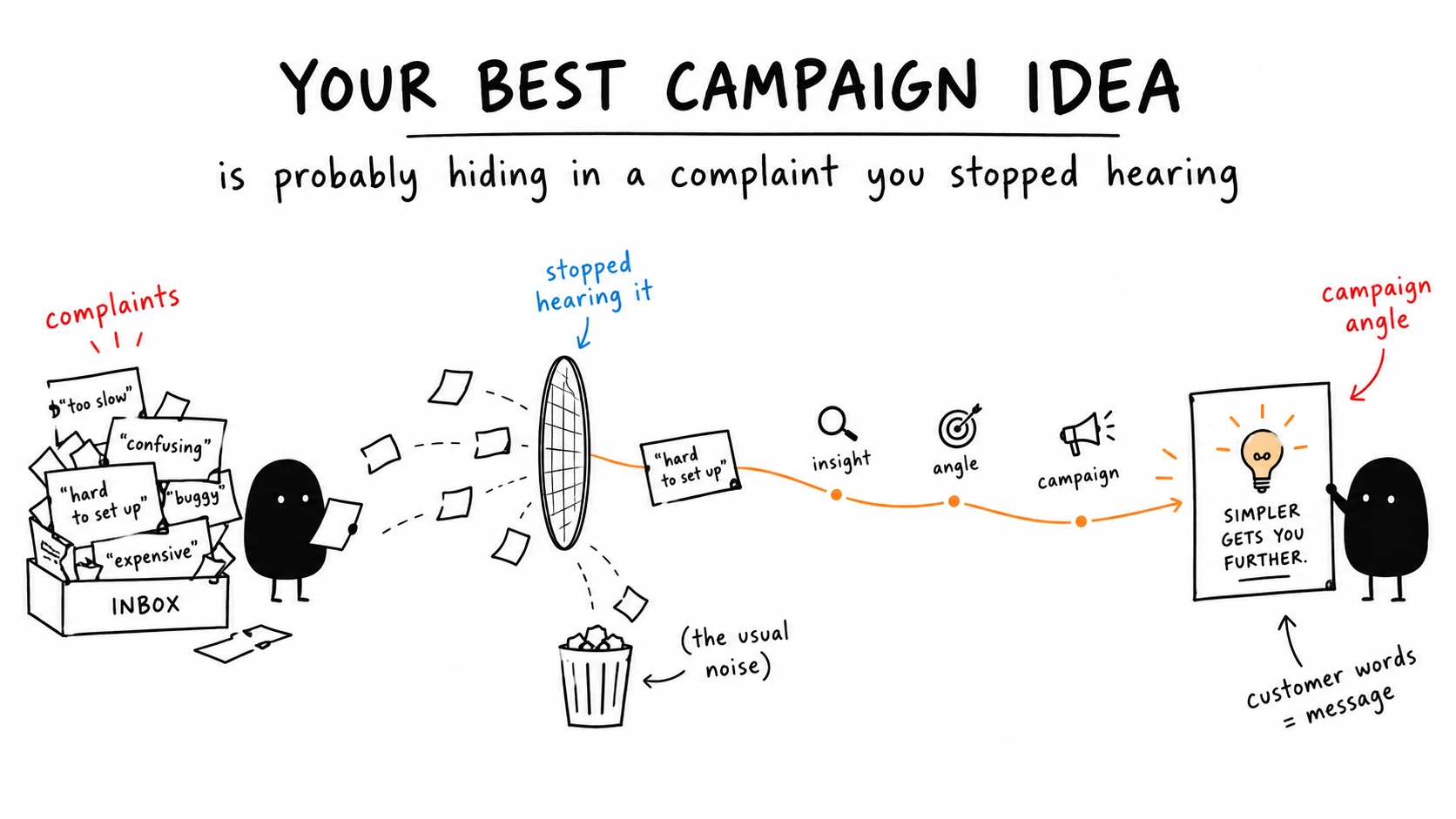
The marketing version of this is just as real and arguably more common. You don’t avoid an idea because it’s hard. You avoid it because you’ve stopped noticing the problem exists at all.
Why the person closest to the problem sees it least
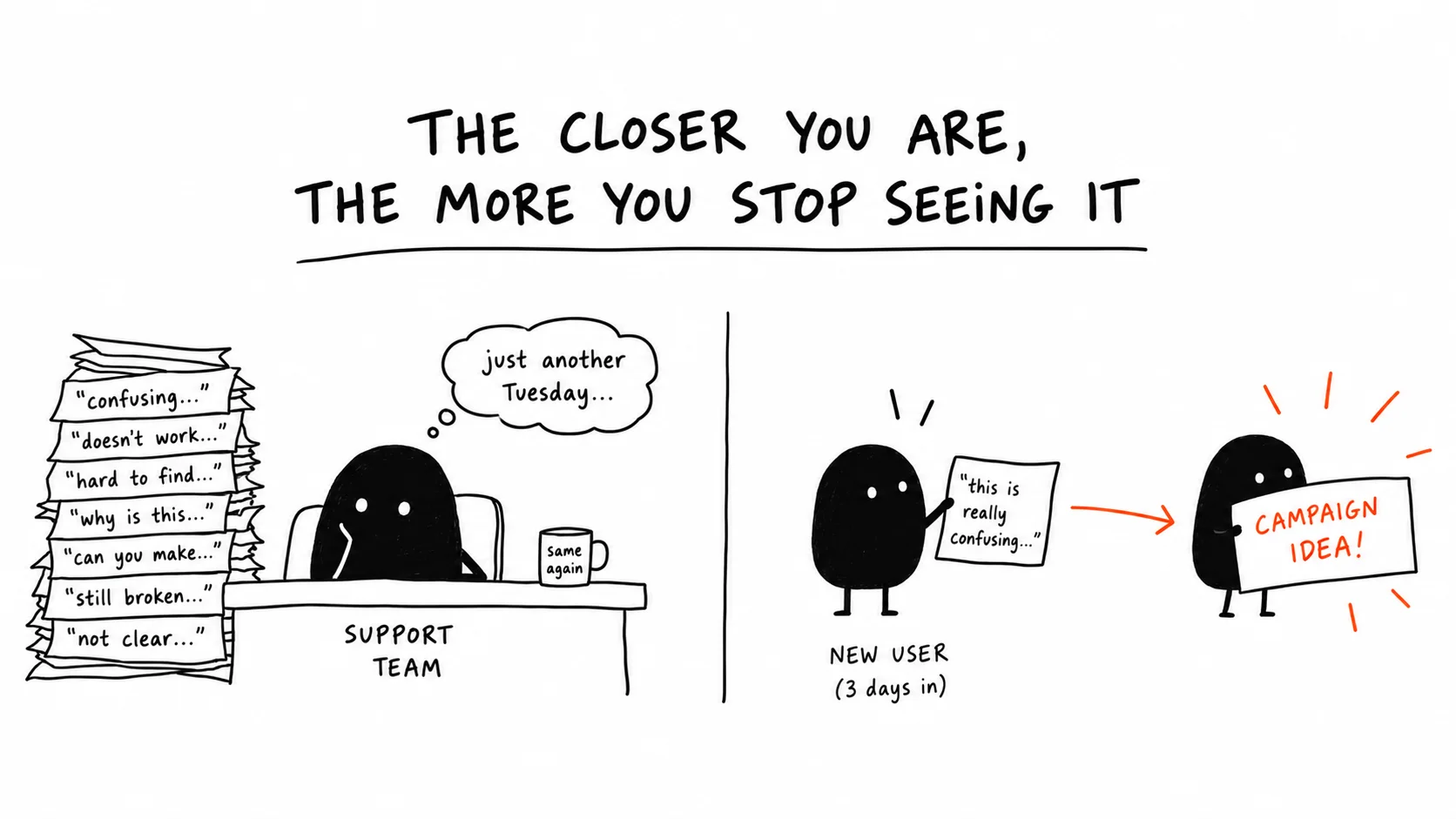
Here’s the part that trips people up: the more experience you have with a product or a market, the less likely you are to spot its biggest gap. Not because you’re careless, but because repeated exposure trains your brain to stop flagging something as a problem. A support rep who’s answered the same confused question five hundred times eventually stops hearing it as a complaint. It becomes background noise, a normal Tuesday, not a signal.
This isn’t just a marketing anecdote. MIT researcher Eric von Hippel studied this pattern directly. In a 1976 study of scientific instrument innovation, he found that roughly 80 percent of meaningful improvements weren’t invented by the manufacturers who made the equipment. They were invented by the users, the people frustrated enough by a limitation to fix it themselves. The people closest to the tool, running it every day, were the ones who saw what needed to change. The people who built it and stared at it from a distance mostly didn’t.
Flip that around for marketing: your newest customer, three days into using your product, is seeing friction your team can no longer perceive. Your oldest, angriest churned customer described your biggest positioning problem in a cancellation survey eight months ago, in language you’d never think to use yourself. That survey is probably still sitting there unread.
The same blindness shows up a level up, too. Teams that spend weeks studying competitors often still can’t see their own gaps clearly. The lens is pointed outward the whole time. We’ve written about what competitor analysis actually reveals about your own blind spots, and it’s the same mechanism at work here, just aimed at your own product instead of someone else’s.
How to force the blind spot into view
Since your own experience is what’s filtering the idea out, you generally can’t think your way to it. You have to go get it from somewhere your habituation hasn’t reached yet.
A few ways teams actually do this:
- Read the exact words customers use in reviews and support tickets, not your internal summary of what they meant.
- Ask someone who joined the company in the last month what confused them. They still have the friction fresh.
- Pull complaints that got dismissed as edge cases six months ago and check if they’re still showing up.
The common thread: you’re looking for language that repeats, that you’ve explained away before, and that nobody on your team currently treats as urgent.
This is a starting point, not the full method. For the complete playbook, including how to mine competitor reviews, forums, and sales objections, and how to check that a pain point is actually worth building a campaign around before you commit to it, see Customer Pain Points: Why Your Marketing Isn’t Working.
How to tell a real pattern from noise
Not every recurring complaint is a campaign waiting to happen. Some are one loud customer restating the same thing five times, not five customers independently hitting the same wall. Before you build anything on a pattern, it needs to clear three checks.
It shows up in more than one source. A complaint that only appears in support tickets might be a support problem, not a marketing opportunity. The same friction showing up in reviews, in a sales call objection, and in a cancellation survey is a different signal. Three unrelated people describing the same friction in their own words is harder to dismiss than one person mentioning it twice.
Nobody had to be prompted to say it. If you only hear about the problem when you run a survey asking about it directly, that’s a weaker signal than a problem people volunteer unprompted. Unprompted complaints tell you what’s actually top of mind. Prompted answers tell you what people will agree to when you hand them the option.
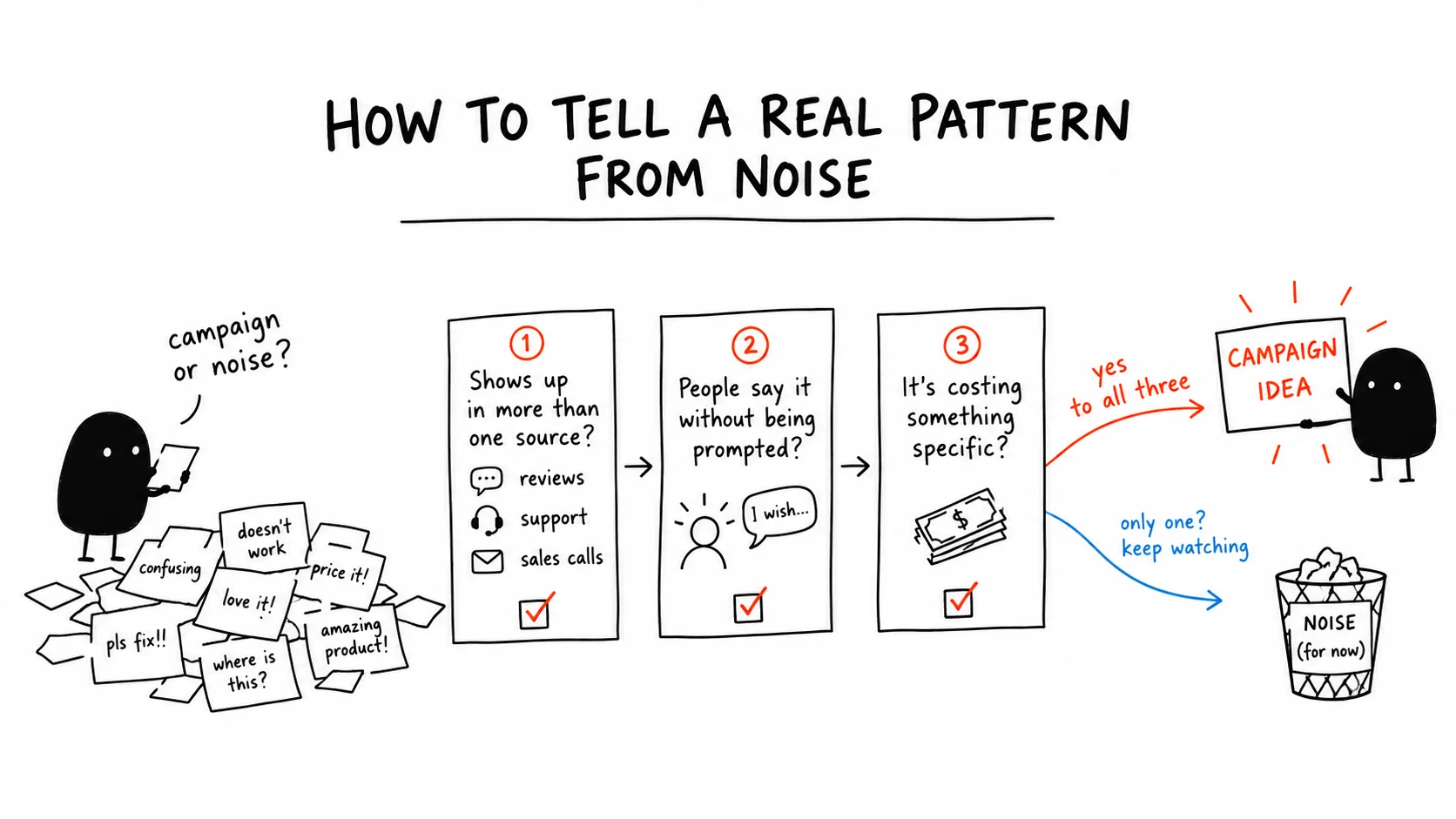
It’s costing something specific. “This is confusing” is a starting point, not a campaign. “I gave up and used a spreadsheet instead” or “I almost cancelled over this” tells you what the customer did about the friction, which is what a campaign can actually speak to. If you can’t name the behavior the friction caused, you don’t yet have enough to write a campaign from.
A complaint that clears only one of these three checks is worth watching. One that clears all three is usually worth a working session with whoever owns the campaign calendar.
None of this requires new tooling or a research budget. It requires deciding, in advance, what counts as real, so you’re not relitigating the question every time something surfaces.
What this looks like when it works
Here’s what this can look like in practice, even for a one-person team.
A solo founder runs a small skincare brand and handles her own marketing. For months, a specific phrase kept turning up in reviews: “I didn’t know what order to use these in.” She’d read some version of that sentence dozens of times and filed it under “customers being customers,” not “campaign idea.”
It cleared all three checks without her looking for it. The same confusion showed up in product reviews, in return reason forms, and in DMs asking which product to use first. Nobody had prompted any of it. And the cost was specific: customers who said this were buying one product at a time instead of the full routine, and some were returning items rather than admitting they didn’t know how to use them.
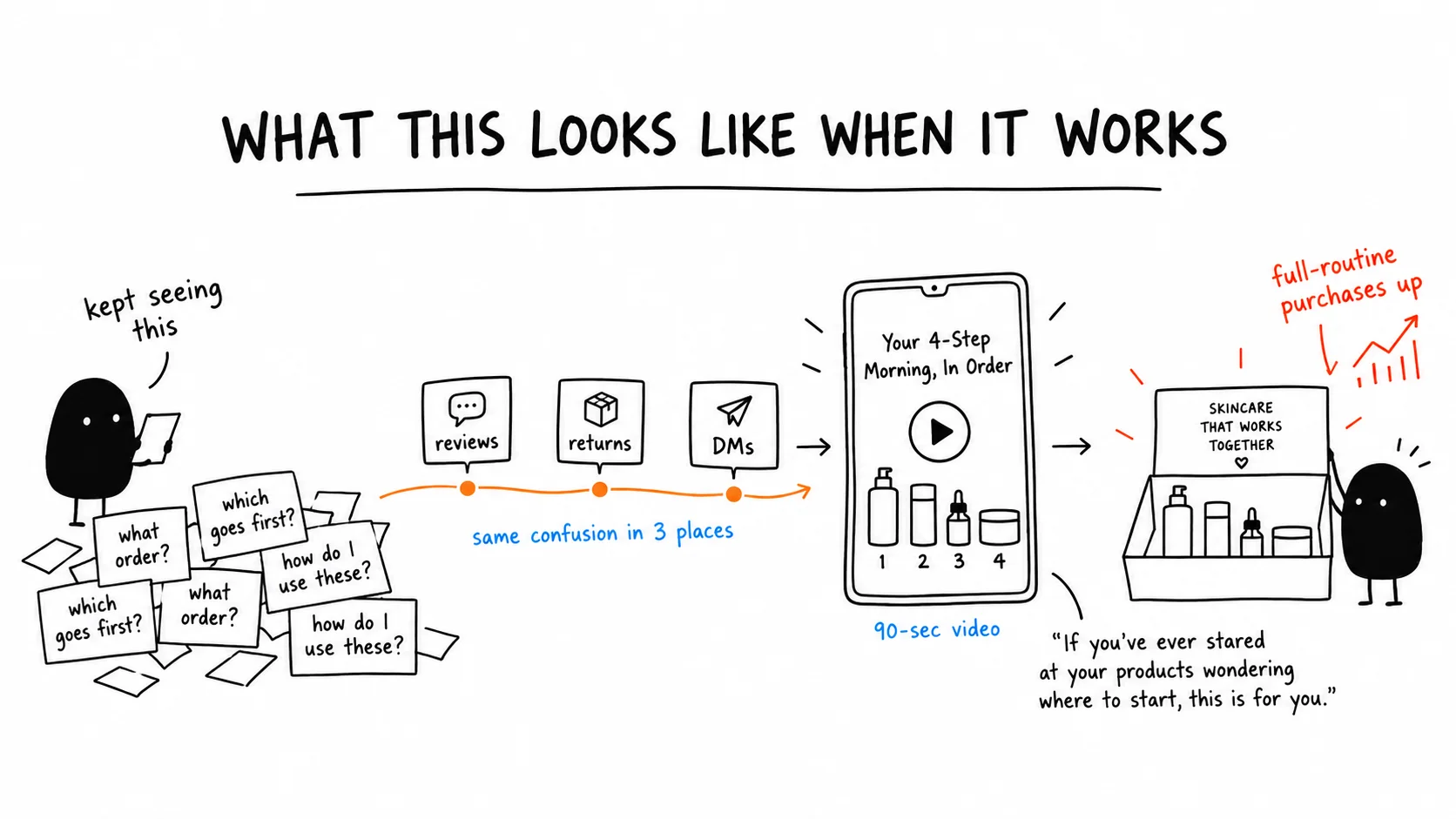
The campaign that came out of it wasn’t a new product. It was a single 90-second video titled “Your 4-Step Morning, In Order,” shot on her phone, showing exactly what goes on the skin first, second, third, and fourth. She used the customers’ own words in the caption: “If you’ve ever stared at your products wondering where to start, this is for you.” Full-routine purchases went up the month she ran it, because for the first time she was speaking to the actual moment of confusion instead of describing what each product does.
Nothing about that required new customer research. The material had been sitting in her own reviews and return forms the entire time.
Why this is worth catching early
The manual version of this works, but it’s slow, and slow is exactly what lets the blindness reset. By the time someone finally reads three months of support tickets end to end, the pattern has usually already cost the business a quarter of missed positioning.
The fix isn’t a longer strategy off-site. It’s treating “read what customers actually said, in their own words, on a schedule” as a standing task rather than something you get to eventually. If you’re also trying to figure out where that reading fits alongside everything else scattered across your website, your competitors, and your own customer conversations, How to Use AI to Build a Marketing Strategy From Your Website walks through pulling all of it into one picture.
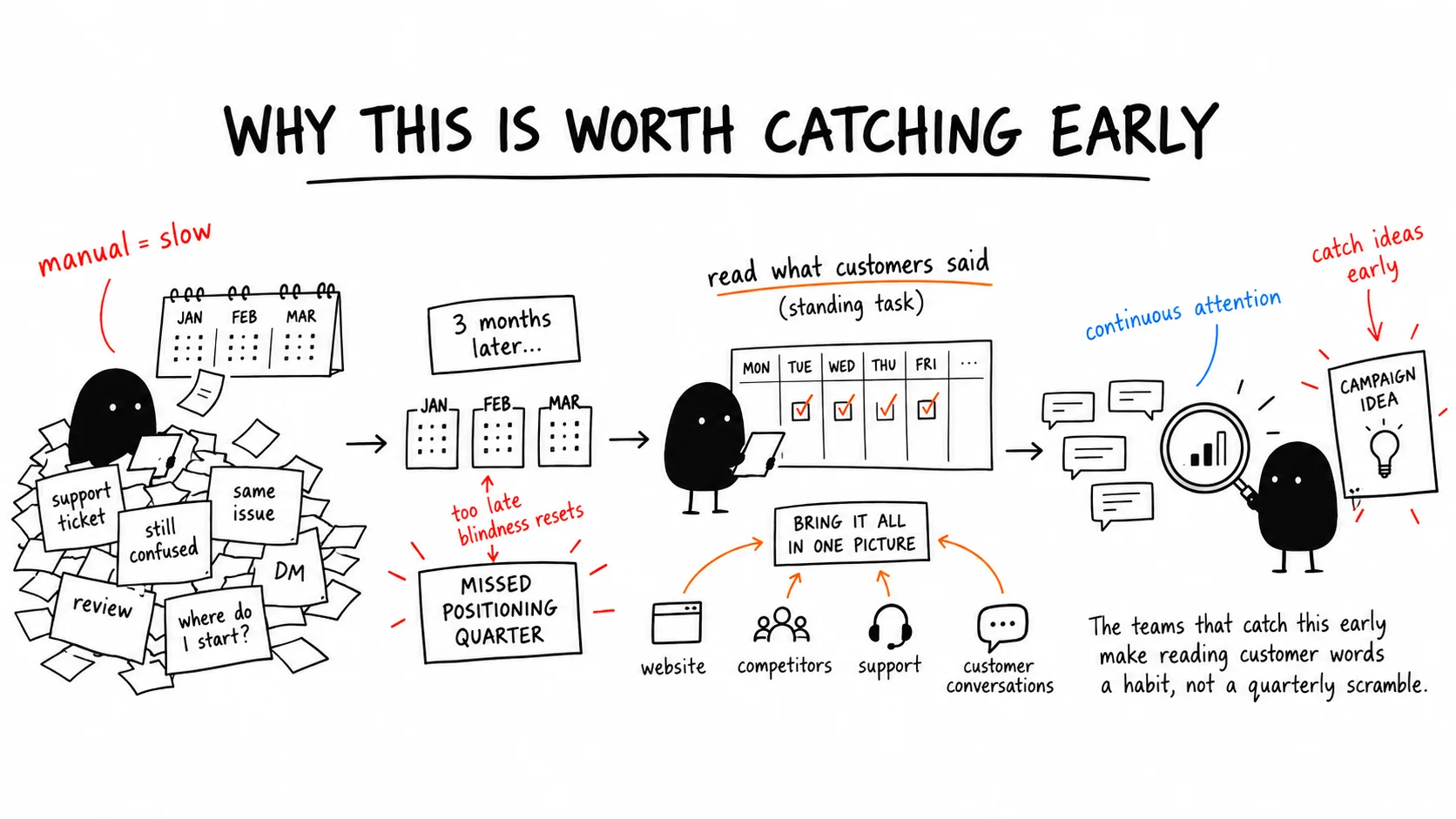
This is exactly the kind of pattern that rewards continuous attention over a periodic audit. The teams that catch these ideas early aren’t smarter; they’ve just made reading what customers actually said a standing habit instead of a quarterly scramble.
The one thing to do this week
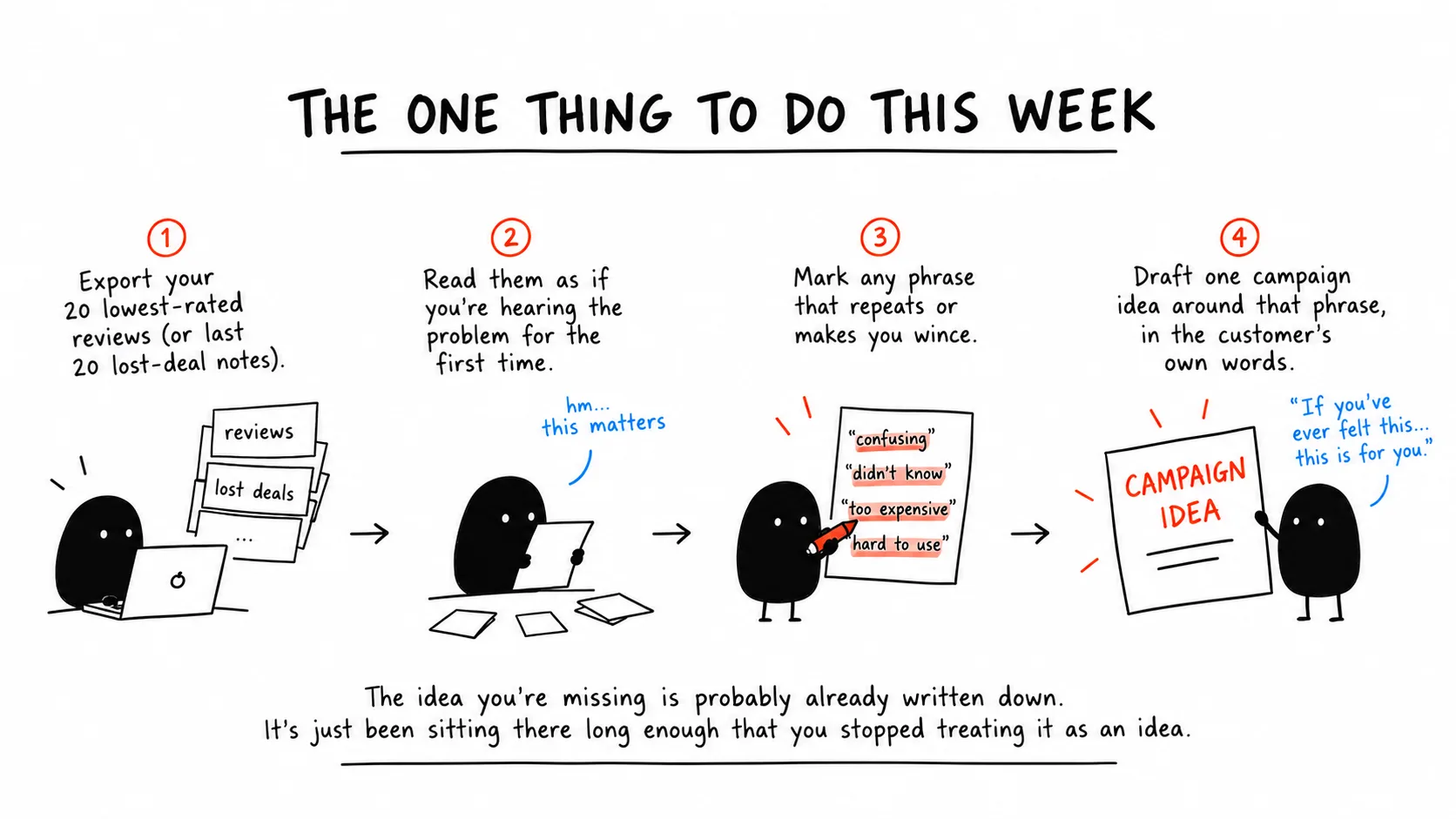
You need one hour with customer language you didn’t write yourself, not a better brainstorm. This week:
- Export your twenty lowest-rated reviews or your last twenty lost-deal notes.
- Read them as if you’re hearing the problem for the first time.
- Mark any phrase that repeats or makes you wince.
- Draft one campaign idea around that phrase, in the customer’s own words.
The idea you’re missing is probably already written down. It’s just been sitting there long enough that you stopped treating it as an idea.
Your turn
What’s one complaint from your customers that you’ve stopped hearing? It might be someone else’s next campaign idea.
FAQ
How do I find campaign ideas if I don’t have many reviews yet?
Look at whatever customer language you do have, even if it’s a handful of support emails or sales call notes. Volume matters less than whether the source is unprompted. Five unprompted complaints that repeat are more useful than fifty answers to a survey question you wrote yourself.
How often should I actually do this?
Treat it as a standing task, not a one-time audit. A short, regular pass, even fifteen minutes every two weeks, catches patterns while they’re forming instead of after they’ve already cost you a quarter of missed positioning.
What if the complaint is about something the product can’t fix right away?
That doesn’t disqualify it as a campaign idea. A complaint about a permanent limitation is still a signal about what customers care about and how they talk about it. Campaigns can address the underlying worry directly, even when the fix itself is on a longer roadmap.
Related reading
- Customer Pain Points: Why Your Marketing Isn’t Working
- What Competitor Analysis Reveals About You (Not Just Them)
- Stop Selling to People Who Don’t Know They Have a Problem
- How to Use AI to Build a Marketing Strategy From Your Website
- Best AI Video Generators for Marketers in 2026
- What Are AI Tokens? A Marketer’s Guide to Context, Cost, and Limits
- AI Image Color Palette: How to Borrow One From Nature
About the author
Serafima Osovitny is a Marketing Manager at Nova Express, where she focuses on digital marketing, search visibility, content strategy, and marketing workflows. She writes practical guides that help marketing teams research their audiences, develop strategies, and put their plans into action.
Explore her work at serafima.digital and follow her on X: @OSerafimaA.








Leave a Comment