

You built a landing page. The design is clean, the copy sounds professional, and the offer is strong. You launch ads, and nothing happens. Clicks trickle in. Conversions stay flat. You blame the headline, rewrite the CTA, and swap the hero image. Still nothing.
The problem isn’t your page. It’s that you’re talking to someone who isn’t ready to hear what you’re saying.
In “Breakthrough Advertising,” Eugene Schwartz laid out what would become the most referenced copywriting framework in history. His central argument was deceptively simple: don’t try to create desire. Channel the desire that already exists. The way you channel it depends entirely on how much your audience already knows about their problem and your solution.
Schwartz identified two dimensions that every marketer must understand before writing a single word of copy: the five levels of customer awareness and the five levels of market sophistication. Together, these two axes tell you exactly what to say, how to say it, and when your audience is ready to hear it.
If you’ve studied Gary Halbert’s copywriting rules or David Ogilvy’s approach to persuasion, you already know that audience understanding beats clever writing every time. Schwartz’s framework explains exactly why.
Part One: The 5 Levels of Customer Awareness
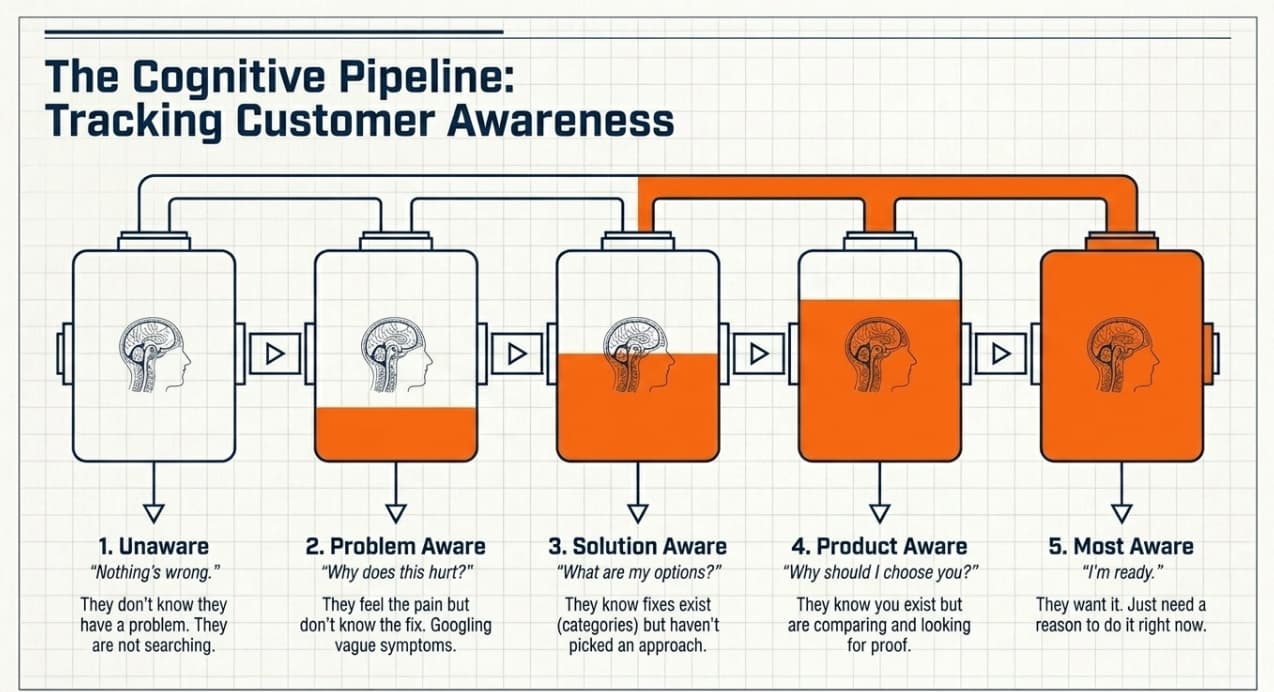
Level 1: Unaware: They Don’t Even Know Something’s Wrong
What’s happening in their head: Nothing related to you. They’re not searching, not comparing, not considering. They don’t know they have a problem, or they’ve normalized it so completely that it doesn’t register.
Real example: Compression socks are roughly a $720 million market today and are projected to cross $1 billion by 2032. The result: strong double‑digit year‑over‑year revenue growth by reaching people who didn’t know they were customers. But the biggest challenge isn’t competition. It’s that most potential customers don’t know they need the product. A graphic designer sits at her desk ten hours a day. Her ankles swell by evening. She thinks, “I’m just tired” or “I need to drink more water.” She’s not Googling compression socks. She doesn’t know poor circulation is the problem, and she doesn’t know a $30 pair of socks could fix it. Brands like VIM & VIGR cracked this by publishing content about why ankles swell after sitting all day and why varicose veins appear in your thirties. Education first, product later.
What works: Education and storytelling that create a moment of recognition. Blog posts about symptoms, short videos describing a familiar frustration, and social posts that make people think, “Wait, that’s me.” If you’re building content for this stage, our guide on understanding customer pain at 4 levels explains how to identify the discomfort your audience hasn’t articulated yet.
What doesn’t work: Product pitches. Discount codes. Anything that assumes they’re already shopping.
Level 2: Problem Aware: They Feel the Pain but Don’t Know the Fix
What’s happening in their head: Something’s wrong, and they know it. They can describe the symptom but not the solution. They’re Googling vague things: “Why is my back always sore?” and “Why do my ads stop working after two weeks?”
Real example: Slack’s early marketing didn’t lead with features. They led with pain: “Be less busy.” Two words that captured what every office worker felt. Drowning in email threads, missing messages, wasting time in meetings. Slack understood that their audience didn’t know they needed a team messaging tool. They knew they needed to stop feeling overwhelmed. By 2019, Slack had 12 million daily active users, built on empathy, not feature lists.
What works: Empathy first. Name the pain before you name the cure. The most powerful thing you can do is describe their situation so accurately that they feel understood.
“You keep launching campaigns that start strong and die within days. Your boss wants answers. Your team is burning through creative ideas. And every ‘best practice’ article gives the same generic advice that stopped working in 2024.”
Content that works: problem-focused blog posts, “why this happens” explainers, and diagnostic quizzes. Our storytelling framework was designed for exactly this: building narrative tension around a problem before introducing any solution.
What doesn’t work: Feature lists. Pricing pages. Product demos. They don’t know what product category they need yet.
Level 3: Solution Aware: They Know Fixes Exist but Haven’t Picked One
What’s happening in their head: They’ve done research. They know the general category of solution. CRMs exist, retargeting might help, and their sleep problem might be a mattress issue. But they haven’t committed to a specific approach.
Real example: When HubSpot coined the term “inbound marketing,” they didn’t promote their software. They promoted a methodology. Hundreds of blog posts, free courses, and an entire academy, all teaching solution-aware marketers why inbound was better than outbound. By the time readers evaluated tools, HubSpot was the obvious choice. The result: over 228,000 customers across 135 countries by 2025, with annual revenue exceeding $2.6 billion.
What works: Education with a point of view. Stop being neutral and start positioning your method as the better path.
“Most agencies try to fight ad fatigue by producing more creative. That’s expensive and exhausting. The faster approach is to restructure your audience segments and let the algorithm find fresh pockets of attention.”
Content that works: “method A vs. method B” comparison posts, detailed how-to guides, webinars, and whitepapers. The 10 legendary copywriters article is a good example. It doesn’t pitch a product but positions principles that naturally lead toward a specific type of tool.
What doesn’t work: Hard selling. They’re not ready to buy. They’re ready to learn.
Level 4: Product Aware: They Know About You, But They’re Not Convinced
What’s happening in their head: They’ve found you. Maybe through search, maybe a referral. They know your product exists. They might have visited your website. But they’re comparing. They’re reading reviews. They’re looking for reasons to trust you and reasons not to.
Real example: Apple doesn’t just list specs. When the iPhone launched, competitors had better cameras and more features on paper. Apple showed the experience: ads featuring real photos taken on iPhone, billboards with customer shots, and the “Shot on iPhone” campaign. By 2025, the campaign had generated over 6.5 billion impressions by turning customer proof into advertising.
What works: Proof. Specificity. Everything that removes doubt. Case studies with real numbers. Customer testimonials describing the before and after. Comparison pages that address competition honestly. Guarantees that lower risk.
Our case studies showing how small businesses turned around their marketing are built for exactly this moment. And David Aaker’s 5Bs framework explains how brand perception drives purchase decisions when features are roughly equal across competitors.
What doesn’t work: Awareness content. Educational blog posts. They already know who you are. Give them reasons to choose you.
Level 5: Most Aware: They’re Ready. Just Give Them the Push
What’s happening in their head: “I want this. I need a reason to do it right now.” They’re subscribed. They’ve bookmarked your pricing page. They’ve used your free tier. They’re one nudge away.
Real example: Amazon’s “Buy Now with 1-Click” patent wasn’t a technology flex. It was a Level 5 conversion weapon. Amazon understood that most aware customers don’t need more information. They need less friction. One click reduced cart abandonment by an estimated 10-15% and generated billions in revenue from people who had already decided to buy.
What works: Direct offers. Urgency. Friction removal. “Upgrade today and get 20% off your first three months.” “Your free trial ends in 48 hours.” “Annual plan saves you $200.”
This is the only stage where discounts, limited-time offers, and aggressive CTAs belong. Using them earlier is wasted ammunition. Using them here is closing the deal.
For campaigns at this level, our guide on writing sales-oriented content provides a step-by-step framework. And welcome sequences are particularly effective for converting free trial users.
What doesn’t work: More education. More social proof. More nurturing. They don’t need convincing. They need a reason to act now.
Part Two: The 5 Levels of Market Sophistication
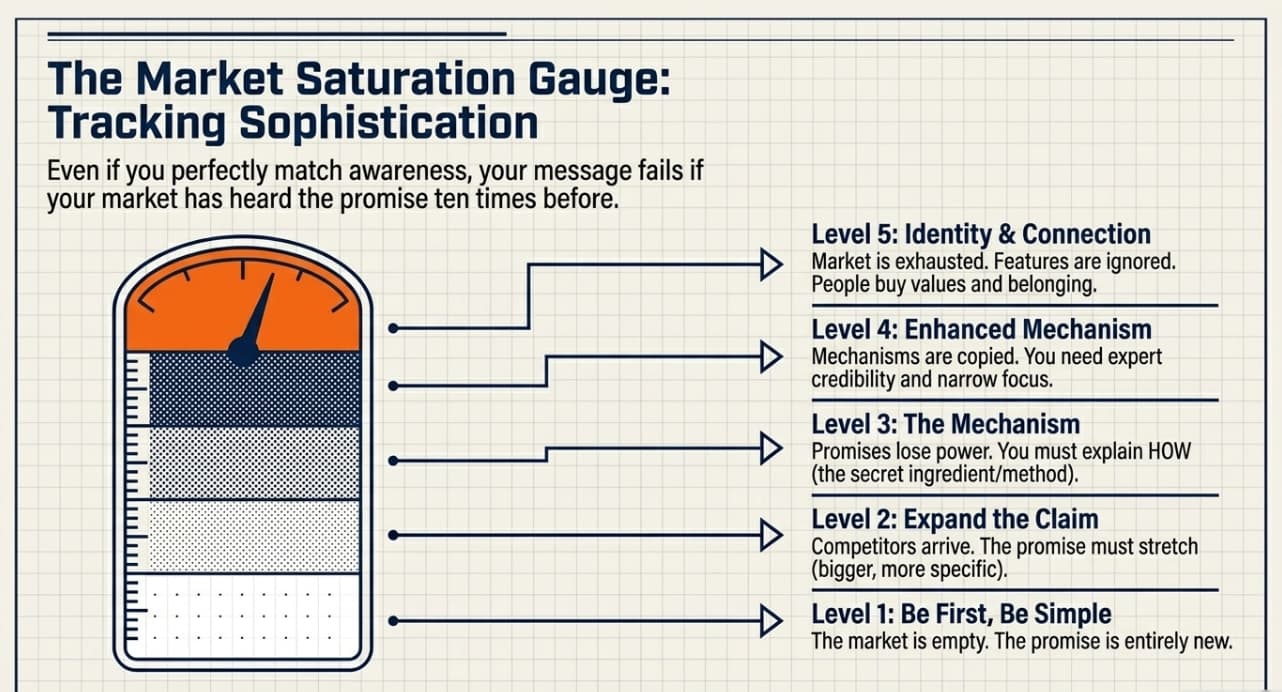
Awareness levels tell you where your customer is. Sophistication levels tell you where your market is. Even if you perfectly match your message to the customer’s awareness stage, it can still fail if your market has heard the same promise from ten other brands.
Schwartz observed that markets evolve through predictable stages. Each stage requires a fundamentally different type of message. Here’s how they work.
Sophistication Level 1: Be First, Be Simple
What it looks like: You’re early. Few competitors exist. The market hasn’t heard your type of promise before. You can state what your product does, and people will respond.
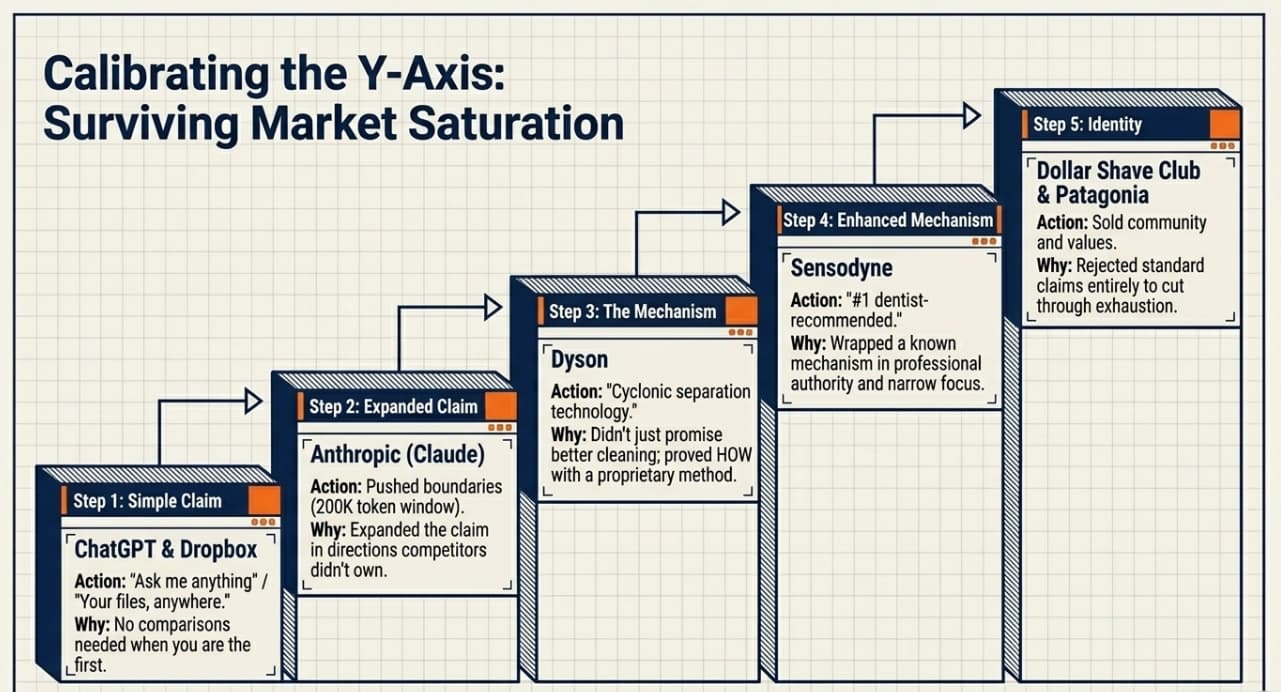
Real example: When ChatGPT launched in late 2022, most people had never interacted with a conversational AI. OpenAI’s message was breathtakingly simple: just a text box and the words “Ask me anything.” No comparisons, no amplified promises, no social proof. Just a clear invitation to try something new.
The result: ChatGPT reached around 100 million users in just two months, becoming the fastest‑growing consumer app in history. Analysts have projected that ChatGPT could approach close to a billion active users and generate multi‑billion‑dollar annual revenue, but the exact numbers depend on how the market evolves.
What works: Direct claims. “This product does X.” Simple, clear, honest. No need for sophistication because nobody else has said it yet.
Sophistication Level 2: Expand the Claim
What it looks like: Competitors appeared. Your original promise is no longer unique. Customers have heard “talk to AI” from five other companies. You need to stretch the claim. Make it bigger, more specific, more measurable.
Real example: When Anthropic launched Claude into a market ChatGPT already dominated, they couldn’t just say, “We’re also an AI chatbot.” They expanded the claim in directions competitors hadn’t owned yet: a 200K token context window (compared to the industry standard of 8K at the time), safety-first design, and responses that felt more thoughtful than robotic. By 2026, Claude reached millions of users, and Anthropic was valued at over $60 billion. Same category as ChatGPT, but the promise was bigger and more specific where it mattered.
Sophistication Level 3: The Mechanism
What it looks like: Everyone is making big promises. Customers have heard “lose weight fast” from a hundred brands. The promise alone no longer differentiates. You need to explain how. The mechanism, the method, the secret ingredient.
Real example: Dyson didn’t promise “better cleaning.” Every vacuum brand said that. Dyson showed the mechanism: cyclonic separation technology. “The first vacuum that doesn’t lose suction.” The mechanism was the differentiator. By the mid‑2020s, Dyson was selling over 20 million products a year across more than 80 markets and reporting EBITDA of about £1.1 billion.
What works: Explain the “how” behind the promise. Unique process names, proprietary methods, patented technology, step-by-step systems. Customers at this stage don’t just want to know what you’ll deliver. They want to know why your approach works when others don’t.
Sophistication Level 4: The Enhanced Mechanism
What it looks like: Even mechanisms have been copied. Multiple brands now explain their process. The market is skeptical. Customers have been burned by promises and mechanisms that didn’t deliver.
Real example: The toothpaste market reached Level 4 decades ago. Every brand had a “mechanism”: whitening crystals, fluoride formulas, and enamel shields. Sensodyne broke through by narrowing focus: “The #1 dentist-recommended toothpaste for sensitive teeth.” They didn’t invent a new mechanism. They took a known mechanism (potassium nitrate) and wrapped it in professional authority and a hyper-specific audience claim.
What works: Enhanced credibility around your mechanism. Expert endorsements. Clinical studies. Third-party certifications. Narrower audience targeting. “Built specifically for agencies with 5-15 employees” beats “built for everyone” at Level 4.
Sophistication Level 5: Identity and Connection
What it looks like: The market is exhausted. Every promise has been made. Every mechanism has been explained. Customers tune out features and benefits entirely. They buy based on identity, values, and belonging.
Real example: Dollar Shave Club didn’t win on product superiority. Their razor was decent, not revolutionary. They won on identity. “Our blades are f***ing great,” a roughly $4,500 YouTube video that rejected everything the Gillette market had built over decades of Level 3 and 4 messaging. The launch video went viral, bringing in around 12,000 new customers in the first 48 hours and ultimately contributing to a reported $1 billion all‑cash acquisition by Unilever in 2016.
Another example: Patagonia’s “Don’t Buy This Jacket” campaign. In a market saturated with performance claims, Patagonia sold values. Revenue grew 30% the year after that campaign ran.
What works: Story. Identity. Values. Humor. Personality. Community. Stop talking about your product and start talking about who your customer becomes when they choose you.
The Two Axes Together: The Strategic Matrix
Here’s where everything connects. Every marketing decision sits at the intersection of two questions:
“How aware is this specific customer?” → Determines the content of your message.
“How sophisticated is this market?” → Determines the style and angle of your message.
A problem-aware customer in a Level 1 market needs simple education about the solution. The same problem-aware customer in a Level 5 market needs education delivered through story, identity, and a radically different voice because they’ve heard the standard educational pitch from fifty other brands.
This is why templates fail. A headline formula that works in a fresh market sounds generic in a saturated one. The matrix forces you to think two-dimensionally instead of one.
The Landing Page Rule
Cold traffic (Awareness Levels 1–3) needs long landing pages. When someone arrives from a cold ad or organic post, they don’t know you, don’t fully understand the problem, and haven’t evaluated solutions. Your page has to do all that work. That takes space. A 3,000-word sales page isn’t excessive for cold traffic. It’s necessary.
Warm traffic (Awareness Levels 4–5) needs short landing pages. When someone clicks from your newsletter, types your brand name into Google, or returns from retargeting, they already know who you are. They need the offer, the price, and the button. Forcing them through 2,000 words of copy they already know is the fastest way to lose them.
The length of your page isn’t a design choice. It’s a strategic decision based on the awareness level of your traffic source.
How This Changes Your Content Strategy
Most marketing teams create content without thinking about which awareness level or sophistication level it serves. They write blog posts for Level 3, run ads targeting Level 1, and build landing pages for Level 5, then send all three audience types to the same page.
Map every piece of content to a specific awareness level. Before writing, ask: “Who is this for, and how much do they already know?” The topic, the tone, the structure, the CTA, everything changes based on the answer.
Build content bridges between levels. A blog post for unaware readers should end with a link to problem-aware content. A webinar for Solution Aware prospects should close with a case study that moves them to Product Aware. Our guide on content-driven marketing efficiency explains how to build these bridges at scale.
Know your market’s sophistication level before choosing your angle. If you’re in a Level 5 market, another feature comparison post won’t move the needle. Lead with a story, identity, or a contrarian point of view instead.
The Mistake That Kills Most Campaigns
The single biggest mistake in marketing is talking to Level 1 audiences like they’re at Level 5. Pitching a 20% discount to someone who doesn’t know they have a problem. Showing a product demo to someone who hasn’t decided what kind of solution they need.
The second biggest mistake is ignoring market sophistication. Making a simple product claim in a Level 4 market where customers have heard that exact promise from twelve competitors. Or explaining your mechanism when the market has moved to Level 5 and customers want identity, not information.
When a campaign underperforms, ask two questions before touching the copy:
“Am I matching the right awareness level?” and “Am I matching the right sophistication level?”
The answer usually reveals the fix.
Nova Express Resources
Tools & Tactics:
- Customer Pain Points: Why Your Marketing Isn’t Working
- AI Tools for Marketers in 2026
- NotebookLM for Marketers
- Nano Banana Pro: The Complete Guide for Marketers 2026
- Storytelling elements for high-converting marketing campaigns
- 7 Midjourney V7 Prompts for Marketing Ads
- What Is Generative Engine Optimization?
- Why AI Cites Some Brands and Ignores Others: The Citation Stack Explained
- What Competitor Analysis Reveals About You (Not Just Them)
- What Is AEO?
- GPT Image 2 for Marketers: How to Finally Get Readable Text in AI Images
About the author
Serafima Osovitny is a Marketing Manager at Nova Express, where she focuses on digital marketing, search visibility, content strategy, and marketing workflows. She writes practical guides that help marketing teams research their audiences, develop strategies, and put their plans into action.
Explore her work at serafima.digital and follow her on X: @OSerafimaA.








Leave a Comment