

Your product is excellent. Your targeting is sharp. Your ad spend is dialed in. But your campaign reads like a datasheet, and nobody cares.
Here’s the uncomfortable truth: features don’t sell. Stories do. Humans are hardwired for narrative. We’ve been making decisions based on stories for 40,000 years, long before anyone invented a marketing funnel.
The data backs the assertion up. Research from Stanford professor Jennifer Aaker shows that people remember stories up to 22 times better than standalone facts. A study by Headstream found that if people love a brand’s story, 55% are more likely to buy in the future, 44% will share the story, and 15% will buy immediately.
Yet most campaigns skip storytelling entirely. They jump straight to “20% off” and wonder why engagement flatlines. Emotion makes people act. Logic just makes them think. This article breaks down seven storytelling elements that transform boring campaigns into narratives people actually care about.
1. Hook: Grab Attention Before They Scroll Past
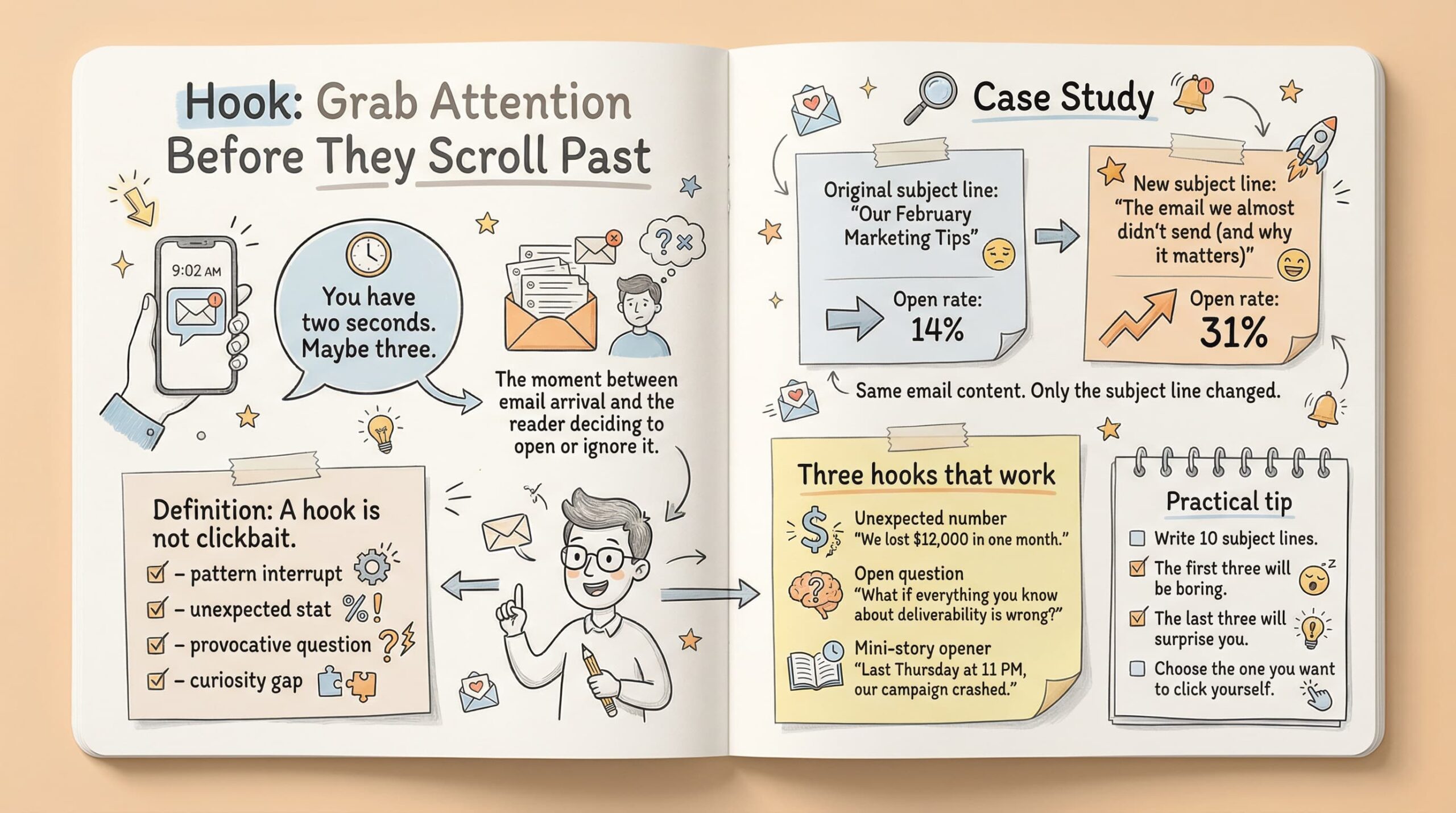
You have two seconds. Maybe three. That’s the window between your email hitting someone’s screen and their thumb deciding to open it or flick it into oblivion.
A hook isn’t clickbait. It’s a pattern interrupt, an unexpected stat, a provocative question, or an opening line that creates a gap the reader needs to close. I tested this with a client’s newsletter. Original subject line: “Our February Marketing Tips.” Open rate: 14%. Rewrite: “The email we almost didn’t send (and why it matters).” Open rate: 31%. Same content inside. The only difference was micro-curiosity.
Three types of hooks that consistently work: the unexpected number (“We lost $12,000 in one month. Here’s what it taught us”), the open question (“What if everything you know about email deliverability is wrong?”), and the mini-story opener (“Last Thursday at 11 PM, our entire campaign crashed.”).
Try this: Write 10 subject lines for your next email. The first three will be boring. The last three will surprise you. Pick the one that makes even you want to click.
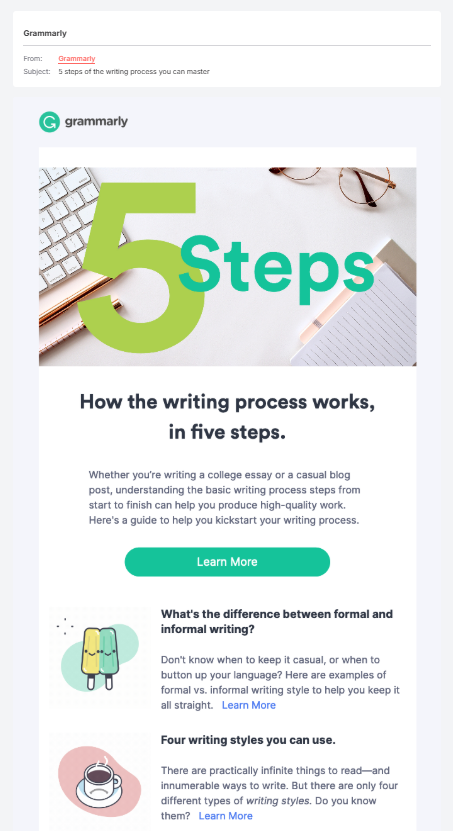
Real-life example: a newsletter hook that earns the click
Grammarly’s newsletter doesn’t start with something generic like “February Newsletter #5. ” Instead, it often leads with a bold, value-packed headline like “5 steps of the writing process you can master” (with practical tips inside) and curiosity-driven subject lines that promise immediate benefit, so the reader instantly thinks “this is useful for me right now,” not “another update.”
2. Setting: Establish Context Before You Sell Anything
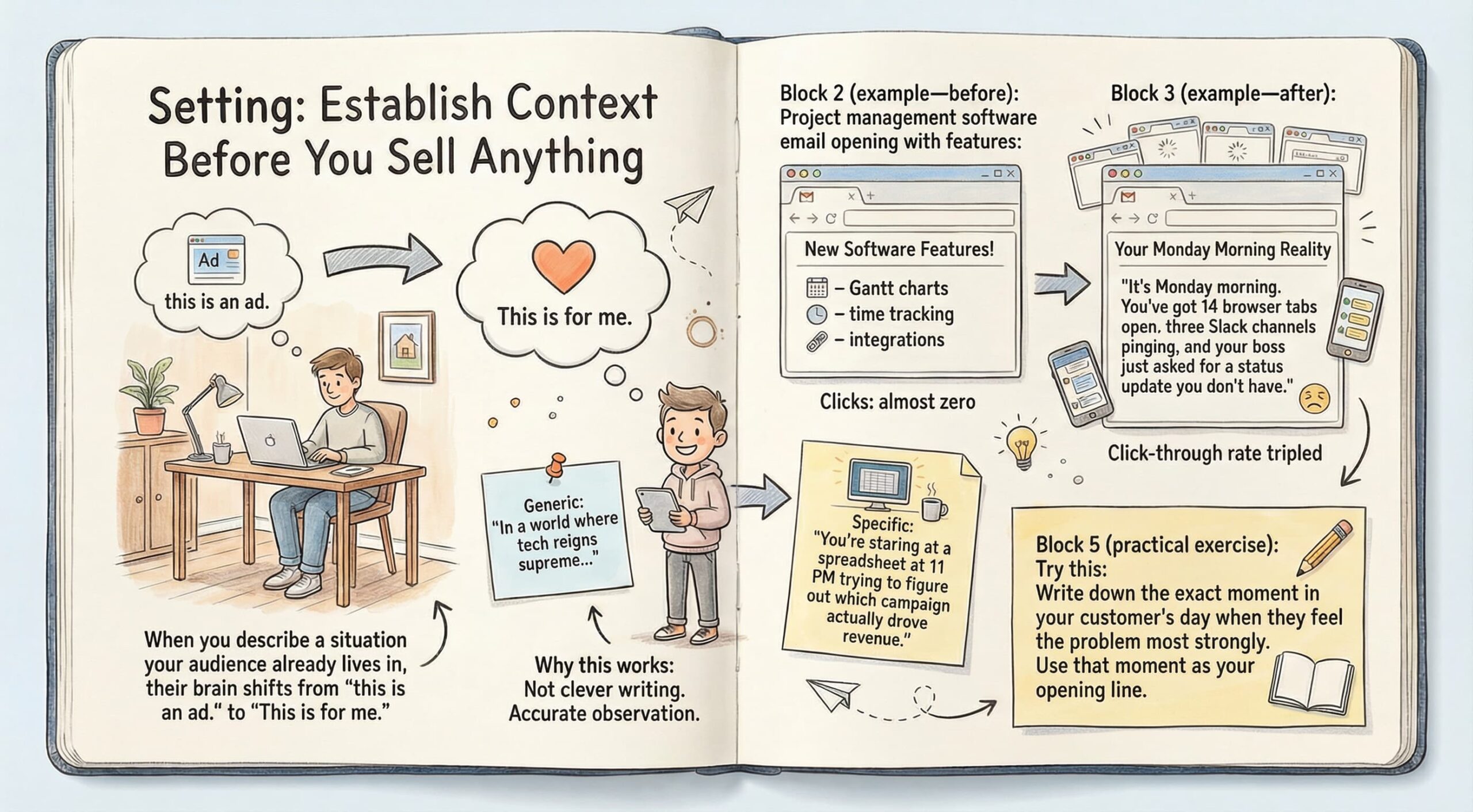
When you describe a situation your audience already lives in, their brain shifts from “this is an ad” to “this is for me.” A client of ours sold project management software. Original emails opened with feature lists: Gantt charts, time tracking, and integrations. Clicks? Almost zero.
We rewrote the opening: “It’s Monday morning. You’ve got 14 browser tabs open, three Slack channels pinging, and your boss just asked for a status update you don’t have.” Click-through rate tripled. The trick isn’t clever writing; it’s accurate observation. “In a world where tech reigns supreme” is generic. “You’re staring at a spreadsheet at 11 PM trying to figure out which campaign actually drove revenue” is the kind of detail that makes readers stop and think, “That was me last Tuesday.”
Try this: Write down the exact moment in your customer’s day when they feel the problem you solve most acutely. Use that moment as your opening line.
3. Characters: Give Your Audience Someone to Root For
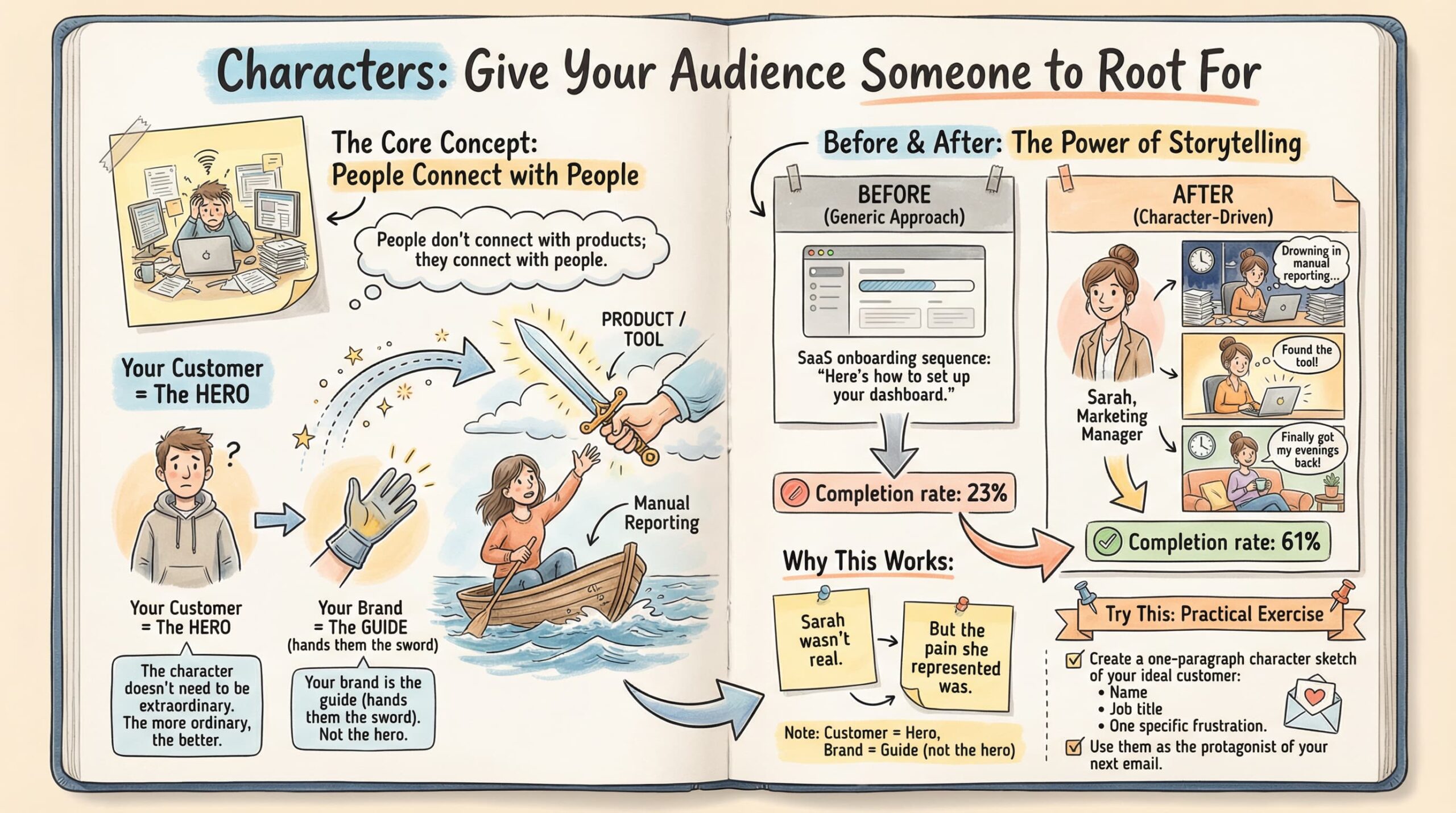
People don’t connect with products; they connect with people. Your customer is the hero. Your brand is the guide, the one who hands them the sword (your product), not the one swinging it. The character doesn’t need to be extraordinary. The more ordinary, the better.
I helped a SaaS company rewrite their onboarding sequence. The original: “Here’s how to set up your dashboard.” The rewrite introduced “Sarah,” a fictional marketing manager based on real customer interviews. Sarah was drowning in manual reporting. Sarah found the tool and finally got her evenings back. The completion rate jumped from 23% to 61%. Sarah wasn’t real. But the pain she represented was.
Try this: Create a one-paragraph character sketch of your ideal customer, including their name, job title, and one specific frustration. Use them as the protagonist of your next email.
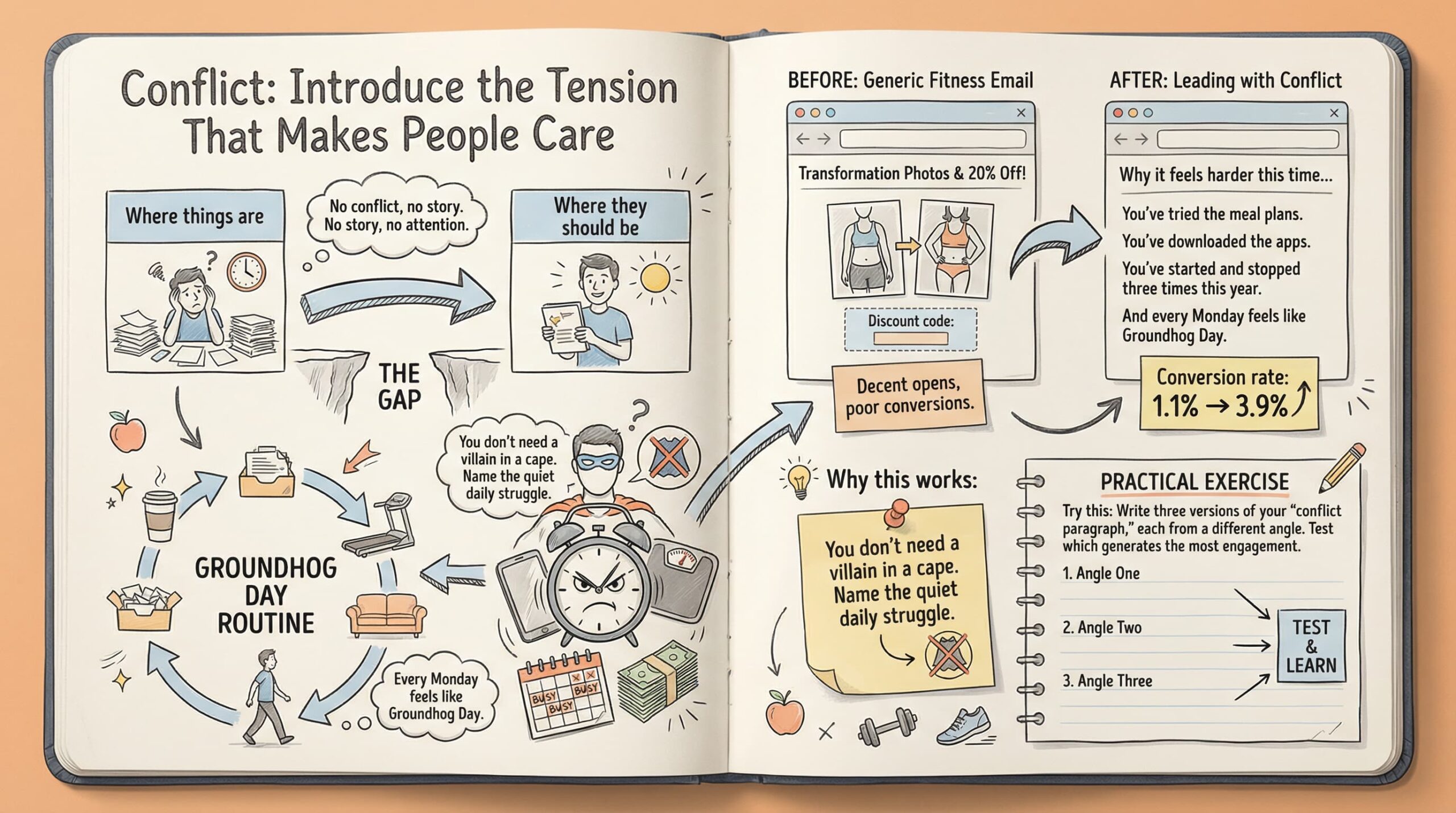
4. Conflict: Introduce the Tension That Makes People Care
No conflict, no story. No story, no attention.
Conflict creates the gap between “where things are” and “where they should be.” That gap is where your product lives. Most marketers skip it; they want to stay positive and aspirational. But skipping the struggle is like telling someone about a movie by only describing the ending. You don’t need a villain in a cape. You just need to name the quiet daily struggle your reader is already living through.
A fitness brand we worked with opened their emails with transformation photos and discount codes. Decent open rates, poor conversions. We restructured to lead with conflict: “You’ve tried the meal plans. You’ve downloaded the apps. You’ve started and stopped three times this year. And every Monday feels like Groundhog Day.” Conversion rate went from 1.1% to 3.9%.
Try this: Write three versions of your “conflict paragraph,” each from a different angle. Test which generates the most engagement.
5. Climax: The Turning Point Where Your Product Enters
This is the moment the problem meets its solution. Your product enters not as a pitch, but as a plot point. The difference between “Buy our software” and “Then she found a tool that automated her entire reporting workflow, and for the first time in months, she left the office before 6 PM.”
Remember who the hero is; it’s still your reader, not you. The product is the mechanism that enables the transformation, not the centerpiece of the story.
Try this: Rewrite your product description as a turning-point scene: frustration → discovery → immediate result. Keep it under 100 words.
Real-life example: conflict in a lead nurturing email
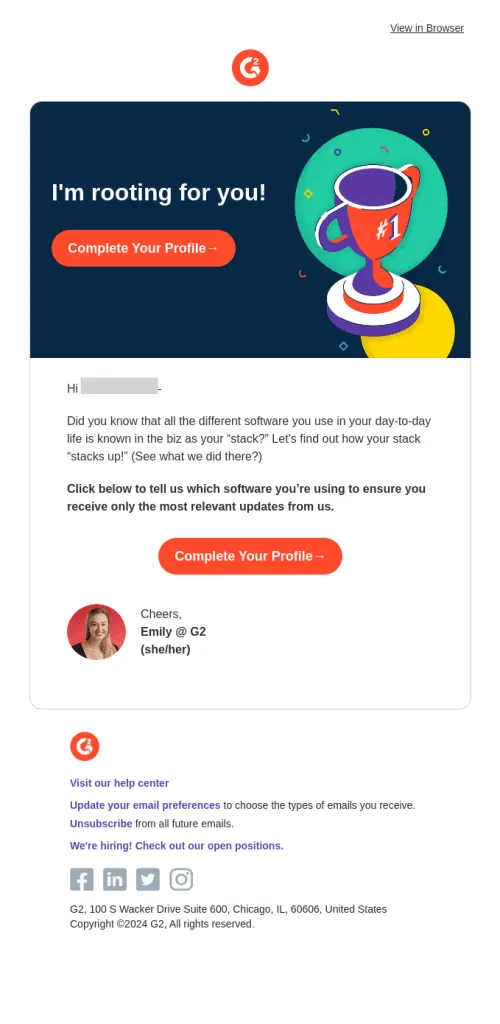
In a lead-nurturing email from G2, the message opens with encouragement (“I’m rooting for you!”) but quickly names the real conflict: the profile isn’t complete, which means worse data and weaker recommendations. The email doesn’t scream “finish your profile”; it shows what the subscriber is quietly losing by staying where they are. That tension is what makes “Complete your profile” feel like a natural next step, not a chore.
6. Resolution: Show the After (Not Just the Before)
Most campaigns stop at the climax; they introduce the product and jump to a CTA. That’s like ending a movie right after the hero gets the sword but before they slay the dragon.
A freelance designer was selling a $197 client acquisition course. Her sales page described the method but never showed the after. We added: “Now, three months later, she has a waitlist. She raised her prices twice. She turned down a project last Tuesday because she had too many clients.” Conversions improved by 34%. The key is concrete detail. “Your business will grow” is vague. “Jane takes Fridays off now” is memorable. Use time markers, numbers, and emotional payoffs.
Try this: Ask three existing customers, “What’s different now?” Use their exact words as your resolution copy.
7. Moral: Drive Home Your Core Value Proposition
The moral ties the entire narrative back to your brand’s core value. It’s the sentence your audience remembers after they’ve forgotten the details. Your moral should be one sentence: “Your email list is your most valuable asset.” “Marketing shouldn’t require a PhD.” That consistency across every piece of content builds brand memory over time.
Try this: Write your brand’s mission in one sentence. Check your last five emails; does each one reinforce it? If not, you’ve found the gap.
Putting All Seven Elements Together
Here’s what a complete storytelling arc looks like in a single marketing email (based on a real Nova Express client test after A/B-testing three variants over two weeks):
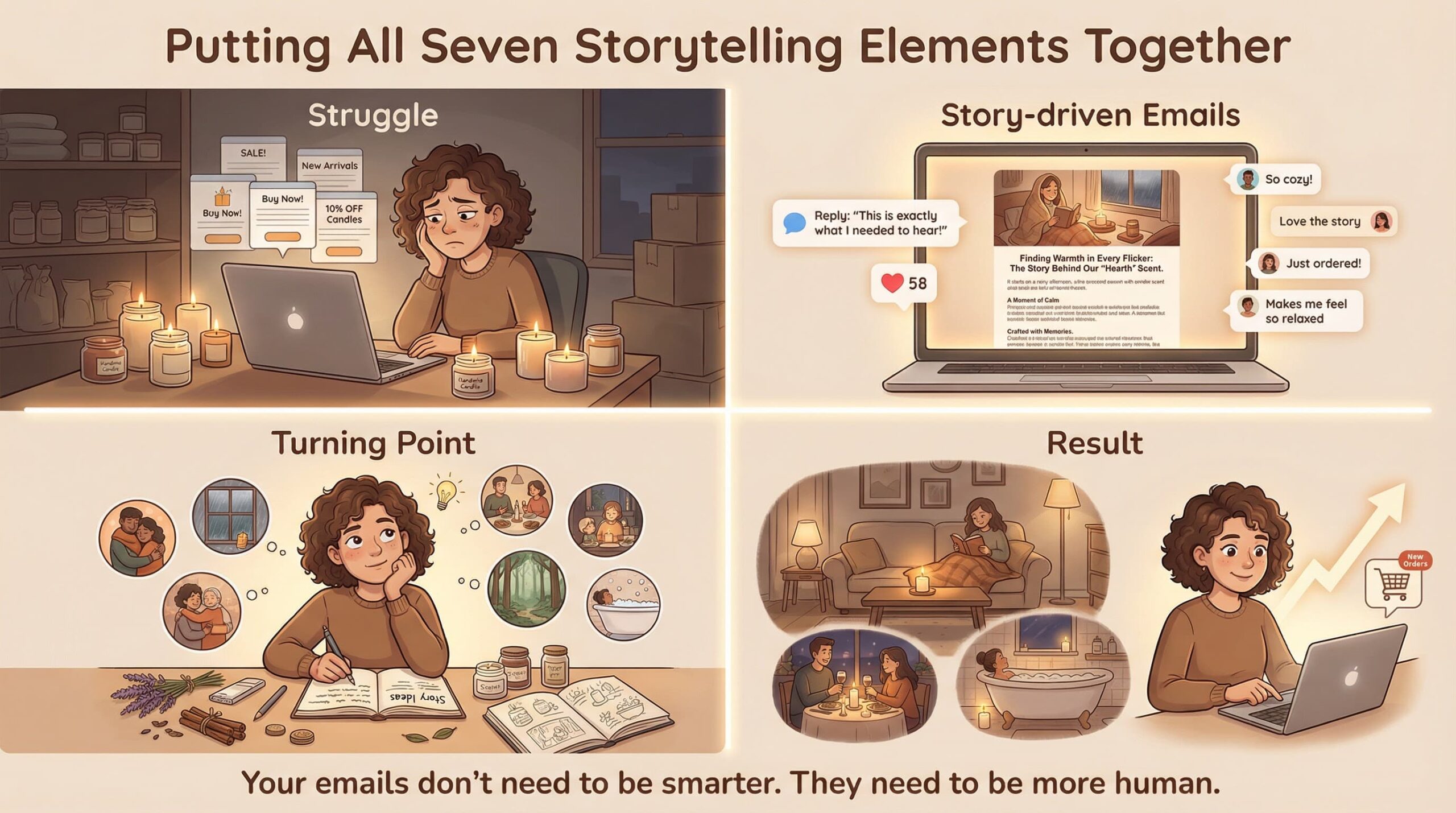
Last winter Clara seriously considered shutting down her small candle business for good.
She founded Lumina to create beautiful hand-poured soy candles that bring comfort and calm into people’s homes. But her emails had turned into the same tired promotions everyone else was sending: new scents, discount codes, and “limited time only.” Sales were dropping, customers felt distant, and she was losing the passion for the brand she loved.
Then Clara made a brave decision: she stopped trying to sound like a marketer and started sharing the real stories — the late nights experimenting with scents in her kitchen, the customers who lit her candles during grief or celebration, and why she believes scent can heal.
She found a simple tool that let her turn those raw, honest moments into warm emails without spending hours staring at a blank screen.
The change was immediate. Customers began replying with their own personal stories. Repeat purchases increased by 63%. Many told her they now light her candles every Sunday evening like a ritual. For the first time in years, Clara felt excited to hit “send” again. Of course, not every email is a home run. But consistent storytelling turned her biggest struggle into her strongest connection with her audience.
Moral? Your emails don’t need to be smarter. They need to be more human.
That’s under 150 words. It tells a complete story, positions the product naturally without a hard pitch, and ends with a message the reader will remember. You can use this exact framework for email campaigns, landing pages, social ads, webinar intros, and welcome sequences. The medium changes. The seven-element structure doesn’t.
Bonus: Turn this framework into a real email
You’ve just seen how the seven elements work inside a single story.
Now here’s exactly how you can use them in a practical weekly email that your subscribers will actually open and love.
Real example from Nova Express (ready to send)
Subject line: The storytelling mistake that was quietly killing my open rates
Hi [First name],
Last week three Nova Express users wrote to me with almost the same message: “I’m doing everything right… but my emails still feel boring and nobody replies.”
That hit close to home, because I used to send exactly those emails.
So I decided to stop hiding behind “professional” copy and start sharing real stories instead. The result? Higher opens, warmer replies, and customers who now feel like they know me.
Here are the three resources that helped me the most this week:
- Gary Halbert’s 10 Email Copywriting Rules That Still Print Money:
The legendary rules that turn ordinary emails into ones people actually read and buy from. Takes 7 minutes to read. Read the article - Dan Kennedy’s Email Marketing Principles That Still Work:
Why old-school direct response still beats modern “hacks” — and how to apply it to storytelling today. Read the article - NotebookLM for Marketers:
How to turn your scattered notes and customer stories into ready-to-send emails in under 30 minutes. Read the article
Want more stories like this every week? Just hit reply and tell me what topic you’d love to see next. I read every single message.
Talk soon, Serafima Osovitny Marketing Manager at Nova Express
Real-life example: re-engagement as a mini story
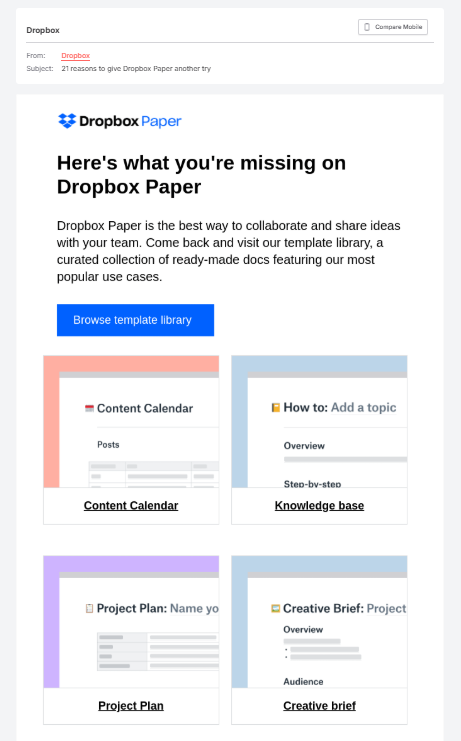
Most re-engagement emails boil down to the same tired template: “We miss you; here’s a discount.” Dropbox takes a smarter, more storytelling-driven approach.
Subject line: “21 reasons to give Dropbox Paper another try.”
The email gently reminds the subscriber what they’re missing: “Here are 21 new templates, improved features, and ways to work faster and more creatively in Dropbox Paper.”
Conflict is introduced softly but effectively: you haven’t logged in for a while, the product has evolved and gotten even better in the meantime, and now you’re losing out on convenience, time, and creative opportunities (blank-page anxiety, missed templates, etc.).
Resolution comes through a beautiful, numbered list (21 items with photos of templates and short descriptions) and simple, quick links, and a low-pressure CTA button like “Give it another try,” no hard sell, no discount. The result is a mini story about lost value and an easy path back to reclaiming it. The reader feels FOMO (“I’m missing out on something great”) rather than annoyance or guilt. This approach excels at reactivating inactive SaaS users.
Quick Check: 6 Storytelling Mistakes That Kill Conversions
✗ Starting with the product instead of the problem.
✗ Making the brand the hero instead of the customer.
✗ Telling (“We’re the best”) instead of showing (“Sarah went from 12% to 28% open rates”).
✗ Skipping the conflict, positive-only messaging feels hollow.
✗ Using vague claims instead of specific numbers and details.
✗ Jumping to the CTA without showing the transformation.
Start Telling Better Stories. Today
Storytelling isn’t a “nice to have” for your marketing. It’s the difference between campaigns that convert and campaigns that get ignored.
The seven elements hook, setting, characters, conflict, climax, resolution, and moral are the same structure humans have used to communicate since cave paintings. They work in emails, landing pages, social posts, and every other channel you use.
The best part: you don’t need a creative writing degree. You need customer empathy, a clear message, and the discipline to put story before sell.
Ready to put these storytelling frameworks into your next email campaign?
→ Start free at novaexpress.ai.
✓ AI-powered copy generation to draft story-driven emails in minutes
✓ 270+ ready-to-use templates with proven narrative frameworks
✓ Segmentation tools to match the right story to the right audience
Nova Express Resources
Getting Started:
- Stop Selling to People Who Don’t Know They Have a Problem
- Customer Pain Points: Why Your Marketing Isn’t Working
- How to Start Email Marketing: Guide for Beginners
- How to Start Your First Email Campaign
- AI Tools for Marketers in 2026
- Nano Banana Pro: The Complete Guide for Marketers 2026
- NotebookLM for Marketers
- NotebookLM Infographic: The Complete Guide to Turning Your Data Into Visual Stories
- 7 Midjourney V7 Prompts for Marketing Ads
- How Humor in Advertising Boosts Engagement
- 6 Psychology Triggers That Make People Share Your Brand
About the author
Serafima Osovitny is a Marketing Manager at Nova Express, where she focuses on digital marketing, search visibility, content strategy, and marketing workflows. She writes practical guides that help marketing teams research their audiences, develop strategies, and put their plans into action.
Explore her work at serafima.digital and follow her on X: @OSerafimaA.







Leave a Comment