

Most companies already have enough information to begin building a marketing strategy. The problem is that this information is scattered across the company’s website, product pages, customer conversations, competitor sites, analytics platforms, reviews, and the founder’s own experience.
AI makes it easier to process all of this information, but there is a catch. If you open ChatGPT and ask it to “create a marketing strategy for my company,” the answer will usually reflect the amount of context you provide. Give it only three sentences about the business, and you are likely to receive recommendations that could apply to hundreds of companies. These might include publishing educational content, improving SEO, building an email list, becoming more active on social media, and experimenting with paid acquisition.
A better starting point may already exist: your website.
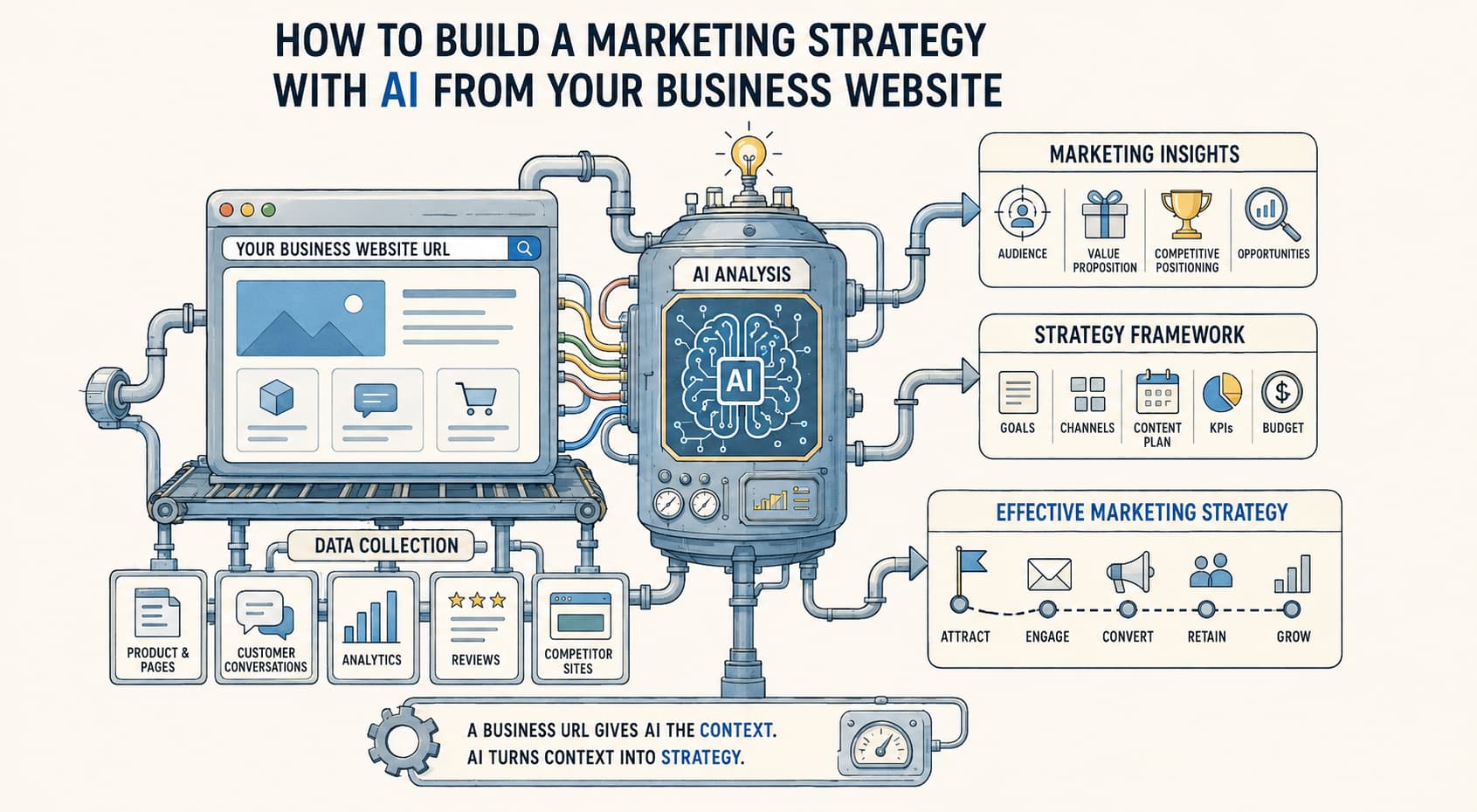
A business URL gives an AI system something concrete to work with. It can examine what you sell, how you describe the product, who you appear to be speaking to, which benefits you emphasize, and what you ask visitors to do. That initial picture can then be tested against market conditions, competitor activity, and customer evidence.
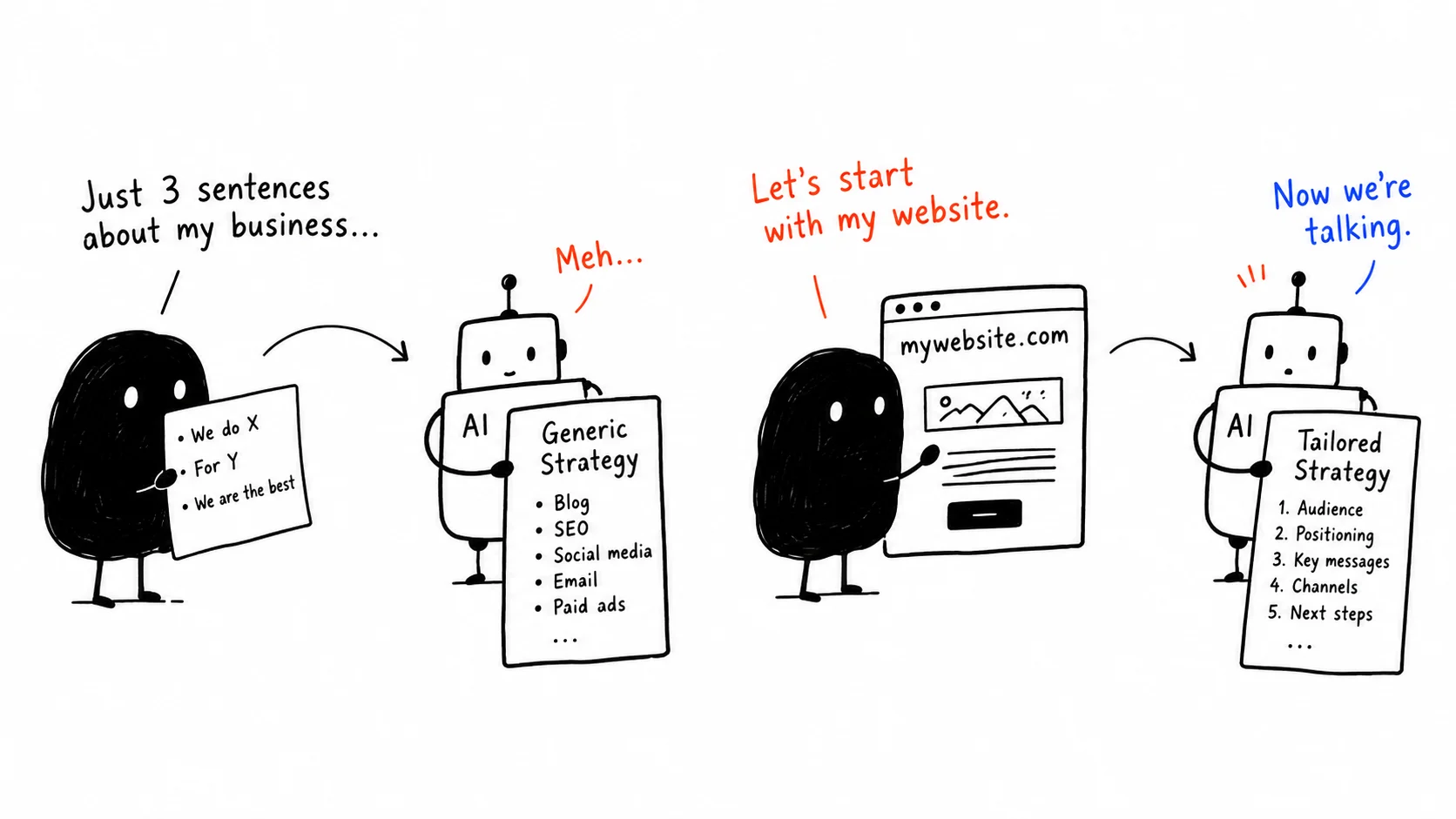
The result is not an instant strategy generated from a single URL. It is a faster way to build the context a useful strategy requires.
Here is what that process can look like in practice.
Can AI Build a Marketing Strategy From a Website?
AI can use a company website as the starting point for developing a marketing strategy. It can analyze the business, identify products and services, examine existing messaging, and form an initial hypothesis about the target audience and positioning. From there, it can examine competitors, market conditions, and customer problems before helping the team define strategic priorities.
There is an important limitation. A website only contains what the company has made public. It does not know which customer segment produces the highest margins, what the founder learned during last week’s sales calls, which feature will launch next quarter, or how much the company can afford to spend on acquisition.
A practical process might look like this:
Website analysis → market research → competitor research → customer evidence → positioning → marketing strategy → execution
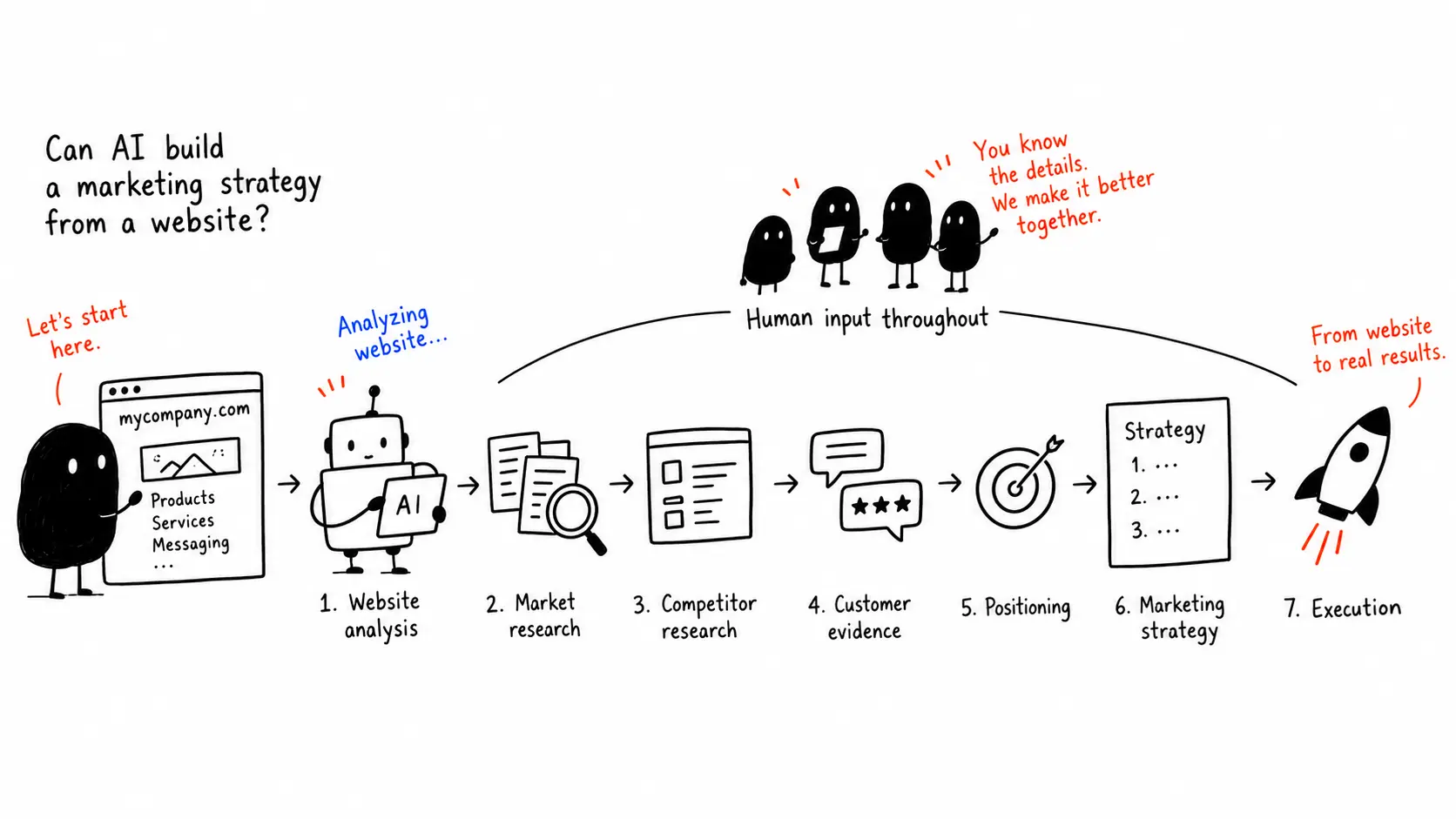
Human input belongs throughout the process. People need to correct inaccurate assumptions and make the strategic choices that research alone cannot make.
To see why this matters, consider a simple example.
Imagine a three-person SaaS company that has built scheduling software for independent consultants. The founders are preparing to launch and want to determine how to market it. They have a website, a product, and some early customer feedback, but no dedicated marketing team yet.
Instead of beginning with a blank prompt, an AI marketing system begins with the company’s website.
1. Analyze Your Website Before Choosing Marketing Tactics
The homepage calls the product an “AI-powered scheduling platform for modern professionals.” The feature pages describe automated scheduling, reminders, and calendar integrations. The pricing suggests that the company is targeting individuals and very small teams.
This provides a basic picture, but it also raises several questions.
“Modern professionals” is extremely broad. The product may have been built for independent consultants, but the homepage does not make that clear. “AI-powered” explains something about the technology, but it does not explain why a consultant should care. The website also emphasizes scheduling features that several established competitors already offer.
This is already more useful than asking AI for a generic marketing plan. Before suggesting a channel or campaign, the system has identified possible weaknesses in the way the company presents itself.
A website can provide much of this initial context through its product descriptions, pricing, customer stories, navigation, and calls to action. It can also reveal inconsistencies. The homepage may target one audience while the blog targets another. Product pages may emphasize convenience while customer testimonials repeatedly praise a completely different benefit.
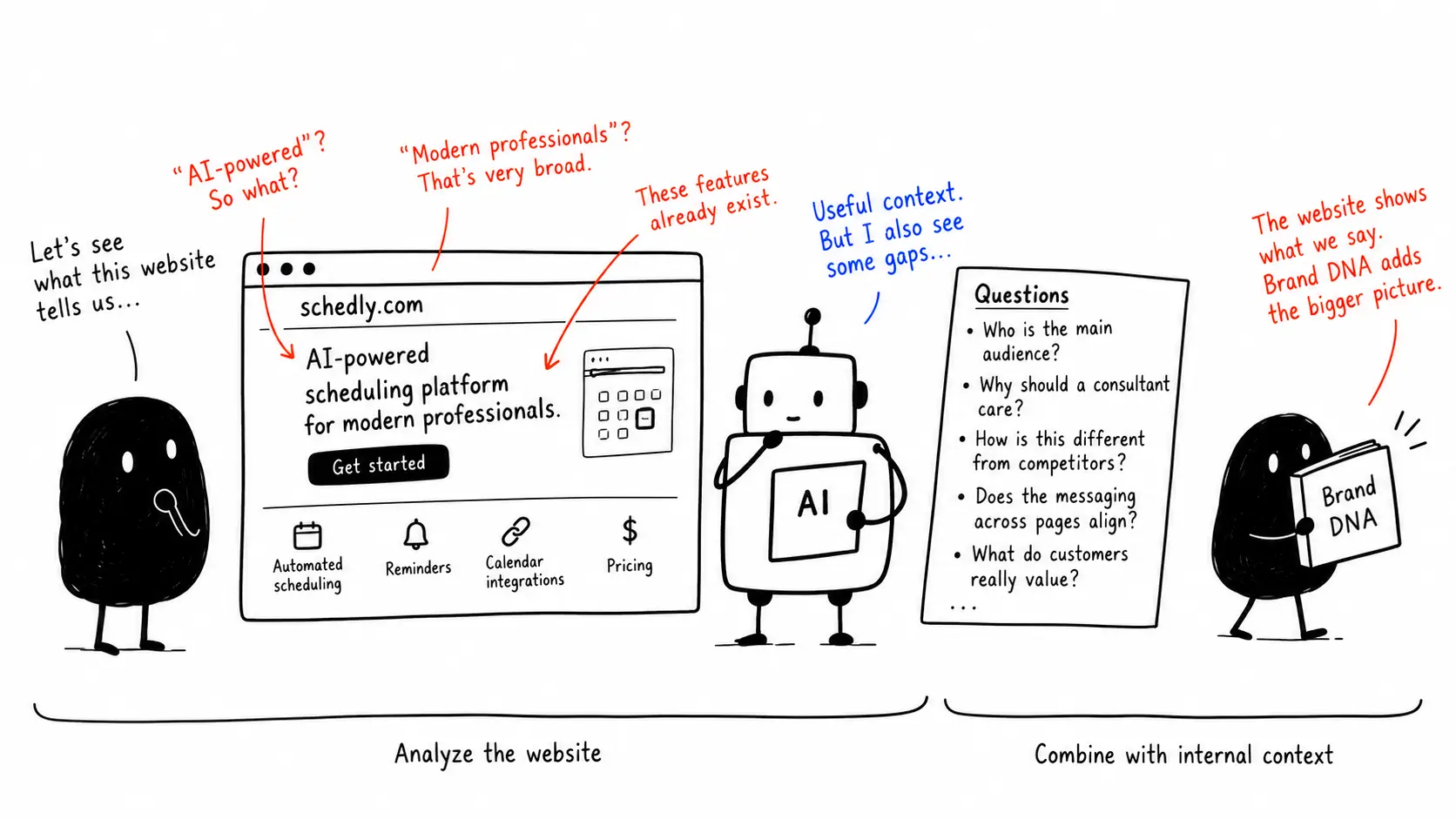
Some context will never be visible publicly. This is why documenting your Brand DNA becomes useful when AI is involved in marketing. The website tells the system what the company currently says. Brand DNA can add the context the company has developed around its audience, positioning, voice, and direction.
Once the initial business picture is reasonably accurate, the research can move beyond the company website.
2. Research Your Market Before Building a Marketing Strategy
Our hypothetical scheduling startup does not compete in a vacuum. Prospective customers already have ways to solve the problem, and some of those alternatives may be good enough.
Market research might reveal that independent consultants use Calendly, calendar features built into other software, virtual assistants, or manual processes to manage scheduling. It might also show that basic scheduling has become increasingly commoditized. If so, building the entire marketing strategy around “easy online scheduling” would place the company in a mature category dominated by larger competitors.
Customer behavior may reveal something more interesting.
Perhaps consultants are not particularly frustrated by the act of booking a meeting. Their real frustration may happen before and after the meeting. They may struggle to prepare for calls, follow up with prospects, remember previous conversations, and keep track of different client relationships.
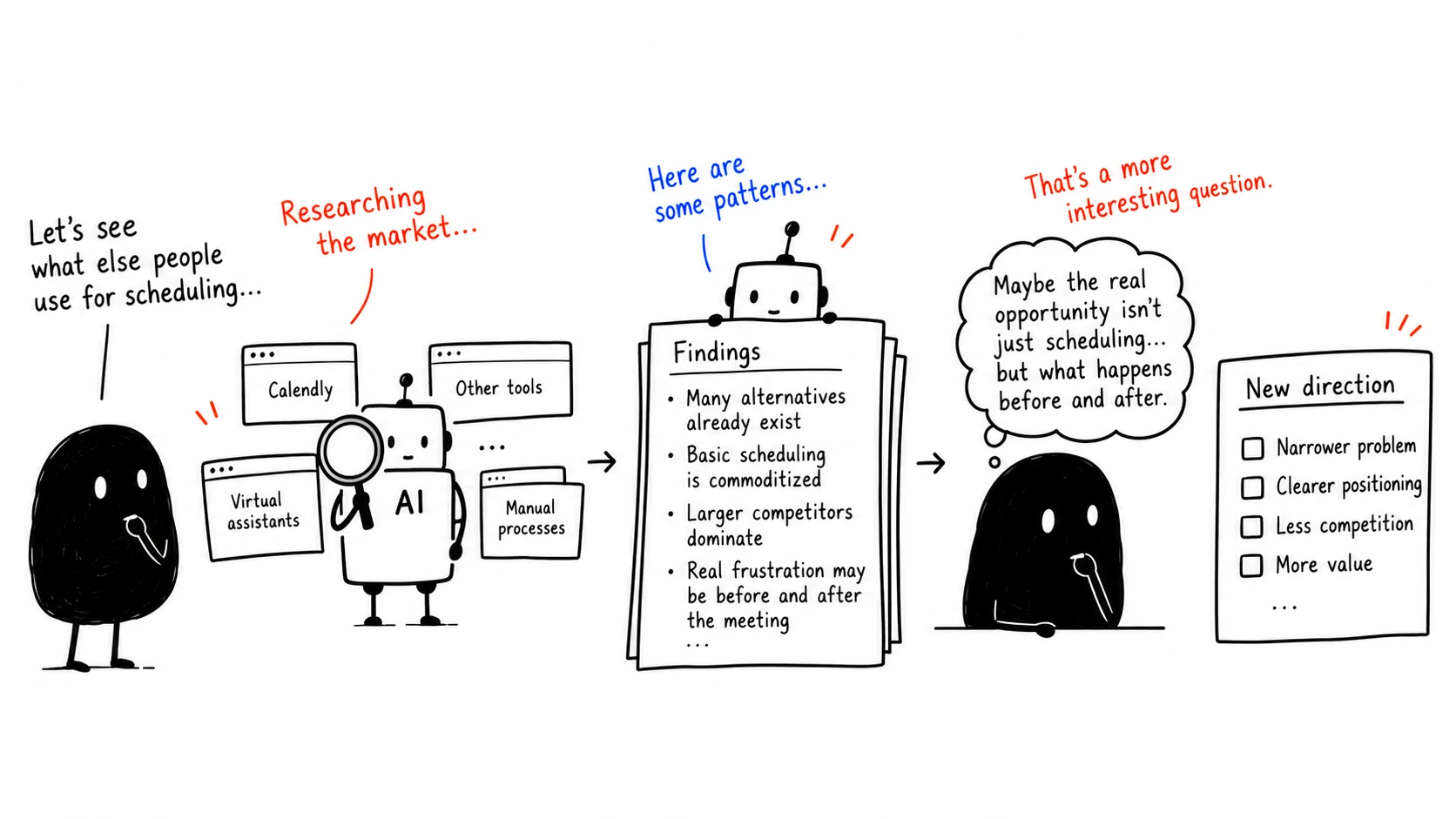
That changes the strategic question.
The company is no longer asking, “How do we persuade people that they need scheduling software?” Instead, it can ask whether there is a narrower and more valuable problem within the scheduling workflow that existing products do not address particularly well.
AI is useful here because it can collect and organize information from more sources than a small team could comfortably review by hand. The marketer still needs to decide whether a pattern is meaningful, but the initial research becomes faster.
3. Analyze Competitor Messaging, Not Just Features
Traditional competitor analysis often ends with a spreadsheet.
Company A has these features. Company B charges this much. Company C has more followers. Company D publishes three articles a week.
The spreadsheet may be accurate without being strategically useful.
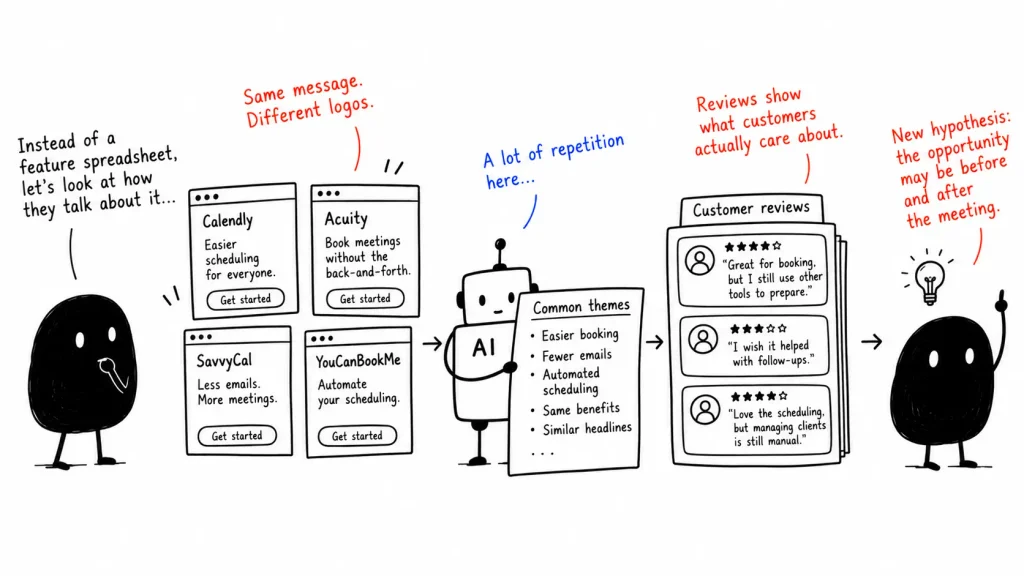
For our hypothetical scheduling company, a better analysis would examine how competitors describe the problem they solve. If most of them promise easier booking, fewer emails, and automated scheduling, those benefits define the existing category.
After reviewing several competitors, repetition usually becomes obvious. Similar headlines appear on different homepages. The same features are presented as differentiators. Even the language starts to converge.
This tells the startup that another version of the same message is unlikely to make a meaningful difference.
The analysis should also include customer reviews. A competitor’s homepage tells you what the company wants customers to value. Reviews can reveal what customers actually value and where they remain frustrated.
Our article on what competitor analysis can reveal about your own brand explores this topic in more detail. The most useful competitor research often teaches you as much about the customer and your own positioning as it does about the companies being analyzed.
Suppose the research shows that independent consultants like existing scheduling products but still rely on separate tools and personal reminders to prepare for meetings and manage what happens afterward.
Now the startup has a hypothesis worth investigating.
4. Find Customer Pain Points in Their Own Words
At this stage, it is tempting to ask AI to create personas.
That can be premature.
A persona called “Sarah, 38, independent consultant, enjoys podcasts and values productivity” does not tell us much about why Sarah would switch scheduling products.
Her circumstances are more useful.
Maybe she has 15 client calls each week. Before every meeting, she searches through emails and notes to remember what was discussed previously. After the call, she has to create a follow-up task manually. If she misses one step, a potential project can disappear into her inbox.
That is a marketing problem worth understanding because it is connected to a real cost.
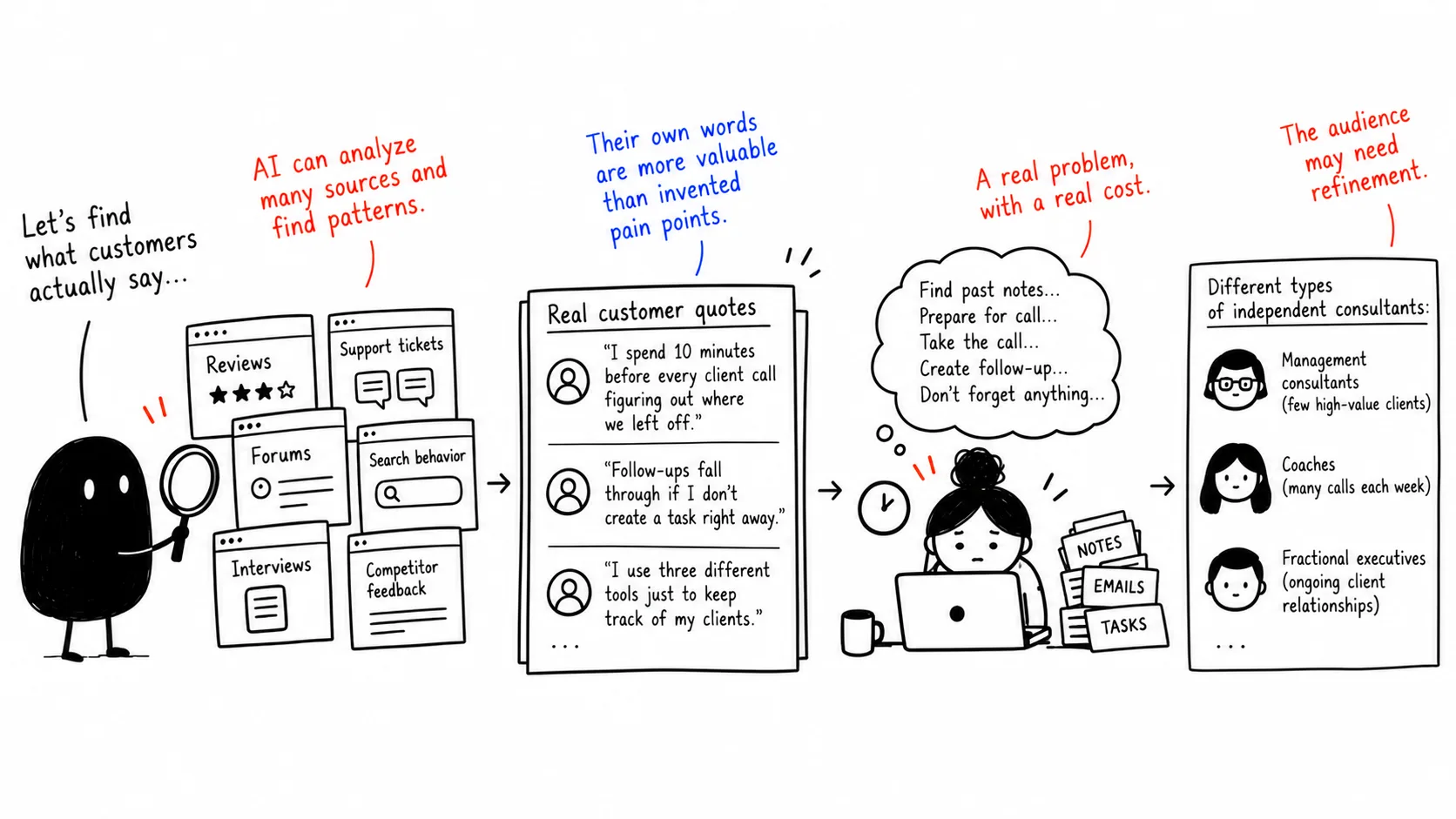
AI can help identify these patterns across customer reviews, support conversations, forums, search behavior, interview transcripts, and feedback about competing products. It can group similar complaints and show how often particular themes occur.
The wording matters. There is a significant difference between an invented pain point such as “busy consultants want to save time” and a recurring complaint such as “I spend ten minutes before every client call figuring out where we left off.”
The second statement gives the company something specific to investigate and eventually communicate.
We wrote more about this distinction in our guide to customer pain points. Strong marketing usually begins with a problem customers recognize immediately, rather than with a broad benefit a company hopes they will care about.
For the scheduling startup, the original audience may also need refinement. “Independent consultants” could include several groups with different needs. These might include solo management consultants with a small number of high-value clients, coaches with dozens of calls each week, and fractional executives managing several ongoing client relationships.
The company does not necessarily need to serve all of them at launch.
5. Use Research to Define Your Marketing Positioning
By now, the original website message, “AI-powered scheduling for modern professionals,” looks weaker than it did at the beginning.
That is useful progress.
The research suggests that basic scheduling is a crowded category. It also shows that “AI-powered” is not much of a differentiator and that the most interesting customer problem may exist before and after the meeting rather than during the booking process.
The company can now explore several positioning directions.
It could remain a general scheduling tool and compete on ease of use. It could specialize in independent consultants. It could position itself around reducing no-shows. Another option would be to broaden the category from booking meetings to managing the client workflow around each one.
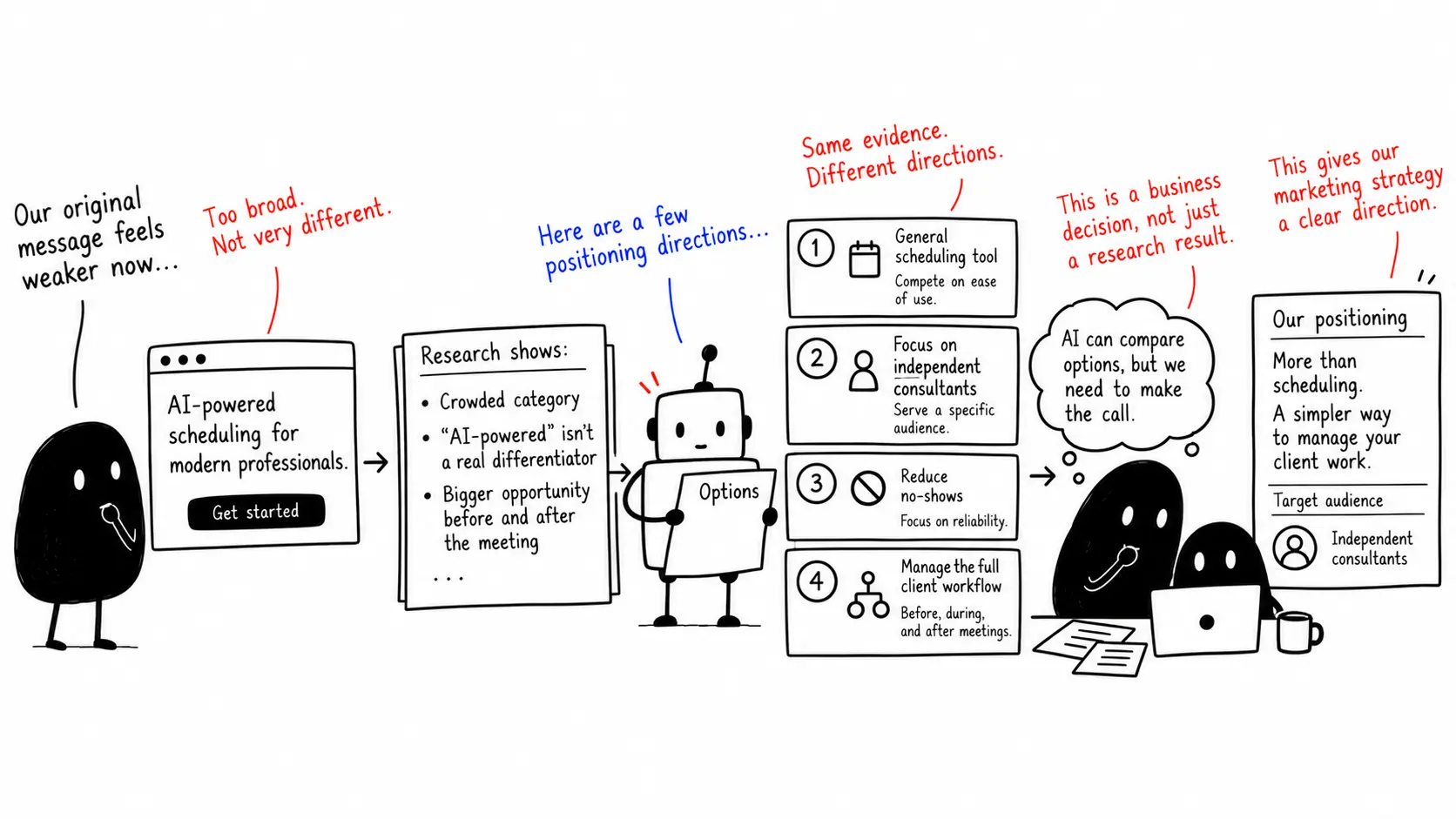
AI can help compare these options against competitor messaging and customer evidence. What it should not do is quietly choose one option and present the result as objective truth.
Positioning involves business decisions that research alone cannot make. The founders may have a product roadmap that strongly supports one direction. They may know from customer conversations that a particular segment is easier to acquire. They may deliberately choose a smaller market because the product can become more distinctive there.
The value of AI is that these choices can be made with a clearer view of the evidence.
Suppose our founders choose to focus on independent consultants and the work surrounding client meetings. That decision now gives the rest of the marketing strategy a clear direction.
6. Build Your Marketing Plan Around Your Positioning
Without clear positioning, content planning often starts with a keyword tool or a brainstorming session.
“What should we write this week?”
Once the company knows what it wants to be known for, that question becomes easier to answer.
The scheduling startup should probably not spend the next six months publishing generic articles such as “10 Productivity Tips for Professionals.” Those articles might attract traffic, but they would do little to establish the company’s point of view.
Its content could instead explore the problems surrounding client meetings:
- how independent consultants prepare for client calls;
- why meeting follow-up falls apart when client work becomes busy;
- the hidden administrative cost of managing recurring client relationships;
- scheduling tools compared with client workflow tools;
- how consultants can automate meeting preparation without losing context.
The same positioning influences search strategy, landing pages, product demos, partnerships, and social content.
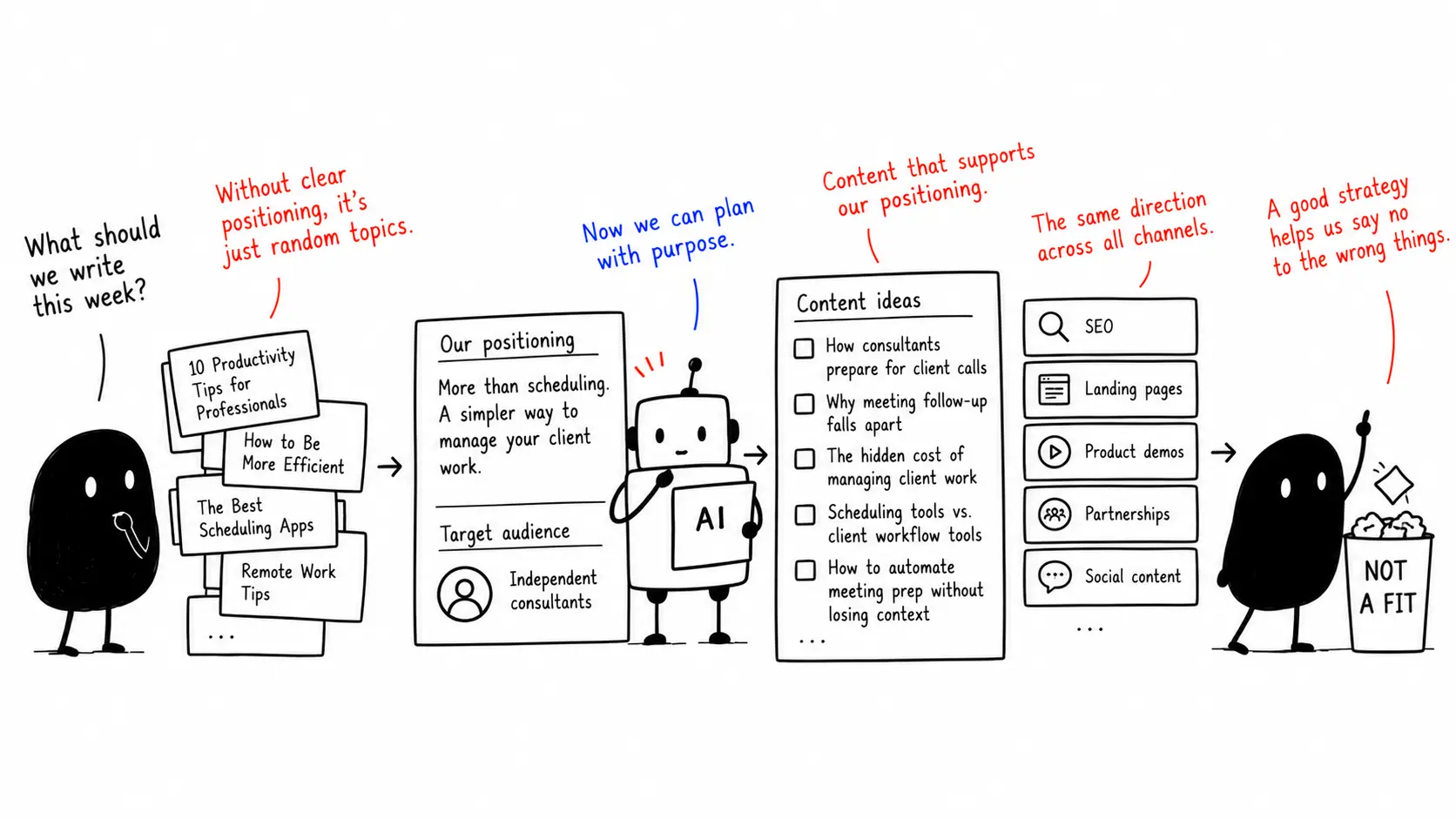
It also helps the company decide what not to do.
If the highest-priority audience is independent consultants, paying to reach every small business owner may be wasteful. If customers need to understand a new workflow before they appreciate the product, educational content and product demonstrations may deserve more attention than broad awareness advertising.
A strategy becomes useful when it starts eliminating options rather than endlessly producing new ones.
7. Connect Your Strategy to an AI Marketing Workflow
This is where the difference between using AI for individual tasks and using an AI marketing workflow becomes practical.
A general-purpose AI assistant can help with almost every stage described above. You can ask it to summarize a competitor, analyze reviews, propose positioning options, and create an editorial calendar.
The limitation is not what AI can generate. The limitation is what happens between those tasks.
Marketers still have to gather sources, move useful findings from one conversation to another, explain the business again, and ensure what they learned during competitor or customer research shows up later in positioning, content, and execution.
This creates a hidden cost: every new task risks starting with an incomplete version of the business context.
A connected AI marketing workflow approaches the problem differently. The website establishes the initial business context. Market and competitor research adds evidence. Customer insights refine the picture. Positioning decisions then become inputs for content, campaigns, and other marketing work.
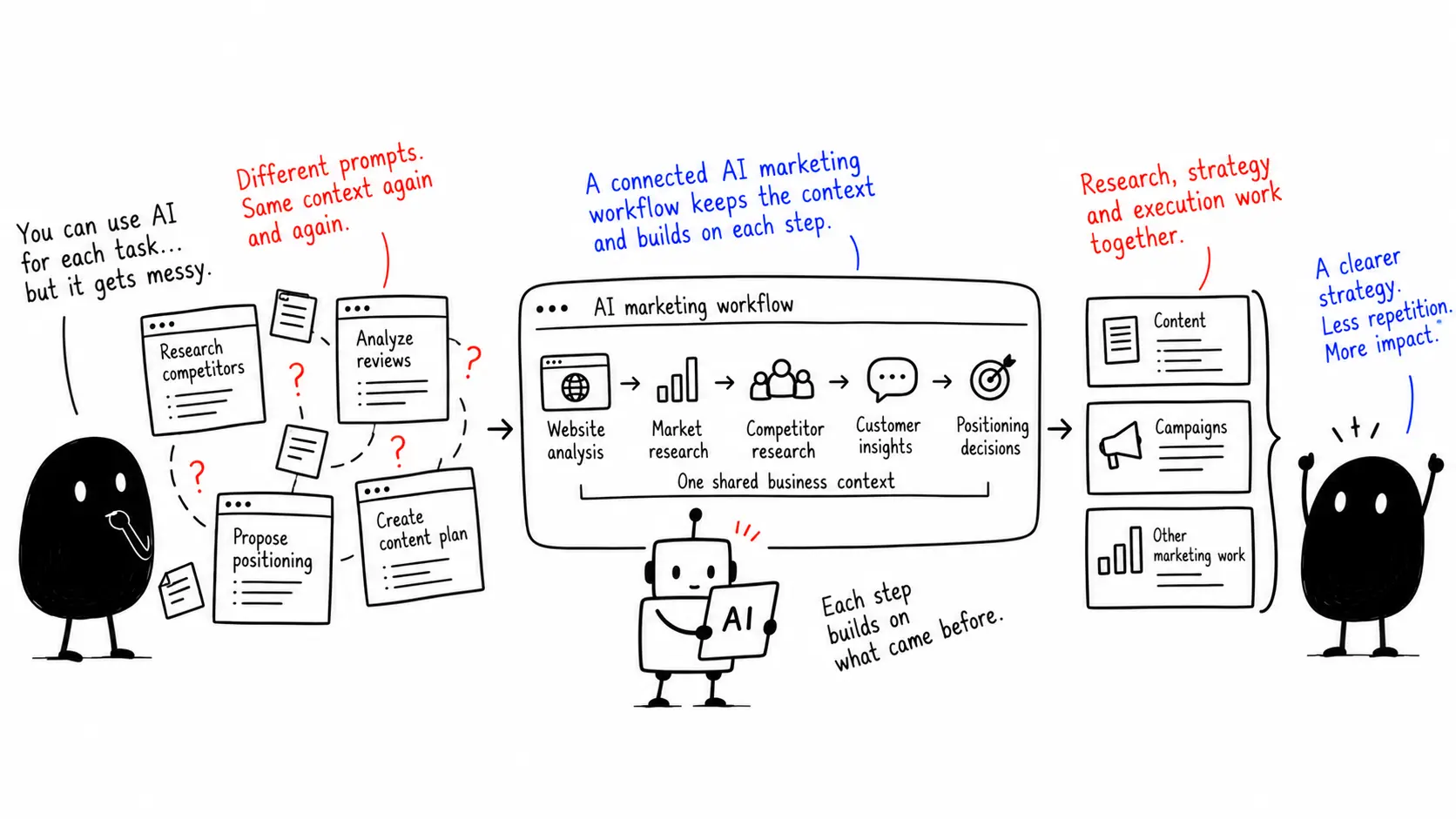
Instead of treating each AI request as a separate task, the workflow allows each stage to build on what came before.
This is the direction behind Nova Express, a platform we are currently developing to help teams carry business context through research, strategy, and execution.
If competitor research shows that the category is saturated with “easy scheduling” claims, that finding should remain available when the positioning is developed. If customer research shows that meeting preparation is the stronger pain point, the content workflow should factor that insight into its topic suggestions.
This is the operational idea behind AI marketing workflows. Research, creation, review, and execution become more valuable when they are connected rather than treated as unrelated AI tasks.
For readers who want to understand the broader difference between an agent and a conventional AI tool, our guide to AI marketing agents explains how agents can work across multi-step marketing tasks.
8. Prioritize Your Marketing Actions
A strategy can still fail if it produces dozens of sensible recommendations without establishing clear priorities.
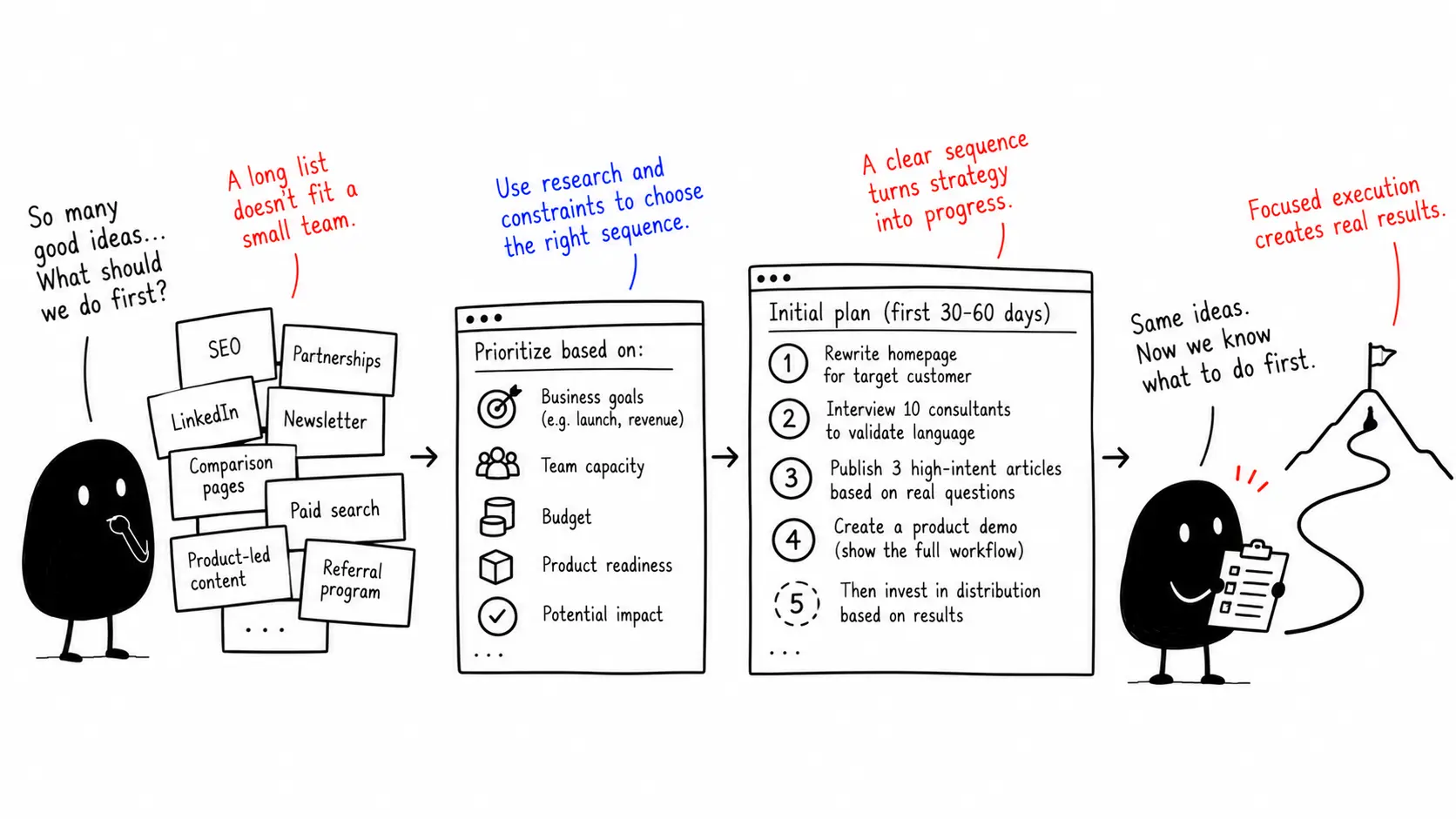
Our scheduling startup might now have ideas for SEO, partnerships, comparison pages, LinkedIn, a newsletter, product-led content, paid search, and referral programs.
A three-person company cannot execute all of these initiatives well.
The final stage is to turn the analysis into a sequence of prioritized actions.
The founders might decide that the first priority is rewriting the homepage around the new target customer and problem. Next, they could interview ten consultants to validate the language discovered during the research. The findings could then shape three high-intent articles and a product demonstration showing how the workflow works in practice.
Only after seeing how these messages perform would the company invest heavily in distribution.
For a business approaching launch, this sequencing becomes especially important. Our 30-Day Pre-Launch Content Sprint shows how research and customer questions can be turned into a publishing plan before the product becomes available.
AI can help rank potential actions, but priorities still depend on constraints that may not be visible in public data. These include budget, team capacity, product readiness, and the founders’ commercial goals.
What AI Should Not Decide in Your Marketing Strategy
There is a risk in presenting this process as more automatic than it really is.
A website may suggest that a company targets small businesses even though most of its revenue comes from mid-market customers. Public reviews may overrepresent customers who are either extremely happy or extremely frustrated. Search demand can show what people ask for without proving that they will pay for a solution.
AI also has no privileged access to the future. A market pattern found across competitor websites is evidence to investigate, not a guarantee that following it will produce growth.
The most useful division of work is practical.
Let AI handle more of the repetitive work involved in reading, comparing, organizing, and analyzing information. Let people correct the context, speak to customers, decide which trade-offs the company is willing to make, and judge whether the resulting position fits the business they are trying to build.
This still represents a significant change in how marketing strategy can be developed.
Research that once required opening dozens of tabs and manually copying findings into spreadsheets can increasingly become part of a connected workflow. A small team can examine more evidence before making a decision without turning strategy into a month-long project.
From a Business Website to a Working Marketing Strategy
Let’s return to our scheduling startup.
The process began with a broad message about “AI-powered scheduling for modern professionals.” After reviewing the website, market, competitors, and customer feedback, the founders saw a more specific opportunity around the client meeting workflow for independent consultants.
The research did not produce the strategy for them; it gave them better choices.
This is where AI becomes useful in marketing—not because it can write a strategy document quickly, but because it can help bring together the context needed to make better decisions.
A website can be the starting point. Market research, competitor analysis, and customer feedback add more context. Human judgment still decides what matters and what to do next.
This is the idea we are exploring with Nova Express: helping teams carry business context through research, strategy, and execution.
We believe AI marketing tools should begin with business context, not a blank prompt.
The better question is not “What can AI write for us?”
It is “What should we do next, and why?”
Frequently Asked Questions
Can AI create a marketing strategy from my website?
A website can give AI enough information to begin analyzing your business, including your products, messaging, apparent audience, and current positioning. A reliable strategy also requires external market and competitor research, customer evidence, and internal information that may not be available publicly.
What should AI analyze on a business website?
Useful inputs include homepage messaging, product or service pages, pricing, customer stories, calls to action, target audience language, and the way the company describes customer problems and outcomes. Contradictions between these pages can be as informative as the content itself.
Is an AI marketing agent different from ChatGPT?
The distinction is mainly about workflow. A general AI assistant responds to individual requests. An agent can be designed to work through several connected tasks, use tools, and retain relevant context as it moves toward a goal.
Can AI replace a marketing strategist?
AI can accelerate research, comparison, and analysis, but strategy requires business context and judgment that may not be present in the available data. Decisions about positioning, priority customers, budgets, risk, and brand direction should still involve people.
What is the biggest advantage of using AI for marketing strategy?
The strongest advantage is not faster document creation. It is the ability to process more context, connect findings across different stages of research, and reduce the manual work required to move from information to a prioritized marketing plan.
Nova Express Resources
If you are working on the same problems, these guides are useful next steps:
- What Is an AI Marketing Agent?
- AI Marketing Workflows: 7 Practical Examples for 2026
- Brand DNA: The Missing Piece Between Your Brand and AI
- What Competitor Analysis Reveals About You (Not Just Them)
- Customer Pain Points: Why Your Marketing Isn’t Working
- AI Marketing Workflows: 7 Practical Examples for 2026
About the author
Serafima Osovitny is a Marketing Manager at Nova Express, where she focuses on digital marketing, search visibility, content strategy, and marketing workflows. She writes practical guides that help marketing teams research their audiences, develop strategies, and put their plans into action.
Explore her work at serafima.digital and follow her on X: @OSerafimaA.








Great insights!