

Brand DNA is the documented foundation of your brand. Think of it as the operating system that guides every marketing decision, whether the work is done by an employee, a freelancer, an AI agent, or an AI system acting on your behalf.
In 2026, Brand DNA is no longer just a branding asset. It has become the context layer that aligns employees, freelancers, and AI systems around the same understanding of who you are, what you stand for, and how you communicate.
Without it, every freelancer guesses, AI systems default to generic outputs, and every campaign starts from scratch. Here’s what Brand DNA is, why it matters more than ever, and how to build it in an afternoon.
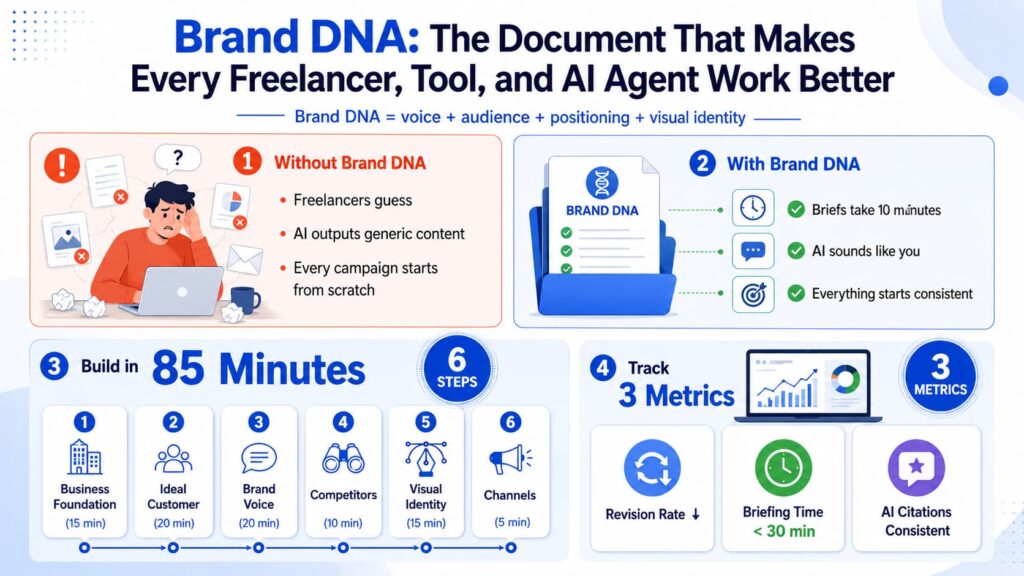
TL;DR: Brand DNA is a single document that captures your voice, audience, positioning, and visual identity. Without it, freelancers guess, and AI tools default to generic outputs that don’t reflect your positioning. Build it in 6 steps (85 min total) and track 3 metrics to know it’s working.
You’ve briefed the same freelancer three times on the same project. The first draft came back sounding like a corporate press release. The second came back too casually. The third was close enough that you rewrote it yourself and called it done.
That hour you spent rewriting wasn’t a creative problem. It was a documentation problem.
Brand DNA is the documented foundation of your brand. A structured set of core elements that defines who you are, who you serve, how you communicate, and what makes you meaningfully different in the market. When it exists, briefs take 10 minutes. When it doesn’t exist, every new hire, tool, or campaign restarts the same work from zero context.
Most brands don’t have it. Not because they’re lazy. Because nobody told them what not having it was actually costing them.
What Brand DNA Actually Is
The biological analogy holds: just as DNA contains the instructions that determine how an organism develops, Brand DNA contains the instructions that determine how your brand expresses itself across every touchpoint. The concept has been used in brand strategy for over 30 years. Peter Wilken, one of its earliest proponents, describes it as the core from which every brand decision should flow. His framework breaks Brand DNA into five components: your Role (why you exist), your Promise (what you commit to), the Benefit you deliver, your Culture and Spirit, and your Icons and Attributes.
The most useful test he applies to any Brand DNA is what he calls RCDC: Is your promise Relevant, Compelling, Differentiating, and, above all, Credible? The last one matters most. A brand that over-promises and under-delivers destroys trust faster than one that promises less and delivers consistently.
It is not:
- A logo
- A color palette
- A tagline
- A one-page brand brief
It is the combination of all the elements. Documented in one place. That makes your brand recognizable and consistent, whether the person producing work for it is your best writer, a new contractor, or an AI tool.
What Brand DNA contains:
Who you are. What you actually believe in and what you’d defend when someone pushes back. Not the values on the About page. The ones that shaped the last hard decision you made.
Who your customer is. Not their job title. Their situation is at the exact moment when something in their workflow stops working, and they realize they need a better system. What they’ve already tried, what they’re frustrated about, and how they’d describe the problem to a friend. The Customer Pain Points article shows why that specificity changes everything about how you write.
How you communicate. The words you reach for naturally and the ones that make you cringe when a contractor uses them. “We help you grow” and “We help solo founders build marketing systems that don’t require them to be everywhere at once” are both technically brand voices. One sounds like anyone. One sounds like someone.
What makes you different. The one thing that’s true about you that isn’t true about your closest competitor. Not a feature list. One thing. Stop Selling to People Who Don’t Know They Have a Problem explains why how you frame that difference matters as much as the difference itself.
What you look like. Colors, typography, and visual style. Specific enough that someone who has never seen your brand before can produce something that looks like it belongs.
When all of this lives in one place, everyone working on your brand is working from the same page. When it doesn’t, everyone makes it up as they go.
What Not Having It Actually Costs
Time
Every new contractor has to figure out your brand from scratch. They read your website, look at your past content, ask questions, make assumptions, and produce something that may or may not reflect what you want. You review it and give feedback; they revise. This cycle repeats for every new person on every new project.
Every briefing recreates context that should already exist as a shared system. You describe your tone in a Slack message. You explain your audience on a call. You add context in a comment on a draft. Multiply that by every campaign, every content piece, every asset.
Revisions compound. “This doesn’t sound right” is a complete brief when Brand DNA doesn’t exist. Every revision round pays twice for the same output.
Budget
Unusable content. When content is produced without proper brand guidance, a significant portion becomes unusable. Wrong tone, wrong audience, wrong angle. That’s the budget spent on output that gets deleted.
Lower performance from AI systems becomes obvious in a simple test. Ask any model to write a LinkedIn post about your product without brand context. Then provide positioning, audience profile, and voice guidelines, and repeat the same request.
The difference is usually immediate. The first version converges toward generic patterns shared across companies. The second reflects your positioning and tone and sounds distinctly like your brand.
AI systems don’t understand brands directly; they infer them from scattered signals. Without Brand DNA, those signals converge into generic patterns shared across most users of the same tools. With Brand DNA, they consistently reproduce your positioning, audience, and voice across content, recommendations, and decisions, resulting in higher alignment and better ROI across AI-driven workflows.
Slower brand recognition. Inconsistency has a compounding cost. When your LinkedIn sounds different from your email, which sounds different from your website, prospects notice. Not consciously, but as a vague sense that they can’t trust you yet. That mistrust costs sales in ways that never show up in an attribution report.
Research on brand consistency found that it can increase revenue by up to 23% (Lucidpress, State of Brand Consistency Report). The specific number is debatable. The direction is obviously true.
The Core Components
Business foundation
The basics: what you do, who you serve, and the one thing that makes you worth choosing over the alternative. Most founders can say all three out loud. Almost none have written them down in one place.
Ideal customer profile
This is where most brands go wrong. An ICP isn’t demographic information (“B2B SaaS companies with 10–50 employees”). It’s behavioral and situational.
❌ “Our customer is a marketing manager at a mid-size company.”
✅ “Our customer spent last Sunday writing Instagram posts that got only four likes. They know they need a system. They’ve tried hiring a VA, tried three scheduling tools, and still feel like they’re behind. They want to feel in control of their marketing without it consuming their weekends.”
When the ICP is documented as in the second example, the content and copy practically write themselves.
One real example worth knowing: Oatly printed their brand guide as a physical wooden book and gave one to every employee, from the CEO to the cleaning crew. The point wasn’t the format. It was that everyone who touched the brand understood it the same way. You don’t need a wooden book. You need the same clarity. The fastest way to build an accurate ICP is from your customers’ own words. Customer Pain Points: Why Your Marketing Isn’t Working shows exactly where to find them.
Brand voice and tone
Voice is who you are. Tone is how you adjust for context.
Your brand voice might be direct, pragmatic, and slightly irreverent. That stays consistent across a blog post, an email subject line, a social caption, and a product description. The tone shifts. More formal on a pricing page, more conversational in a newsletter. But the underlying voice is the same.
Documented brand voice includes:
- Five words or phrases you use consistently
- Five words or phrases you never use
- Three example sentences that demonstrate the voice
- How tone shifts across contexts (email vs. social vs. support)
Competitor landscape
Who you’re competing with and how you’re positioned relative to them. Not to be negative about competitors. To know where you stand so your messaging can occupy a clear, differentiated position in the market. 6 Psychology Triggers That Make People Share Your Brand shows why distinctiveness is a precondition for everything else. Shareability, memorability, and trust.
Visual identity
Colors (hex codes), typography, and logo usage. Documented specifically. “We use blue” is not documentation. “#3B82F6, primarily on CTAs and headlines, never as background on body text” is documentation.
How It Saves Time in Practice
Briefing new contractors: Instead of a 30-minute onboarding call for every new person, you share the Brand DNA document. They read it. The first draft is close.
Reviewing work: When something comes back wrong, you point to a specific section instead of giving subjective feedback. “The voice in this paragraph doesn’t match section 3 of our Brand DNA” is faster to act on than “It just doesn’t feel right.”
Training AI tools: This is an increasingly critical application. AI marketing agents. The kind that runs competitor research, generates content recommendations, or analyzes your social performance. Produce aligned output when they have brand context and statistically average output when they don’t. Brand DNA is exactly that context. It’s what unlocks the difference between an AI tool that sounds like everyone else and one that sounds like you.
Making faster decisions: “Should we take this tone in this campaign?” becomes answerable in 30 seconds when you’ve already documented what your voice is and isn’t.
How to Build Yours This Week
You don’t need a brand agency. You don’t need six weeks. Here’s the minimum version that actually works, built in an afternoon.
Step 1. Business foundation (15 min)
Company name, industry, what you do, who you serve, and your USP. One or two sentences each. Capture, don’t polish.
Step 2. Ideal customer (20 min)
Write a paragraph describing your best customer: their role, their specific problem, what they’ve already tried, and what success feels like to them. Then list the exact words they use to describe their problem. Use their language, not yours.
Step 3. Brand voice (20 min)
Write three sentences that sound exactly like your brand. Then write three sentences that are the opposite. The voice you’d never want. List five words you use often and five you never use.
Step 4. Competitors and positioning (10 min)
List 3–5 competitors. For each, write one sentence on how you’re different. This forces you to articulate what makes you worth choosing instead of them.
Step 5. Visual identity
Colors (hex codes), typography, and logo usage rules. If this isn’t documented anywhere, it’s worth the extra 20 minutes. It’s the most frequently referenced component.
Step 6. Channels and approach
Where you show up, how often, and what you publish. One paragraph is enough.
When this is done, put it somewhere everyone can access. A shared document, a team wiki, or a platform that your tools can reference directly. The format matters less than making it accessible and keeping it current.
Nova Express stores your Brand DNA at the center of every AI agent, so every research run, every content draft, and every insight starts from who you actually are. Follow our launch →
How Much Do You Actually Need?
Not everyone needs the same document.
Solo founder working alone: One page. Brand voice, ICP, three competitors, and USP. That’s it. Done in 90 minutes. The point is having something written down, not having something comprehensive.
Small team with freelancers: Full document across all six components. Without it, every new person you bring in starts from scratch. With it, the first draft is almost always close.
Team using AI tools and agents: Everything above, plus documented tone examples your AI tools can reference directly. The quality gap between a well-briefed AI and a generic one is almost entirely explained by what’s in the brand context.
Brand DNA and AI: Why It Matters Now
AI tools that generate content, suggest social posts, analyze competitors, or run SEO research all produce better output dramatically when they have brand context. The gap between generic AI output and brand-accurate AI output is almost entirely explained by the quality of the brand information provided.
Without Brand DNA, every AI system optimizes for average language instead of your positioning. The result is output that sounds like every other brand using the same tool. With Brand DNA, the same systems produce content that reflects your voice, positioning, and way of thinking, and it sounds recognizably like you.
This is why the better AI platforms ask for brand context before they do anything else. Not as a nice-to-have. As a requirement. The AI can analyze your market, research your competitors, and draft your content. But only if it knows who it’s working for.
And as AI search changes how brands get discovered, ChatGPT recommends tools, and Perplexity cites sources. AI Overviews replace the first page of Google; brand consistency isn’t just a marketing concern anymore. As How AI Search Decides Which Brands to Show in Answers explains, AI engines cite brands they recognize. Recognition comes from consistency. Consistency comes from documentation. Documentation is Brand DNA.
How to know it’s working: Three signals to track. First, the revision rate is the number of edits a contractor or AI tool needs before their output is usable. If it’s dropping, the Brand DNA is doing its job. Second, briefing time: how long it takes to onboard a new person or set up a new tool. If it’s under 30 minutes, you have a working document. Third, AI citation consistency: if you’re checking how your brand appears in ChatGPT or Perplexity answers, consistent descriptions across queries mean the brand signal is clean.
Brand DNA and AI Search Visibility
As AI-powered search becomes more common, consistency matters beyond your own channels.
Systems like ChatGPT, Perplexity, and Google AI Overviews construct brand understanding from distributed public signals. For a practical breakdown of how these systems decide what to show, see GEO vs SEO vs AEO: What’s the Difference and Where to Start in 2026. When your website, blog, social profiles, and third-party mentions are inconsistent, these systems resolve contradictions by collapsing them into a generic identity.
Strong Brand DNA does not just improve consistency. It removes interpretation from the system entirely, ensuring that every output, whether human or AI, starts from the same definition of who you are.
In practical terms, Brand DNA ensures consistency in how your brand is recognized by people and described by AI systems.
FAQ
What is the difference between Brand DNA and a brand style guide?
A style guide covers visual identity: colors, fonts, and logo usage. Brand DNA includes all of that plus voice, values, audience, and positioning. A style guide is one component of Brand DNA, not a substitute for it.
How long does it take to create?
Two to four hours for the core. You can always go deeper later, but done beats perfect.
How does Brand DNA work with AI tools?
AI tools use Brand DNA as context for generating content and making recommendations. The more complete your Brand DNA, the more on-brand the AI output. Many platforms now treat it as a required setup step. Without it, the AI has no basis for producing brand-specific work.
Nova Express uses Brand DNA as the foundation for its AI agents. Follow our launch →
Related articles
- How to Use AI to Build a Marketing Strategy From Your Website
- How AI Search Decides Which Brands to Show in Answers
- 6 Psychology Triggers That Make People Share Your Brand
- What Is an AI Marketing Agent?
- What Is AEO?
- What Competitor Analysis Reveals About You (Not Just Them)
- What Is Generative Engine Optimization?
- The 2026 Marketing Audit
- What Are AI Tokens? A Marketer’s Guide to Context, Cost, and Limits
- Best AI Video Generators for Marketers in 2026
- What Are AI Tokens? A Marketer’s Guide to Context, Cost, and Limits
About the author
Serafima Osovitny is a Marketing Manager at Nova Express, where she focuses on digital marketing, search visibility, content strategy, and marketing workflows. She writes practical guides that help marketing teams research their audiences, develop strategies, and put their plans into action.
Explore her work at serafima.digital and follow her on X: @OSerafimaA.







Leave a Comment