

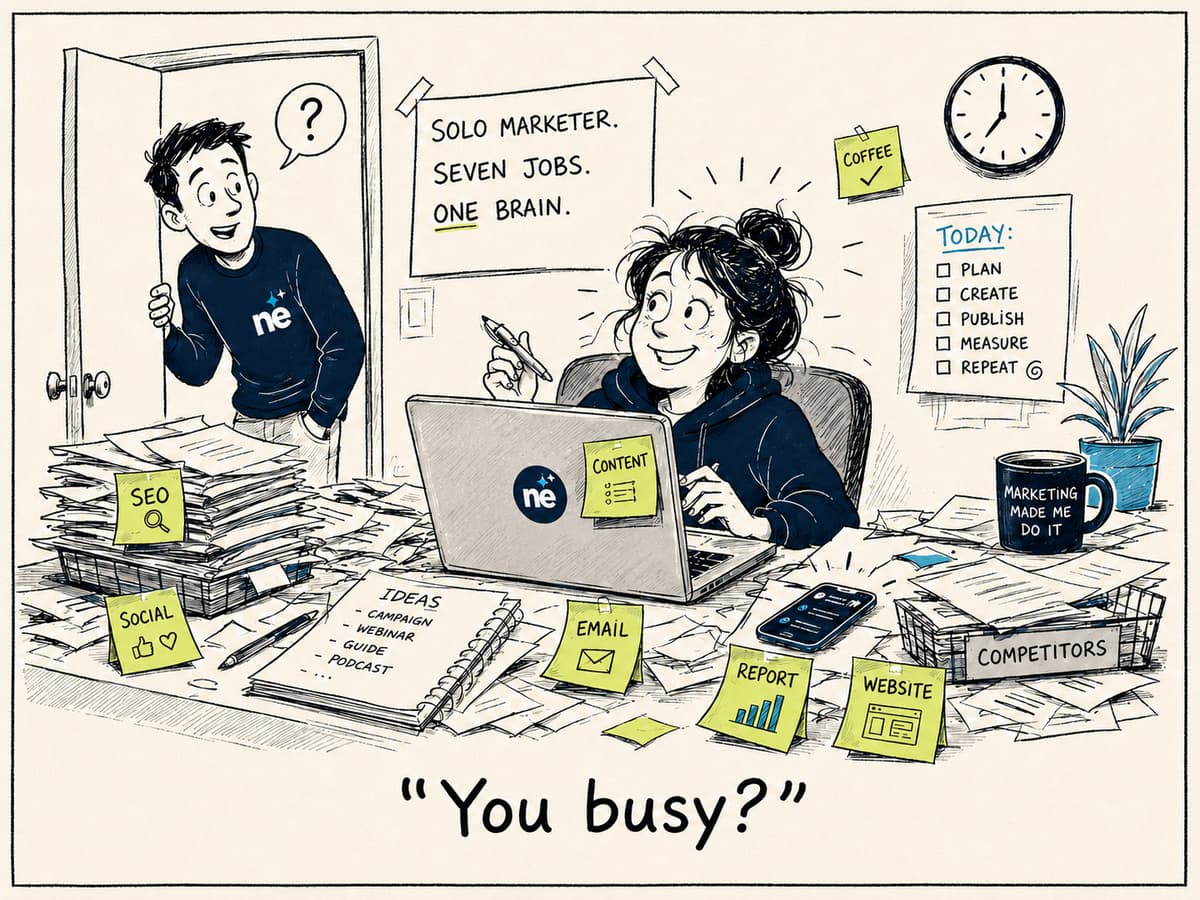
When one person owns SEO, social media, email, content, reporting, website updates, competitor research, and whatever becomes urgent that morning, the problem is rarely a lack of things to do. The real problem is deciding what deserves attention first.
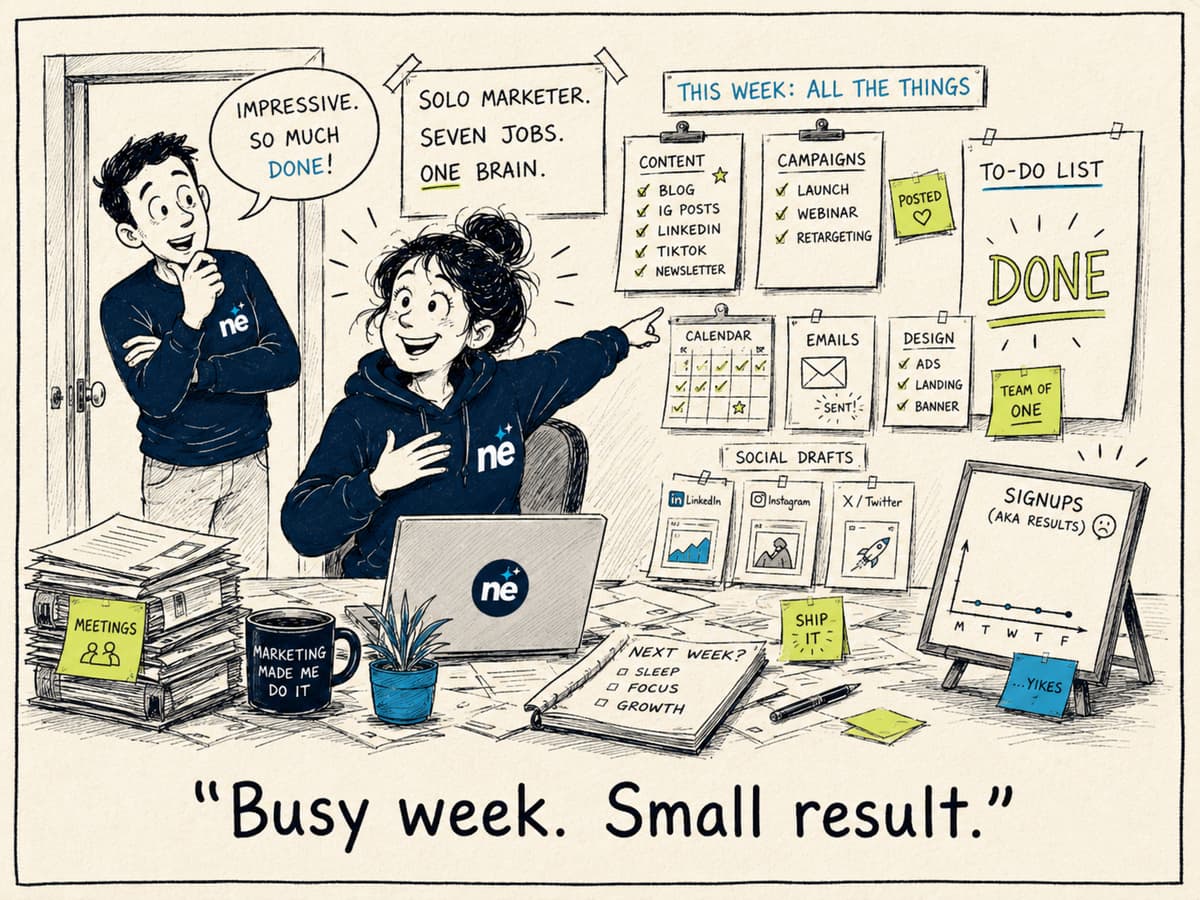
A solo marketer can finish an exhausting week with a full social calendar, a newsletter sent, several pages updated, and a report delivered—yet still wonder whether any of it addressed the problem that mattered most. As a marketing team of one, you collect the evidence, decide what matters, choose the channel, do the work, and explain the results.
The instinctive fix is to become more productive: build a better calendar, batch content, automate repetitive tasks, or try another project management tool. These changes may make the week easier to manage, but they avoid the harder question:
What is worth your limited attention right now? For a marketing team of one, the more useful move is to stop prioritizing by channel and start prioritizing by constraint.
Why Marketing Keeps Generating False Priorities
Marketing has an unusual talent for producing work that feels urgent and reasonable. There is always a campaign that could be sharper, an article that could go out, an email worth rewriting, a landing page worth testing, or a channel worth trying. Most of those ideas are perfectly reasonable on their own. They just all compete for the same limited hours.
A small SaaS company may already have steady website traffic but very few trial signups. If visitors leave without understanding why the product matters, the real issue is probably positioning, proof, or the path to conversion.
More traffic just sends more people into the same weak experience. Being busy and making progress are two different things, and a full week doesn’t guarantee the second one.
The better question isn’t “What should we do with SEO this month?” It’s “Where is growth actually getting stuck?” Once that becomes clear, the right activity is usually much easier to name.
Start With the Business Constraint, Not the Channel Calendar
Many solo marketers build their week around channels because channels are easy to schedule. Content gets a day, social gets a day, email gets a slot, and reporting gets pushed to Friday. That structure helps with execution, but it quietly assumes every channel deserves roughly equal attention. They usually don’t.
Four businesses might all use SEO, email, social, and paid acquisition, yet need completely different priorities. One may need more qualified traffic, another stronger messaging and a better conversion path, a third better lead follow-up, and a fourth improved retention or referrals.
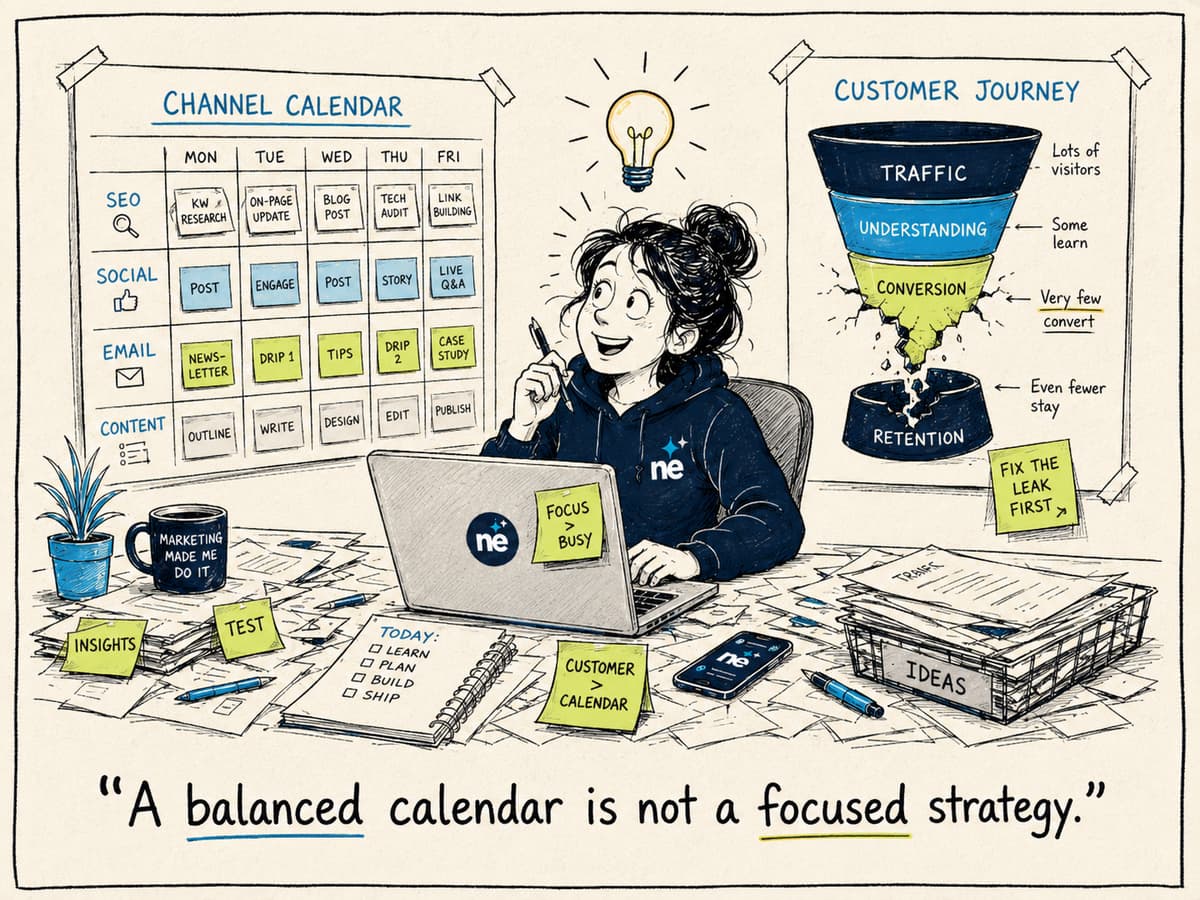
A balanced marketing calendar is not the same thing as a focused marketing strategy. If you’re not sure where your own weakness sits, our 2026 Marketing Audit walks through audience, channels, competitors, content, and measurement so you can find the leak before deciding what deserves more effort.
Find Evidence Before You Call Something a Priority
“We need more content” sounds like a priority, but it is really a proposal. Look for evidence in customer conversations, search behavior, sales objections, reviews, campaign performance, competitor changes, social discussions, and website behavior. No single source has to prove the case; what matters is whether several signals point in the same direction.
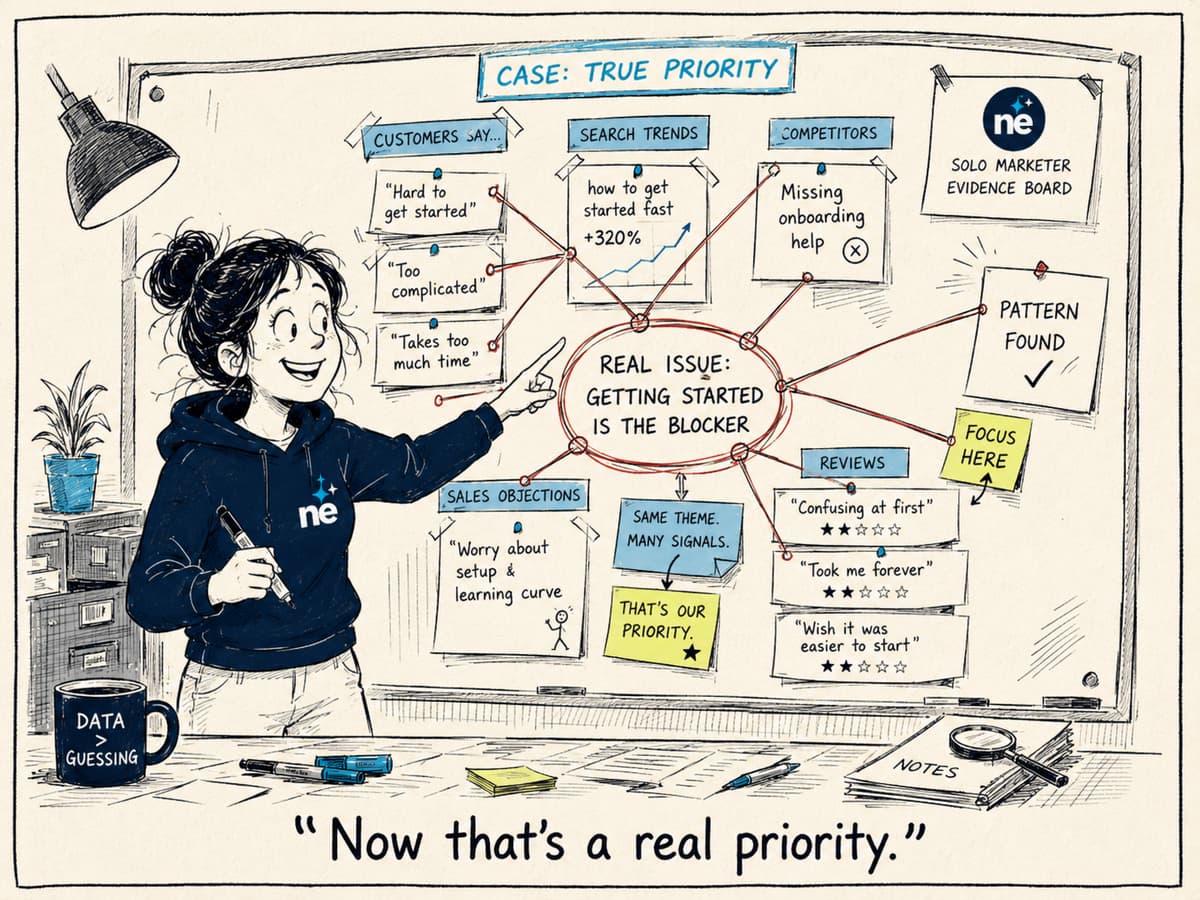
If customers keep describing the same frustration, people are actively searching for solutions, and competitors barely address the problem, it’s usually worth pursuing.
This is also why customer research pays off disproportionately for a solo marketer. Our guide to customer pain points looks at how real customer language usually surfaces the actual problem faster than internal marketing terminology does.
Ask Where Momentum Disappears
Once a problem has real evidence behind it, the next step is finding where it hits the business. This doesn’t need a sophisticated attribution model. A few questions usually tell you enough: Are the right people finding you? When they arrive, do they understand what you offer? Do they take the next step? Do leads keep moving or stall? Do customers stay, return, or recommend you?
Suppose, hypothetically, that a site gets 20,000 visits a month and almost nobody starts a trial. Pushing traffic up another 20 percent is probably less valuable than figuring out why the visitors you already have aren’t converting. Now flip it: the site converts well, customers are happy, and sales calls go smoothly, but very few new people ever discover the company. That’s a distribution problem, not a conversion one.
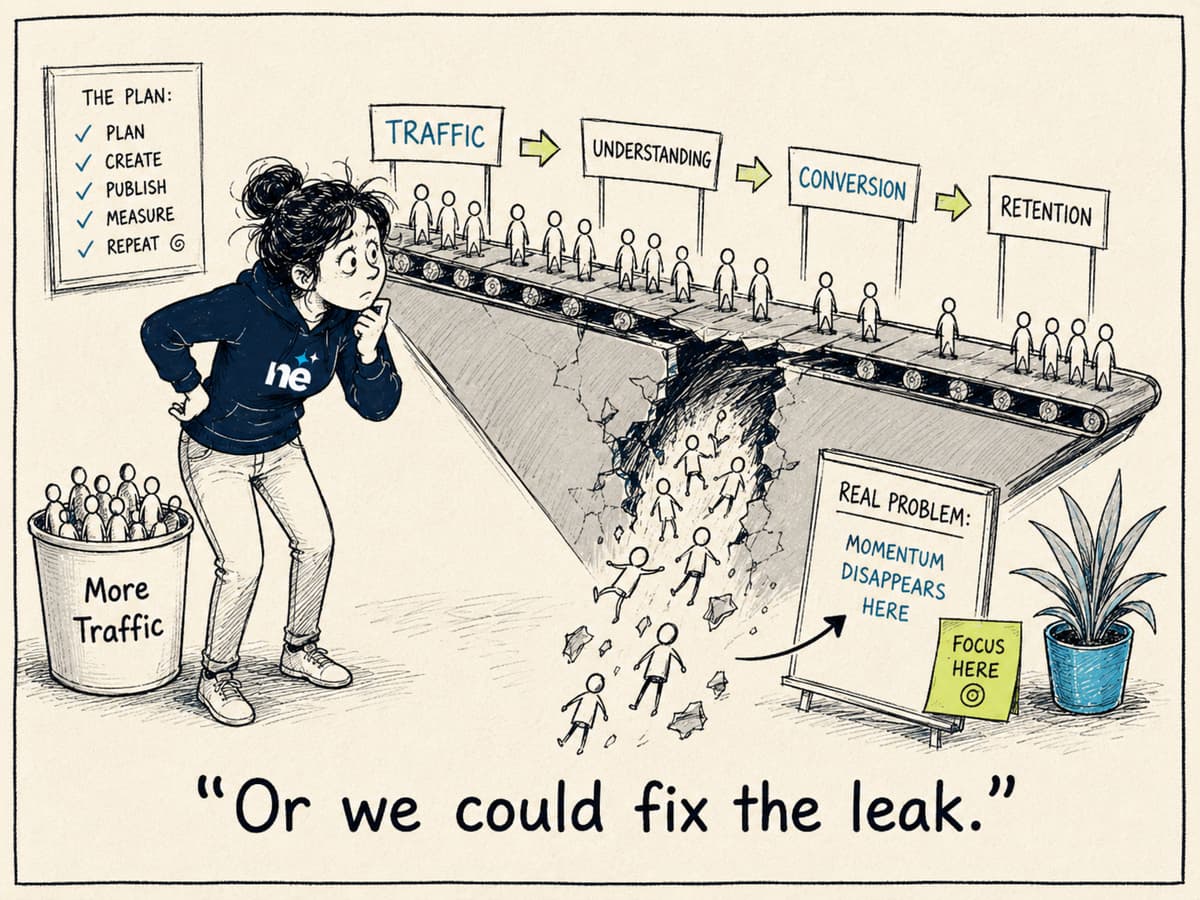
The same SEO project could help solve a distribution problem but become a distraction when conversion is the real issue. Generic advice like “invest in SEO,” “post more,” or “start a newsletter” can each be useful, but only under the right condition, and that condition is exactly what most generic advice leaves out.
Choose the Smallest Move That Can Test the Constraint
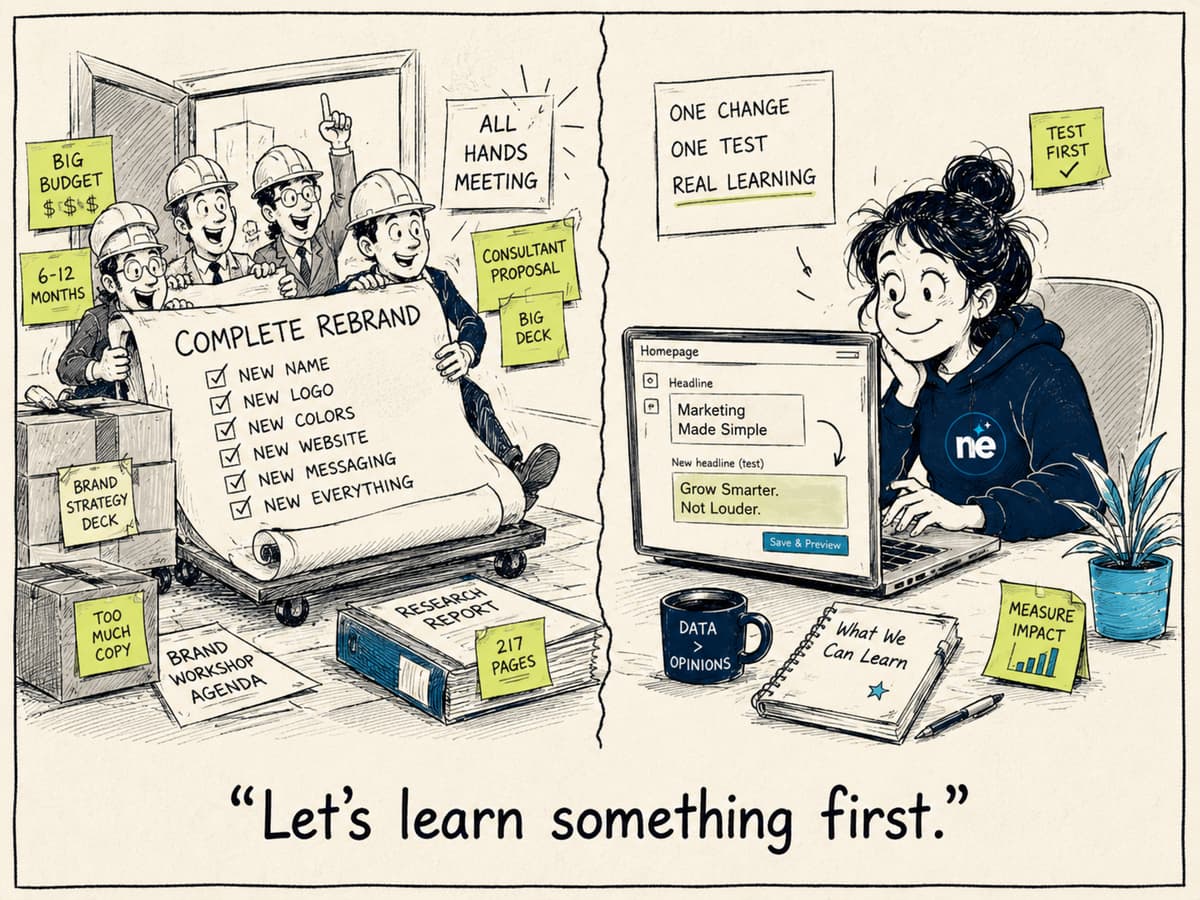
Once a real problem gets identified, the proposed fix often grows too big too fast. Weak positioning turns into a full rebrand. Low organic visibility turns into a six-month content plan. A weak email sequence becomes a lifecycle rebuild from scratch.
Big projects sometimes make sense, but they’re an expensive way to test an assumption. For a marketing team of one, smaller diagnostic moves usually pay off faster. If prospects don’t understand the product, rewrite the one section of the homepage that’s doing the most damage before redesigning the whole site. If the same objection keeps surfacing in sales conversations, build one strong page addressing it before planning a thirty-article content cluster. If one acquisition channel is already producing qualified visitors, strengthen that channel before opening three new ones.
The question isn’t only “What should we fix?” It’s also “What’s the smallest action that would tell us whether we’re right?” That habit keeps a solo marketer from sinking weeks into an idea that sounded convincing in a meeting but had almost no evidence underneath it.
Some Channels Should Be Neglected on Purpose
This is uncomfortable, especially when a company expects the marketer to “be everywhere.” But one person can’t give every channel equal attention and still do any deep work. Trying to maintain everything at once produces a familiar pattern: a little LinkedIn, email, SEO, paid activity, and social experimentation. Every channel gets enough effort to require upkeep, but not enough to become effective.
A better approach is picking one or two channels tied directly to the current constraint. If buyers actively search for the problem you solve, SEO may deserve outsized attention. If the category is new and customers don’t yet know what to search for, communities, partnerships, outbound, or social distribution likely matter more. If awareness is already solid but conversion is weak, adding another acquisition channel is close to the least useful thing you could do with the month.
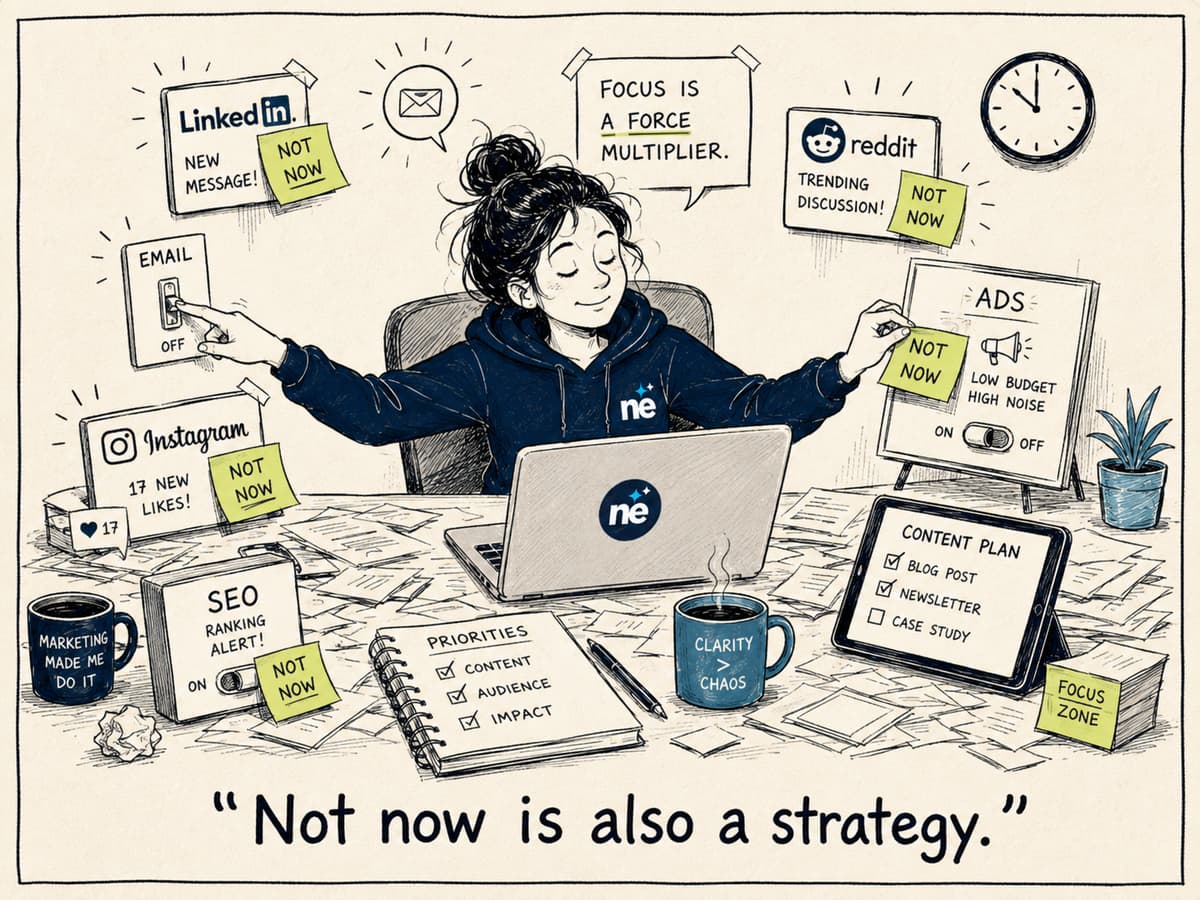
Focus doesn’t mean permanently walking away from everything else. It means accepting that marketing priorities have seasons: a channel worth heavy investment this month might deserve very little three months from now, and that’s adaptation, not inconsistency.
Separate Growth Work From Marketing Maintenance
Part of why solo marketers struggle with priorities is that important work and routine work sit on the same task list. Campaigns need monitoring, reports need to be built, links need checking, posts need scheduling, and information needs updating. All of it is legitimate work.
But none of it should have the same claim on your attention as work that could actually change the system. A simple distinction helps here: Growth work changes the system; maintenance work keeps it running. Without that separation, maintenance quietly eats the week because it arrives in small, reasonable pieces. Answer a request, update a dashboard, schedule a post, fix a link, check a campaign, and the day is gone. Nothing went wrong, and you were productive, but there’s no time left for work that could materially improve the result.
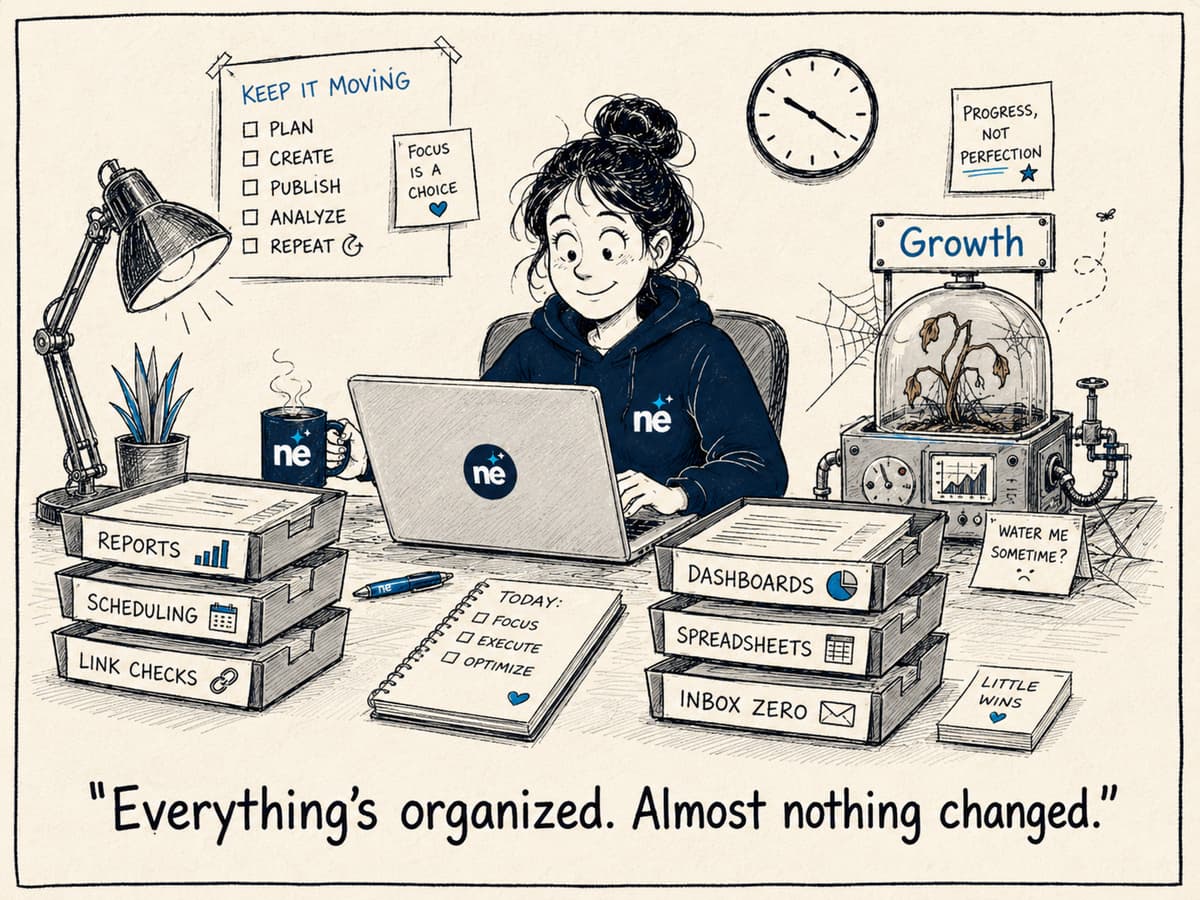
The fix isn’t to stop maintaining marketing. It’s to make the maintenance cheaper. Some tasks can be templated, some scheduled, some automated, and increasingly, parts of research and monitoring can run without someone manually checking every source. The goal is keeping your best hours available for judgment, not for upkeep.
Use AI to Watch the Market, Not Just to Produce More Content
The easiest AI use case in marketing is content creation. That saves time, but it also makes it easier to produce work that should never have existed. Ten content ideas are useless if none connect to a real customer problem, and five campaign concepts cannot fix unclear positioning.
The more interesting use of AI for a solo marketer is monitoring rather than production. It can help organize customer feedback, summarize meaningful competitor changes, group related search questions, surface recurring conversations, and flag patterns worth a closer look while the marketer is doing something else entirely. Writing for Think with Google, Jim Lecinski argues that AI is moving marketing away from isolated campaigns and toward systems that continuously sense and respond to change.
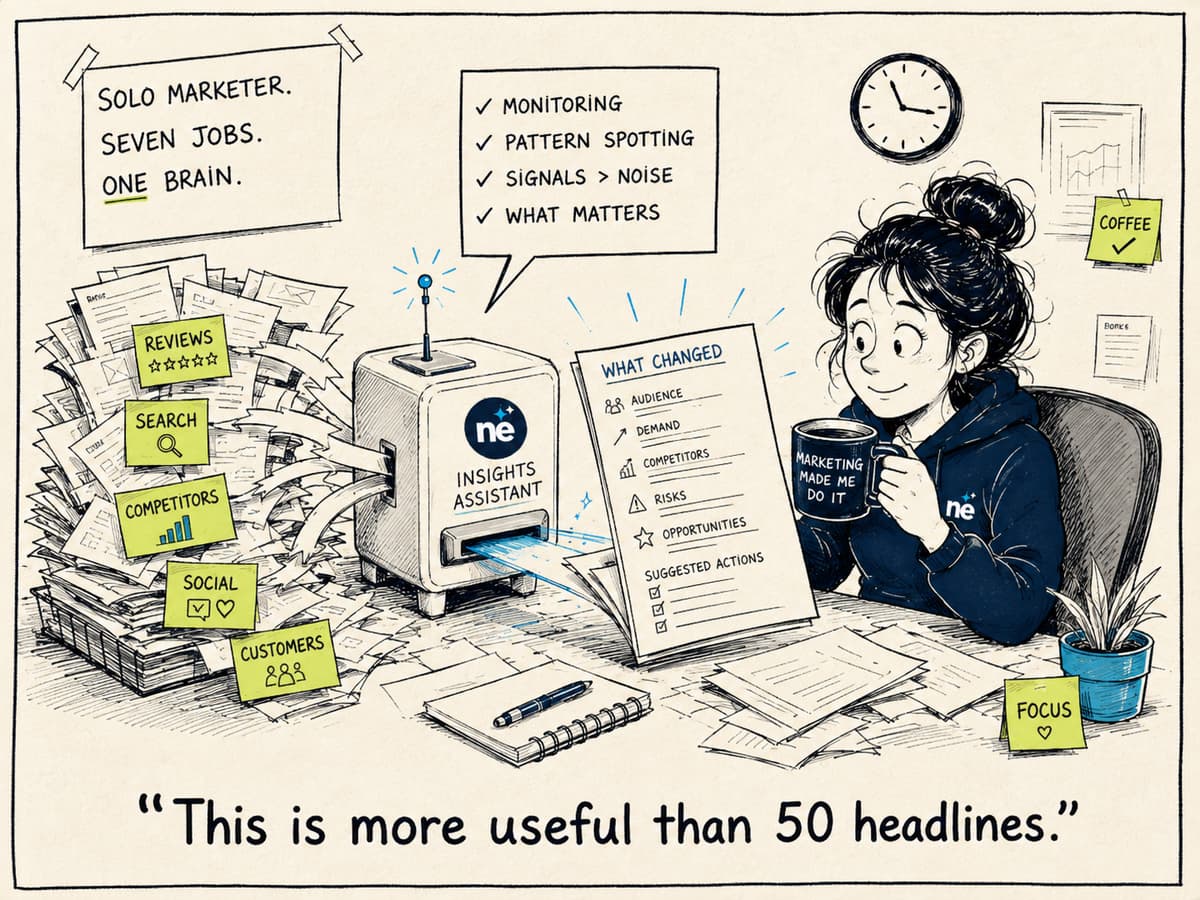
That distinction matters in practice. AI that only helps a marketer produce more material adds noise to an already crowded list. AI that cuts the manual research needed to decide what deserves attention gives the marketer something far more valuable: better information before the time gets committed.
Our article on AI marketing workflows goes deeper on this shift, including why shared context and clean handoffs matter more as AI takes on a larger share of the marketing process.
A Five-Question Test for Any New Marketing Priority
Use the following five questions before giving any new marketing task a place on your calendar.
What problem are we trying to change?
“We need to do more marketing” isn’t specific enough to act on. Name the actual problem instead: traffic is too low, the wrong people are arriving, visitors don’t understand the product, leads vanish after signup, and customers don’t stay, return, or refer others.
A specific problem gives you something to test each proposed task against.
What evidence says this problem matters?
Look for customer behavior, sales feedback, search demand, performance data, reviews, or repeated market signals. One data point rarely settles the question, but two or three pointing in the same direction usually do. Stronger evidence makes the priority easier to defend.
Why now?
A problem can be real without being urgent. Ask what happens if it sits untouched for another month.
Sometimes very little changes, and the task can wait. Sometimes an opportunity closes, frustration builds, or an existing leak gets more expensive to fix the longer it runs, and that changes how soon it needs attention.
What are we giving up to do this?
Every yes uses capacity that, for a team of one, disappears immediately. A new channel means fewer SEO articles get written. A landing page rebuild means a campaign test gets delayed.
If a new priority can be added without anything else visibly moving off the calendar, the workload was probably unrealistic to begin with, and that’s worth noticing before committing to more.
Does this actually require human judgment?
Some work needs your read on customers, positioning, brand, and trade-offs, things no tool can decide for you. Other work is mostly collecting, monitoring, organizing, or repeating.
That second group is exactly where automation can free up real time. Your attention should be hardest to get for the work that genuinely needs it, not for the parts that just need to get done.
What This Looks Like in a Real Week
Picture a solo marketer at a B2B software company. Traffic has been flat for three months. Sales calls keep surfacing the same question: does the product work with a specific existing workflow? Search research shows growing interest in the same question, and competitors have only shallow content covering it. Meanwhile, twelve social posts still need to go out, an old email sequence could use a refresh, and someone wants to try Instagram.
Every one of those tasks has a defensible case. The evidence doesn’t support them equally. The workflow question has customer evidence, search demand, and a competitive gap behind it, which makes it a stronger candidate than another round of routine social content. The marketer builds one strong page around that specific problem, backs it with a supporting article, distributes it where existing prospects already spend time, and watches whether the response confirms the theory. The Instagram experiment can wait, not because Instagram is unimportant, but because it is less connected to the problem the business needs to solve now.
That’s what prioritization looks like in practice. It isn’t finding the one universally correct marketing tactic. It’s having enough evidence to say, honestly, “This matters more right now than that does.”
How This Fits Into a Solo Marketing System
Prioritization and systems solve related but different problems. A marketing team of one needs a prioritization system that protects limited attention, keeps routine work from taking over the week, and prevents you from reinventing your marketing process every Monday morning.
If the operational side is your bigger headache, our Solo Marketing in 2026: The 4-Loop System covers research, production, distribution, and review as repeatable loops. This framework sits a level above that system: decide which constraint deserves the work before deciding how to execute it. Otherwise, an efficient system just helps you do the wrong things faster.
What We’re Building at Nova Express
This prioritization problem is one of the reasons we’re building Nova Express. A small marketing team rarely needs another stream of ideas competing for its attention. It needs a clearer view of what’s actually changing across customers, competitors, search, social conversations, trends, influencers, and sentiment.
Nova Express is being built around specialized AI marketing agents that monitor those areas using a shared understanding of the business, so a marketer spends less time gathering the evidence and more time deciding what to do with it. The aim isn’t to make marketing decisions automatically. It’s to cut the manual research required before someone can make a good one. Nova Express is currently in pre-launch.
The Hardest Part Is Deciding What Can Wait
There will always be more marketing work than one person can finish. That’s not a scheduling failure; it’s part of the job description. The skill worth building isn’t fitting every possible activity into the week. It’s telling apart the work that could change the current constraint from the work that’s simply available to be done.
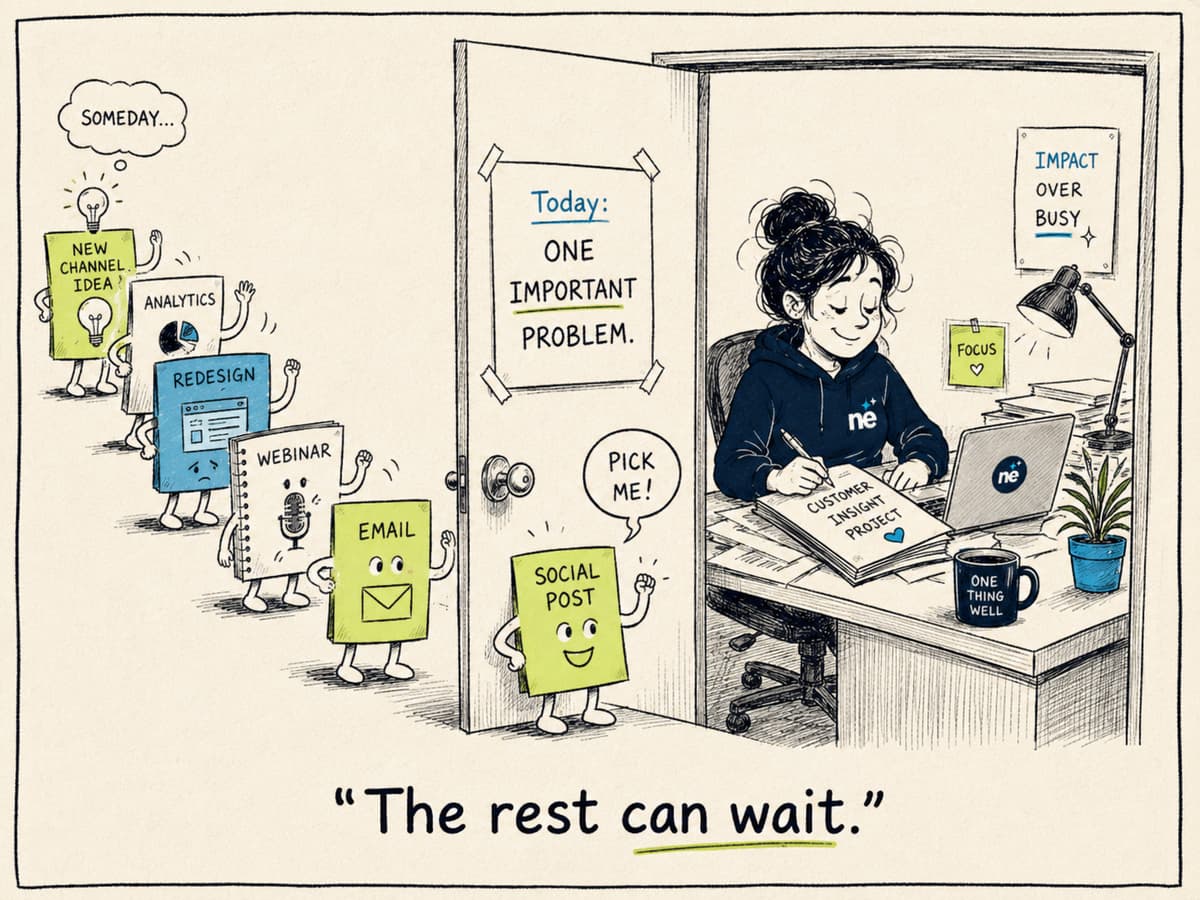
Start with evidence, find where momentum is disappearing, and choose the smallest meaningful action that could move it. Then let the rest wait.
A solo marketer doesn’t need to win every channel at once. They need to know which problem is worth solving now.
Nova Express Resources
If you are working on the same problems, these guides are useful next steps:
- How to Use AI to Build a Marketing Strategy From Your Website
- What Is an AI Marketing Agent?
- AI Marketing Workflows: 7 Practical Examples for 2026
- Brand DNA: The Missing Piece Between Your Brand and AI
- What Competitor Analysis Reveals About You (Not Just Them)
- Customer Pain Points: Why Your Marketing Isn’t Working
- Best AI Video Generators for Marketers in 2026
- What Are AI Tokens? A Marketer’s Guide to Context, Cost, and Limits
About the author
Serafima Osovitny is a Marketing Manager at Nova Express, where she focuses on digital marketing, search visibility, content strategy, and marketing workflows. She writes practical guides that help marketing teams research their audiences, develop strategies, and put their plans into action.
Explore her work at serafima.digital and follow her on X: @OSerafimaA.


Leave a Comment