

Running marketing solo and constantly behind? The problem isn’t time; it’s the system. Here’s the 4-loop solo marketing framework that removes 80% of weekly decisions.
I used to think I needed more hours. Then I looked at how I was actually spending them: fifteen minutes checking analytics that hadn’t changed, twenty minutes deciding what to write next, and another ten figuring out where to post it. The problem wasn’t the calendar or my bandwidth. It was that I had no real system, just a to-do list that reset every Monday.
How to Run Marketing Solo in 2026: The 4-Loop System
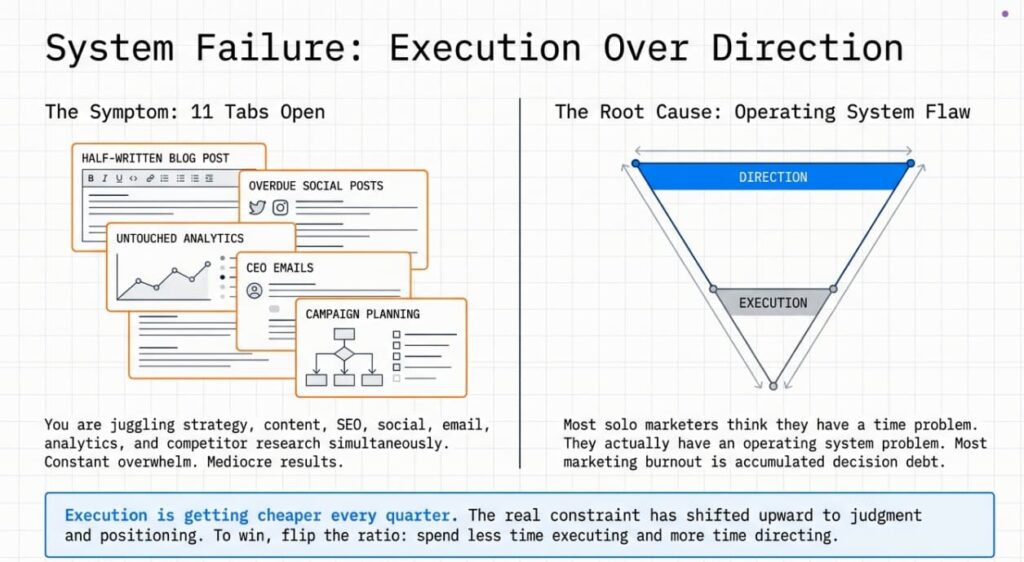
You have too many tabs open, too many channels in motion, and too many decisions made from scratch every week. One tab is a half-written blog post. Another has social posts that are already overdue. Your analytics dashboard hasn’t been touched in days, two urgent questions from the CEO are waiting in your inbox, and a campaign planning call starts in 20 minutes.
Most solo marketers think they have a time problem. They actually have an operating system problem.
Most founder-led marketers build their work like an endless to-do list instead of a self-running system. The result? Constant overwhelm and mediocre results.
The best solo operators (brands like Basecamp and Notion are great examples) don’t work harder. They operate inside systems that automate the repetitive work, allowing them to focus on high-leverage decisions.
Here’s the system we’re using to reduce chaos and increase output in 2026.
The Core Problem: You’re Executing When You Should Be Directing
Most founder-led marketers spend their time on execution: writing, scheduling, reporting, briefing, and fixing. The work that actually moves the needle (deciding what to create, figuring out what the audience wants, understanding why campaigns fail) gets squeezed into whatever time is left, which is usually none.
This is backwards. Execution is becoming cheaper every quarter. What used to take hours of manual work can now be handled in minutes. The real constraint has shifted upward, toward judgment, positioning, and deciding what is worth doing at all.
When you flip the ratio and spend less time executing, your output per hour goes up dramatically. Even if you’re doing less work.
The companies that run marketing with small teams have made this flip explicitly. They’ve taken the execution layer off the founder’s plate and built systems that run it, so the founder spends most of their time on strategy, positioning, and decisions.
The goal isn’t to work less. It’s to make every hour count more.
The Founder-Led Marketing Stack
Before you build the system, you need to be honest about what you actually need to do and what you’re doing out of habit or anxiety.
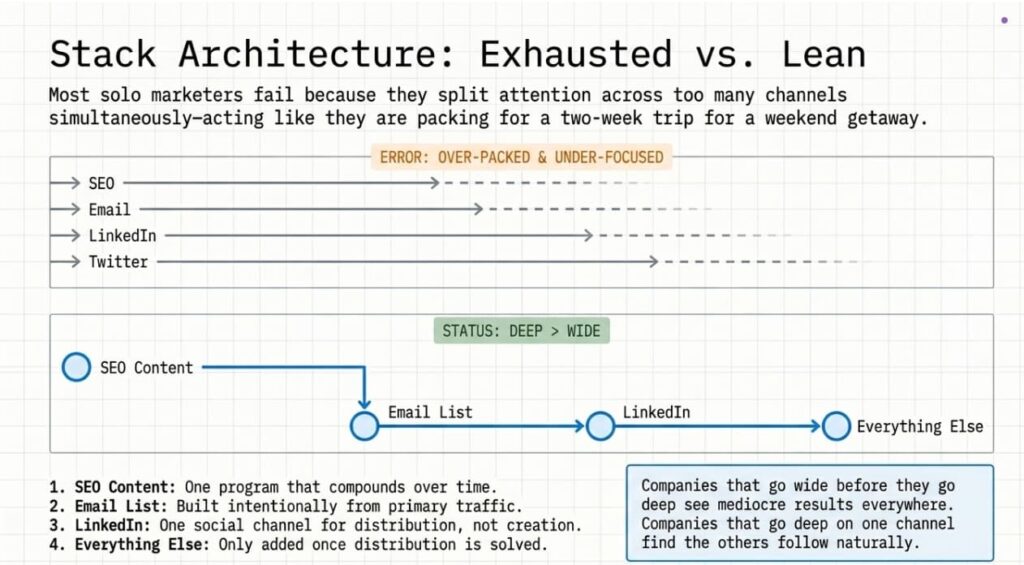
Most solo marketers don’t fail because they lack channels. They fail because they split attention across too many of them. Not because it’s working, but because stopping feels risky. Basecamp’s Jason Fried has written about this: most companies market as if they’re packing for a two-week trip when they’re actually going away for a weekend. Over-packed, under-focused, and exhausted before they start.
The lean solo marketing stack:
One primary content channel where your audience actually lives. One email list you build intentionally. One SEO content program that compounds over time. One social channel for distribution, not creation.
Not all four simultaneously on day one. The one that’s already working gets scaled properly before adding the next one.
For most B2B products and SaaS tools, that order is: SEO content > email > LinkedIn > everything else. The companies that go wide before they go deep usually have mediocre results everywhere. The companies that go deep on one channel first usually find that the others follow naturally once distribution is solved.
The System: Four Repeatable Loops
A strategy deck doesn’t help you on a Tuesday morning when you have nothing written and a newsletter goes out Thursday. A system does. Not because it’s smarter, but because it removes the decision entirely.
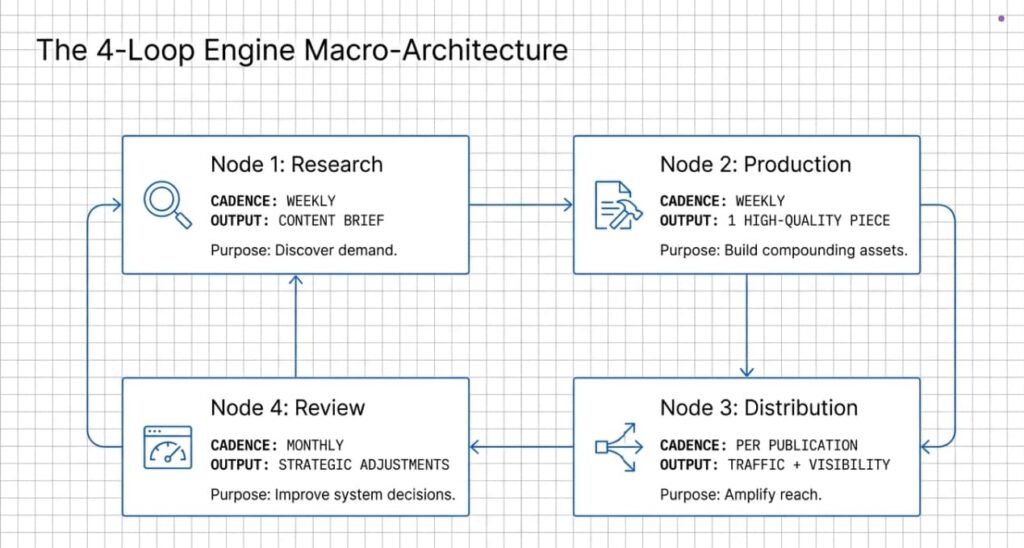
Here are the four loops every solo operator needs:
| Loop | Purpose | Cadence | Output |
|---|---|---|---|
| Research | Discover demand | Weekly | Content brief |
| Production | Build compounding assets | Weekly | One high-quality piece |
| Distribution | Amplify reach | Per publication | Traffic + visibility |
| Review | Improve system decisions | Monthly | Strategic adjustments |
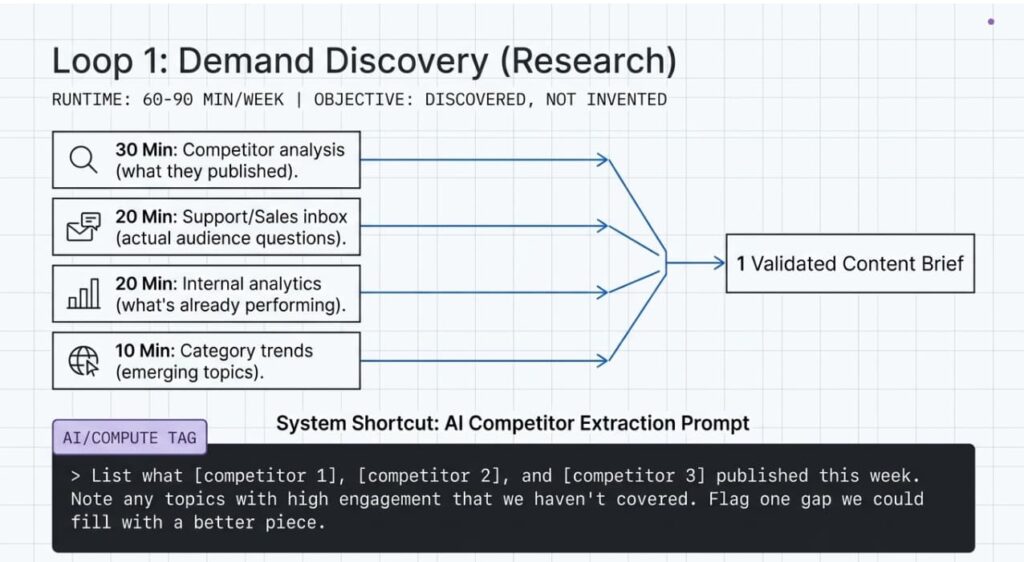
Loop 1: Content Research (Weekly, 60-90 minutes)
Before you create anything, you need to know what’s worth creating. Without a research loop, it’s easy to write about whatever is on your mind or whatever the CEO asked about. That’s how you end up with content that doesn’t rank and doesn’t convert.
The brief writes itself if you know where to look for it. Competitor activity from the last seven days. Questions your audience is asking right now. Your own performance data: what ranked, what didn’t, what got shared. Combine those three, and you have a topic. Not a guess. A signal.
If you’re tracking competitors, it also helps to understand how AI search decides which brands to surface, which changes which gaps are actually worth filling.
A prompt that works:
List what [competitor 1], [competitor 2], and [competitor 3] published this week. Note any topics with high engagement that we haven’t covered. Flag one gap we could fill with a better piece.
Run that every Monday. It takes ten minutes and removes the biggest decision of the week.
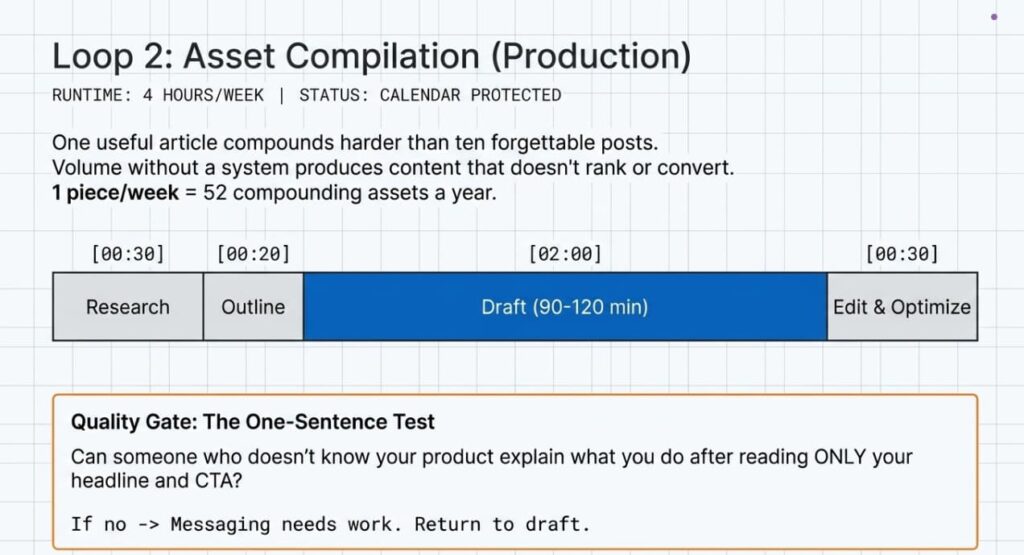
Loop 2: Content Production (2-3 Days Per Piece)
The brief from Loop 1 is your starting point. No blank page, no deciding what angle to take. That decision is already made.
The classic trap: trying to produce volume before you have a system. Volume without quality produces content that doesn’t rank, doesn’t convert, and takes just as long to create as the good stuff would have.
One piece a week sounds boring until you’re 40 weeks in and the third article you wrote is still pulling traffic. That’s when the math starts feeling real.
The production process:
- Research: 30 min
- Outline: 20 min
- Draft: 90-120 min
- Edit and optimize: 30 min
Total: 4 hours. Block it in your calendar in advance. Don’t squeeze it into gaps.
But the piece only works if it’s built around a specific pain your audience has actually voiced, not a topic you find interesting. As covered in Customer Pain Points: Why Your Marketing Isn’t Working, addressing someone’s pain in their own words is the difference between copy that feels like an ad and copy that feels like recognition.
The one-sentence test: Can someone who doesn’t know your product explain what you do after reading only your headline and CTA? If not, your messaging needs work before the content will convert.
Before you move to Loop 3, block your first 4-hour production slot in your calendar. The system only works if the time is protected.
Loop 3: Distribution (30 Minutes After Publishing)
Every piece of content gets distributed the same way every time. No creative reinvention, no deciding in the moment. A template.
You’re not rewriting for each channel. You’re pulling from the same piece. LinkedIn post with one key insight from the article. Twitter/X thread if there’s a clear framework or numbered list. One Slack community or forum where your audience actually talks.
That’s it. Same process every time. No improvising. The format stays the same. What changes is the hook, and that’s where storytelling does the work.
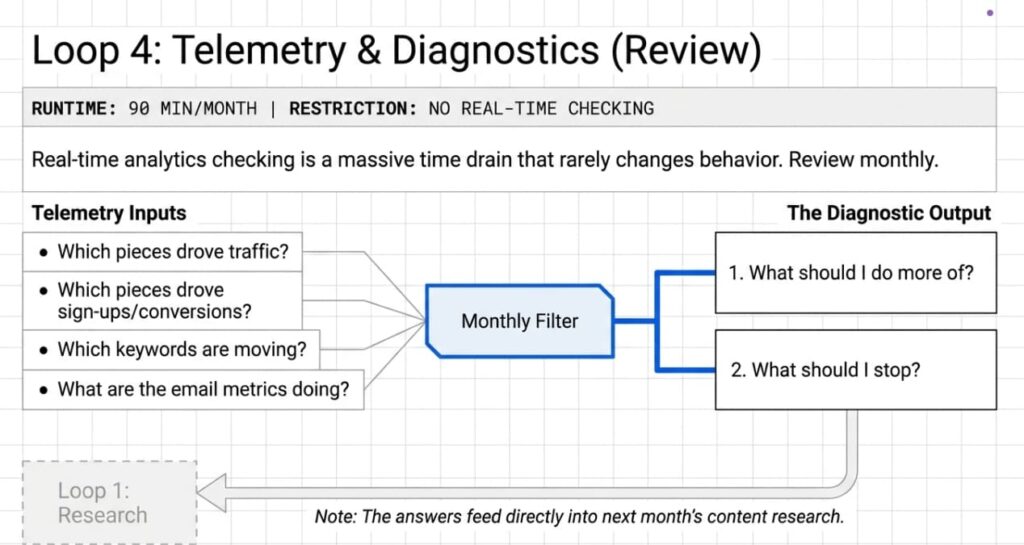
Loop 4: Performance Review (Monthly, 90 Minutes)
Real-time analytics checking is one of the biggest time drains in solo marketing. You open the dashboard; nothing has changed since Tuesday, and you’ve just lost twenty minutes.
Once a month, you sit down with the numbers and answer one question: what should I do more of, and what should I stop? Not daily. Not weekly. Monthly. Because patterns only show up when you give them time.
That’s it. The answer goes into the next month’s content research. The loop closes.
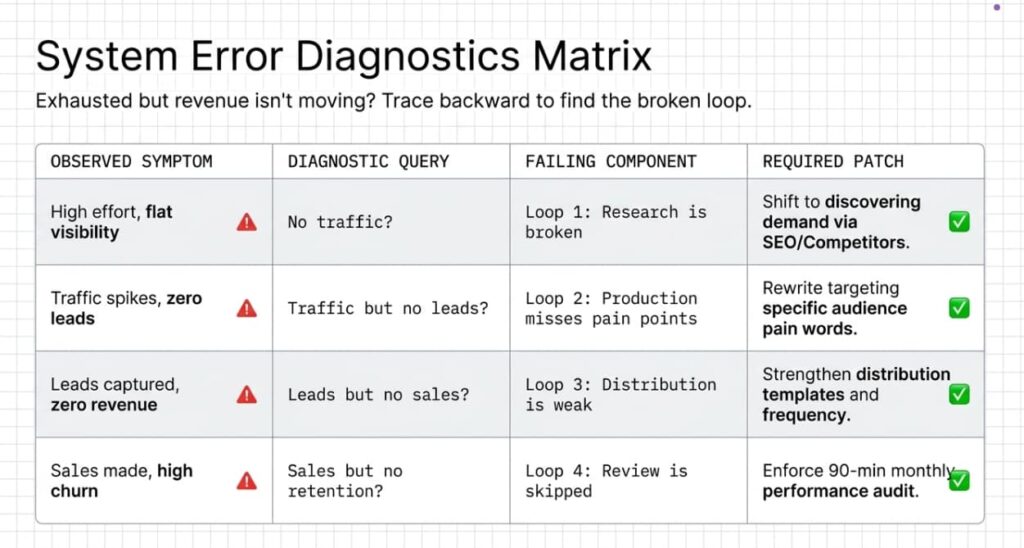
Which loop is broken? If you’re exhausted but revenue isn’t moving, trace backward:
- No traffic? Your research loop is broken.
- Traffic but no leads? Your content isn’t hitting a real pain point.
- Leads but no sales? Your distribution is too narrow.
- Sales but no retention? You’re skipping the review entirely.
What to Automate and What to Keep
Automation won’t write your positioning for you. It won’t figure out why your last campaign didn’t land or decide which angle to take on a crowded topic. That’s still yours.
What it will do: check what competitors published while you were asleep, schedule the LinkedIn post you wrote on Tuesday, and send the report you’d otherwise skip. That’s not glamorous. It’s also three hours a week you don’t spend on things that don’t require your brain.
What you keep: the angle, the voice, and the call on whether a topic is worth writing about at all. What runs without you: monitoring, scheduling, reporting, and keyword tracking. Set it once. Let it go. If you’re building this stack from scratch, here’s what’s actually worth using.
The split feels wrong at first. You’re doing less. That’s the point.
The Real Constraint Isn’t Time
If you’re running marketing alone, you’ve probably blamed the calendar. “Not enough hours.” There aren’t any. But that’s a symptom, not the bottleneck.
Most marketing burnout is accumulated decision debt. Every time you ask yourself what to write, where to post it, when to hit send, or whether a competitor moved, you’re burning cognitive bandwidth that should go toward positioning, messaging, and growth.
Architecture solves this. Strong systems remove recurring decisions before they become recurring stress. You don’t pick a topic weekly. You set a quarterly content thesis, and Loop 1 feeds Loop 2 automatically. You don’t manually track competitors. The monitoring loop alerts you only when something actually changes.
The best solo marketers don’t scale effort. They scale leverage. They’ve simply removed 80% of the micro-decisions from their week so the remaining 20% actually move the needle.
Operating Principles for Solo Marketing
AI scales systems, not chaos. AI is reducing the cost of repetitive execution work. But without a documented process, faster execution only creates faster confusion. The advantage no longer comes from using AI alone. It comes from using AI inside a repeatable operating system. And the brands that show up in AI search are the ones that have that system documented. For the full breakdown of how that works, see Why AI Cites Some Brands and Ignores Others.
Focus compounds faster than reach. One strong distribution engine outperforms five inconsistent ones. Most solo marketers spread attention across too many channels before any one channel starts compounding. Depth scales better than constant expansion.
Research removes guesswork. Competitor gaps, customer questions, search demand, and performance data create a filter that turns content creation into a repeatable process instead of a weekly guessing game.
Documentation creates leverage. Any process that exists only in your head becomes fragile under pressure. Documented systems handle delegation, growth, and AI adoption. Undocumented ones collapse the moment complexity increases.
How to Install the System (Without Breaking)
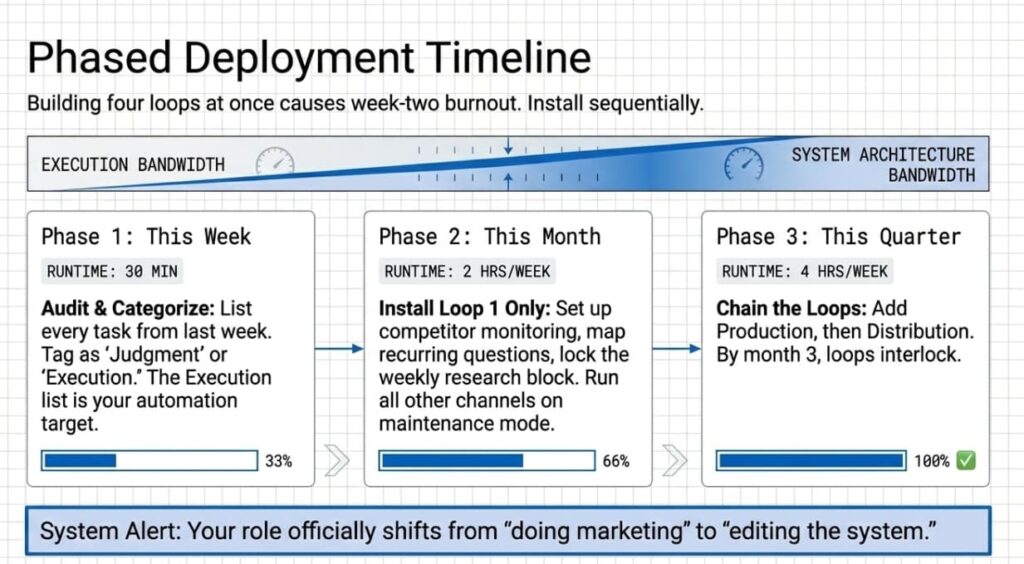
If you’re reading this with 11 tabs open and no system, don’t build four loops at once. You’ll burn out by week two.
Phase 1: This Week (30 min) — Write down every marketing task you did last week. Mark each as “judgment” (needs your brain) or “execution” (repetitive, rule-based). Start with execution for automation.
Phase 2: This Month (2 hrs/week) — Set up competitor monitoring, map your audience’s recurring questions, and lock a weekly research block. Run all other channels in maintenance mode.
Phase 3: This Quarter (4 hrs/week)—Once research runs automatically, add production. Then the distribution. By the end of month 3, all four loops are running together. Your role shifts from “doing marketing” to “editing the system.”
The system isn’t fragile. It’s designed to absorb reality.
The people I’ve seen burn out doing solo marketing weren’t lazy.
They were making the same decisions every week. What to write. Where to post it. Whether a competitor had moved. And calling that work.
Building the system first feels slow. You publish less in month one. You second-guess whether it’s worth it. It is. By month three, the loops run, and your job changes from doing marketing to editing the system. That’s a different job. Better one.
We’re building Nova Express to make this system run automatically. Follow the build on our blog.
Nova Express Resources
- AI Tools for Marketers in 2026
- The 2026 Marketing Audit
- NotebookLM for Marketers
- 7 Midjourney V7 Prompts for Marketing Ads, Products, and Social Media
- What Is an AI Marketing Agent?
- What Is AEO?
- What Is Generative Engine Optimization?
- Brand DNA: The Missing Piece Between Your Brand and AI
- What Competitor Analysis Reveals About You (Not Just Them)
Ready to engineer the system? Read the next article in this series:
- Why AI Cites Some Brands and Ignores Others: The Citation Stack Explained
- AEO vs SEO vs GEO: What’s the Difference and Where to Start in 2026
- Why AI Engines Trust Reddit More Than Brand Content (And How to Change That)
About the author
Serafima Osovitny is a Marketing Manager at Nova Express, where she focuses on digital marketing, search visibility, content strategy, and marketing workflows. She writes practical guides that help marketing teams research their audiences, develop strategies, and put their plans into action.
Explore her work at serafima.digital and follow her on X: @OSerafimaA.








Leave a Comment