

This is a 30-day plan for building an audience before your product exists. You’ll spend about five hours a week on it. By the end, you’ll have three articles that show up in search, a small but genuinely interested group of people, and a waitlist that’s already warm on launch day. No theory for its own sake here, just what to write, where to post it, and how to tell if it’s working.
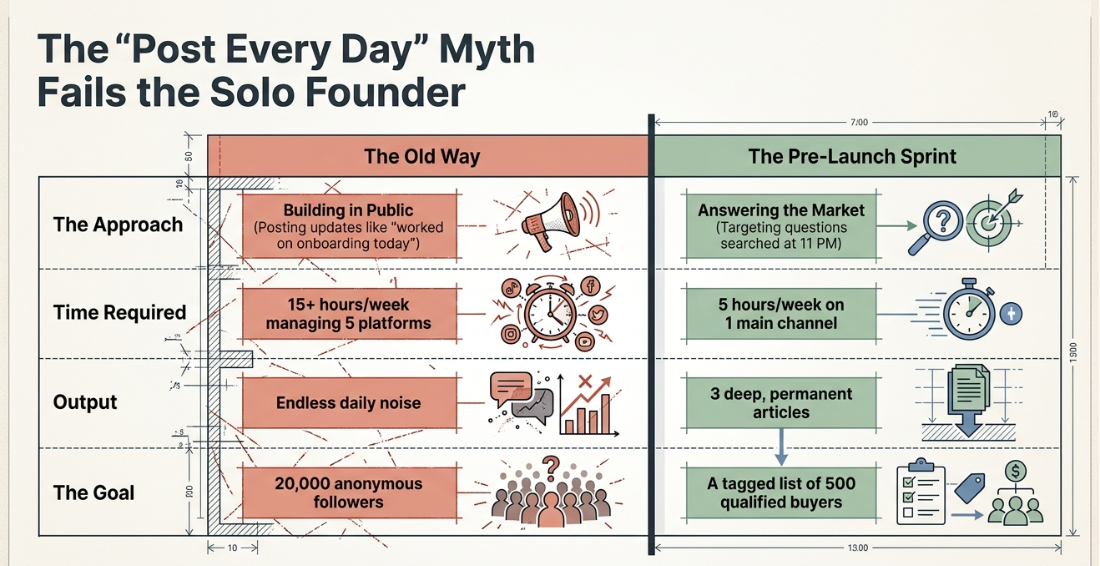
Most pre-launch advice tells you to post every day. This plan asks you to publish three times in a month, and explains why that works better. You don’t need a big following to run it. You need 10 real questions and about five hours a week.
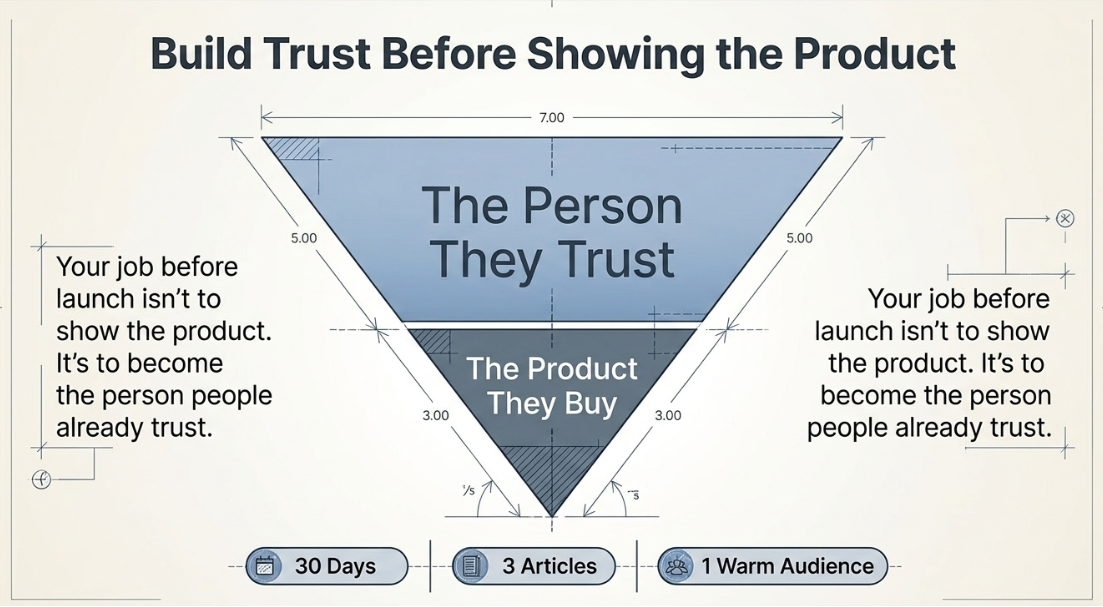
The one sentence to remember: before launch, your job isn’t to show the product, it’s to become the person people already trust. Thirty days, three articles, one audience that’s waiting for you.
This sprint is for you if:
- you’re building something that doesn’t exist yet, or is still early
- you don’t have a big audience to lean on
- you can spend about five hours a week on content
It’s probably not for you if:
- you’re expecting a “post every day” plan
- you’re looking for a growth hack
- you want results without writing anything real
What you’ll need to run it:
- a Google Doc or Notion page to hold your 10 questions
- a simple waitlist page, even a basic Typeform or Tally form works
- one main channel where your customers already spend time (LinkedIn, X, a niche subreddit)
- a design tool for a one-page PDF, Canva or even a formatted Google Doc is fine
Nothing here requires a budget or any tools you don’t already have.
The 30 days at a glance
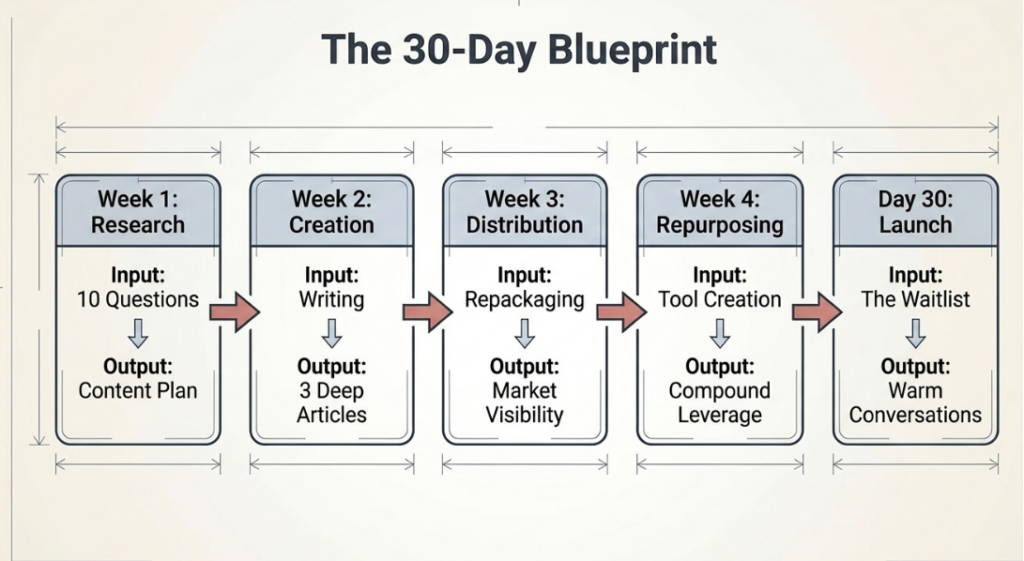
Picture five boxes in a row, connected by arrows. You could sketch this on paper or drop it into Canva in ten minutes. If you do, you’ll have a one-page map of the entire sprint.
Week 1.
You find 10 real questions your future customer is already asking. Result: a content plan for the month.
Week 2.
You write 3 deep articles. Result: three assets that build your authority.
Week 3.
You turn each article into a post, a short video, an email, and a downloadable PDF. Result: people actually see what you wrote.
Week 4.
You turn the three articles into a checklist, a simple decision tool, and a poll. Result: more value from work you already did.
Day 30.
You launch to people who already know and trust you. Result: no cold outreach, just people who were already waiting.
A concrete example, start to finish
Say you’re building a tool for founders who handle their own marketing without a team.
Week 1. You find 10 questions these founders type into Google at 11pm: “why don’t my LinkedIn posts bring in customers,” “how do I know my funnel is broken,” “should I hire a marketer or do it myself.” You group them into four themes: the problem, the method, the tools, and the myths.
Week 2. You write three articles: “A 4-Step Marketing System for a Team of One” (the framework), “Notion vs. Trello for Solo Founders: Which One Actually Helps Your Marketing” (the comparison), and “Why ‘Post Every Day’ Is Bad Advice for B2B Founders” (the contrarian take).
Week 3. Each article becomes a short LinkedIn post, a 60-second video reading the intro aloud, and an email with a PDF checklist attached.
Week 4. The framework article becomes a one-page checklist. The comparison becomes a simple “if X, choose A, if Y, choose B” chart. The contrarian article becomes a poll: “what’s your biggest content mistake right now?”
Day 30. You launch with 200 to 300 people on your list, a dozen or so warm conversations already started, and an audience that’s read your thinking for a month, not strangers you’re pitching cold. That’s the whole point: you’re not introducing yourself on launch day, you’re finally showing them the tool.
If you only take one thing from this article, take this.
The checklist you can just copy
Week 1
- Write down 10 questions your future customer asks in the month before they’d search for a product like yours.
- Sort them into 3 or 4 themes: the problem, the method, the tools, the myths.
Week 2
- Write three articles: one framework, one honest comparison, one contrarian take.
- Check each one: is more than half the text about the reader, not about you?
Week 3
- Turn each article into one post, one short video, one email, and one PDF.
- Send 10 to 15 personal messages with a link to your best piece.
Week 4
- Turn one article into a checklist, one into a simple decision chart, one into a poll.
- Write a closing post: “What I learned from 30 days of pre-launch content,” with a link to join the waitlist.
Day 30
- Announce the launch to your list, with a clear offer, a real deadline, and one concrete reason to act now (early access, a founding-member price, or a limited number of spots).
Going deeper (optional): the theory behind the plan
Everything above is enough to run the sprint. If you’re curious why it works, and where most people trip up, here’s the rest.
Why “building in public” usually doesn’t work yet. Posting “worked on onboarding today, hard stuff” only builds authority if people already find you interesting. Before that, it’s just noise. Answering the questions your customer is already typing into ChatGPT and Google does more, because when they finally search for a real solution, your name is the one they remember. This is the same logic as AI search visibility. You just start a month earlier than most founders think.
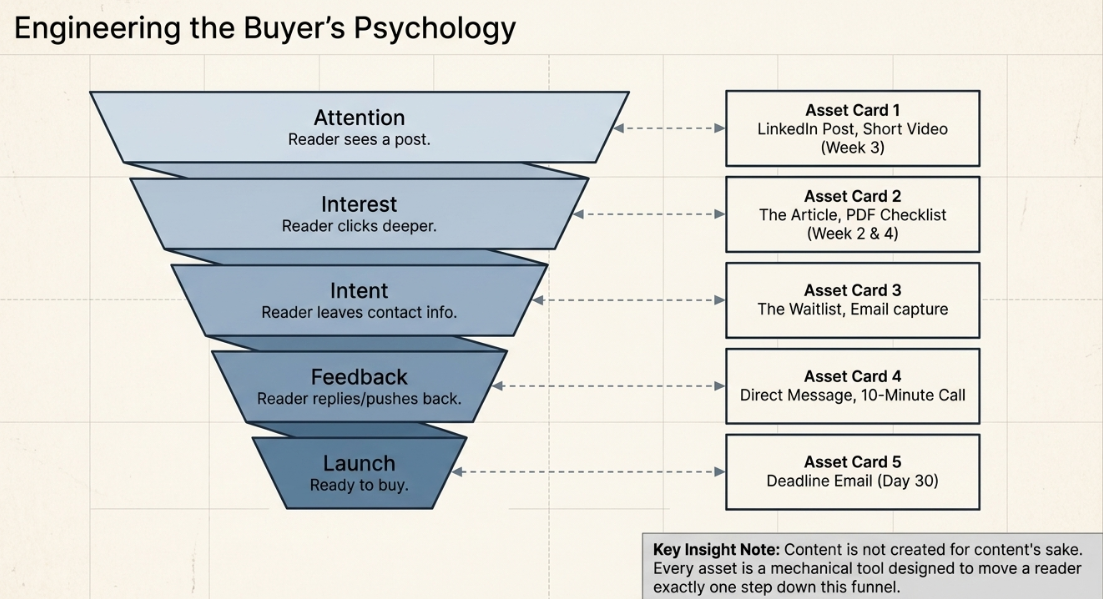
Why week 3 is where most people quit. Week 1 feels like progress because it’s research. Week 4 feels easy because you can see the finish line. Week 3 is the trap: two articles published, real effort spent, and the response is thin. This is exactly the point where it’s tempting to decide the whole thing “isn’t working.” It usually is working, just not in a way that shows up as a like count. Watch for replies that quote a line back to you, DMs describing someone’s own version of the problem, or a stranger booking a call. Any one of those matters more than a spike in views. Rule of thumb: if by day 21 you don’t have at least one DM or one reply that quotes your own text back to you, change the question you’re answering, not the whole system.
The mistakes that quietly kill a sprint. Publishing only product updates. Waiting until launch week to start. Judging success by likes instead of replies. Trying five platforms at once instead of two done well. Changing your point of view every week so readers can’t tell what you actually believe.
Where your 10 questions should come from. Reddit threads in your niche, the “cons” section of G2 and Capterra reviews (a complaint is a question in disguise), and your own conversations with potential customers if you’ve had any. If you want a sharper check on whether your 10 questions are the real ones, this breakdown of customer pain points is a useful gut check. And before picking channels, it’s worth a quick look at what’s already working for competitors in your space, not to copy them, but to skip the guessing.
Protecting the credibility you’re building. One dishonest sentence undoes weeks of good work faster than any bad post could. If a comparison quietly favors you more than the facts support, or a number gets rounded up, readers notice even when they can’t say exactly why. Give credit where a competitor genuinely earned it. That’s what makes the fourth week’s soft pitch land instead of falling flat.
If you’re not sure what your product’s story even is yet, start with a Brand DNA page before writing anything else in this plan. Every article in the sprint should quietly agree with it.
If running all of this by hand across five different tabs sounds like the hard part, that’s exactly what Nova Express is built to simplify: research, drafting, and scheduling in one place, so you can spend those five hours on the thinking, not the tab-switching, and still hit day 30 with a warm waitlist instead of a cold launch.
Related articles
- Why AI Cites Some Brands and Ignores Others: The Citation Stack Explained
- What Is Generative Engine Optimization?
- AI Tools for Marketers in 2026
- 50 Places to Find Your First Client (Most People Only Check 3)
- The 2026 Marketing Audit
- GPT Image 2 for Marketers: How to Finally Get Readable Text in AI Images
- Why AI Engines Trust Reddit More Than Brand Content (And How to Change That)
- AI Marketing Workflows: 7 Practical Examples for 2026
- How to Use AI to Build a Marketing Strategy From Your Website
About the author
Serafima Osovitny is a Marketing Manager at Nova Express, where she focuses on digital marketing, search visibility, content strategy, and marketing workflows. She writes practical guides that help marketing teams research their audiences, develop strategies, and put their plans into action.
Explore her work at serafima.digital and follow her on X: @OSerafimaA.








Leave a Comment