

Most marketers no longer need proof that AI can write a headline, summarize a report, or produce a first draft in minutes. The harder problem is everything that happens around those tasks.
A campaign still has to move from an idea to a brief through research, messaging, creative production, review, approval, launch, and measurement. When those steps happen in separate tools, the marketer becomes the person carrying information between them: copying research into briefs, repeating brand context, finding the latest version, and deciding what happens next.
AI marketing workflows are useful when they reduce that operational load. The starting point is a process your team already runs. From there, you can decide which steps are repetitive enough for AI, which require human judgment, and how the result will be measured.
What Is an AI Marketing Workflow?
An AI marketing workflow is a repeatable marketing process in which AI assists with defined parts of the work, such as research, analysis, briefing, writing, editing, reporting, or campaign execution.
Generating five headlines with an AI assistant is a task. A workflow connects that task to the rest of the process. Customer research informs the brief, the brief guides the copy, approved content moves into the right channels, and campaign performance influences what the team does next.
This broader view of AI is already appearing in marketing education. Kellogg’s AI-First Marketing Strategy program describes AI-enabled marketing through connected workflows supported by shared memory, specialized services, orchestration, and governance. The focus is on making separate parts of marketing work as a coordinated system rather than treating every AI capability as another isolated tool.
Before automating a workflow, clarify three things: what context the system needs, where human approval belongs, and which metric will tell you whether the process actually improved. Audience, positioning, products, approved claims, competitors, and brand voice should come from dependable sources instead of being rewritten differently every time. Our guide to Brand DNA explains how to build that foundation.
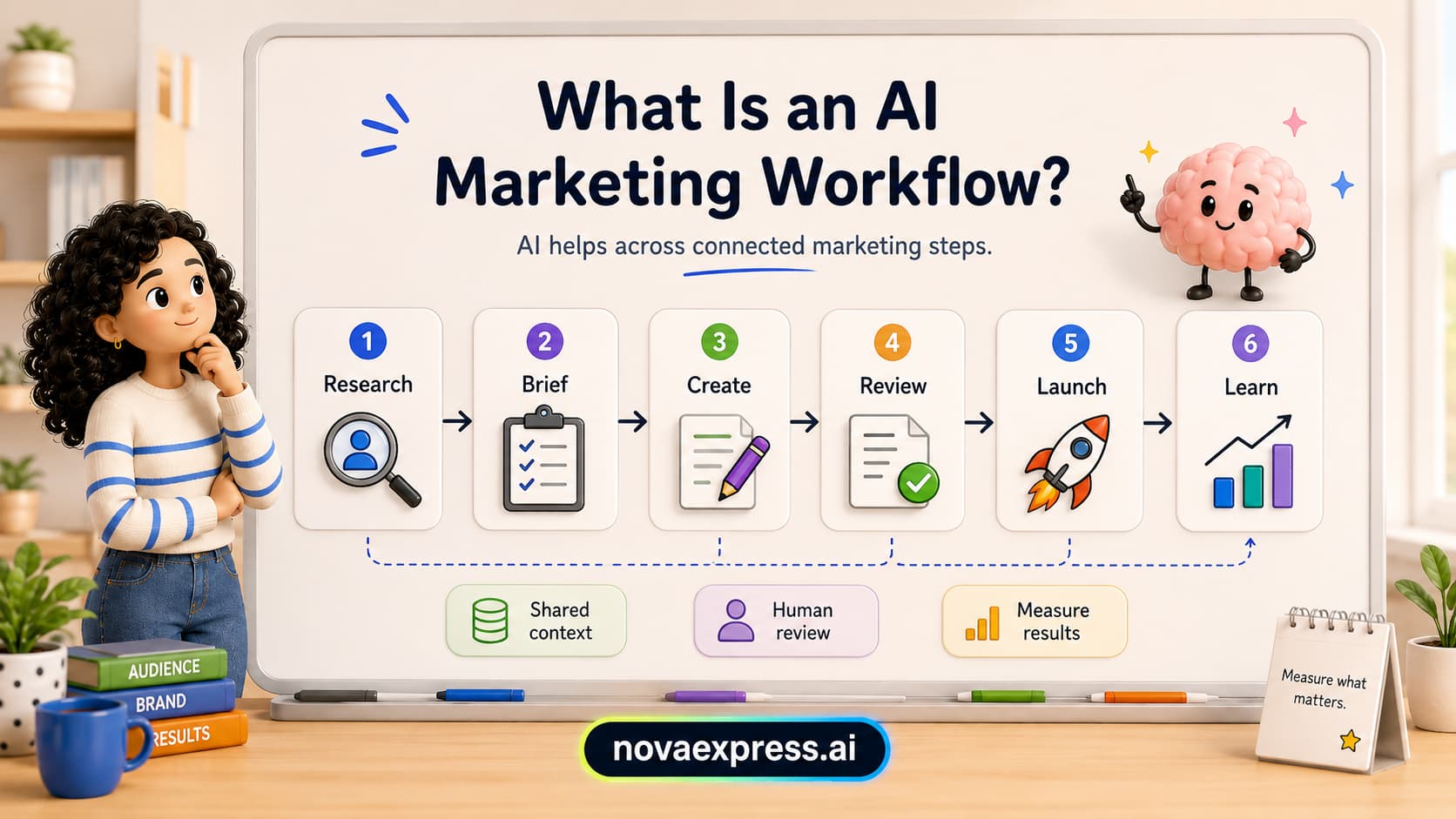
Here are seven practical workflows where AI can remove meaningful marketing work.
1. Campaign Planning and Launch
Campaign planning often begins with information scattered across meeting notes, Slack conversations, customer feedback, product documents, previous results, and a marketing calendar. Before creative work starts, someone has to turn those inputs into a usable plan.
AI can organize the material into a first-pass campaign brief with the objective, audience, offer, customer problem, supporting evidence, channels, required assets, deadline, approval owner, and success metric. The campaign owner reviews the strategic choices before the brief moves into production.
Once the brief is approved, the same context can support landing page copy, email, ads, social assets, and creative direction. Review and approval become defined stages of the process instead of emergency steps just before launch.
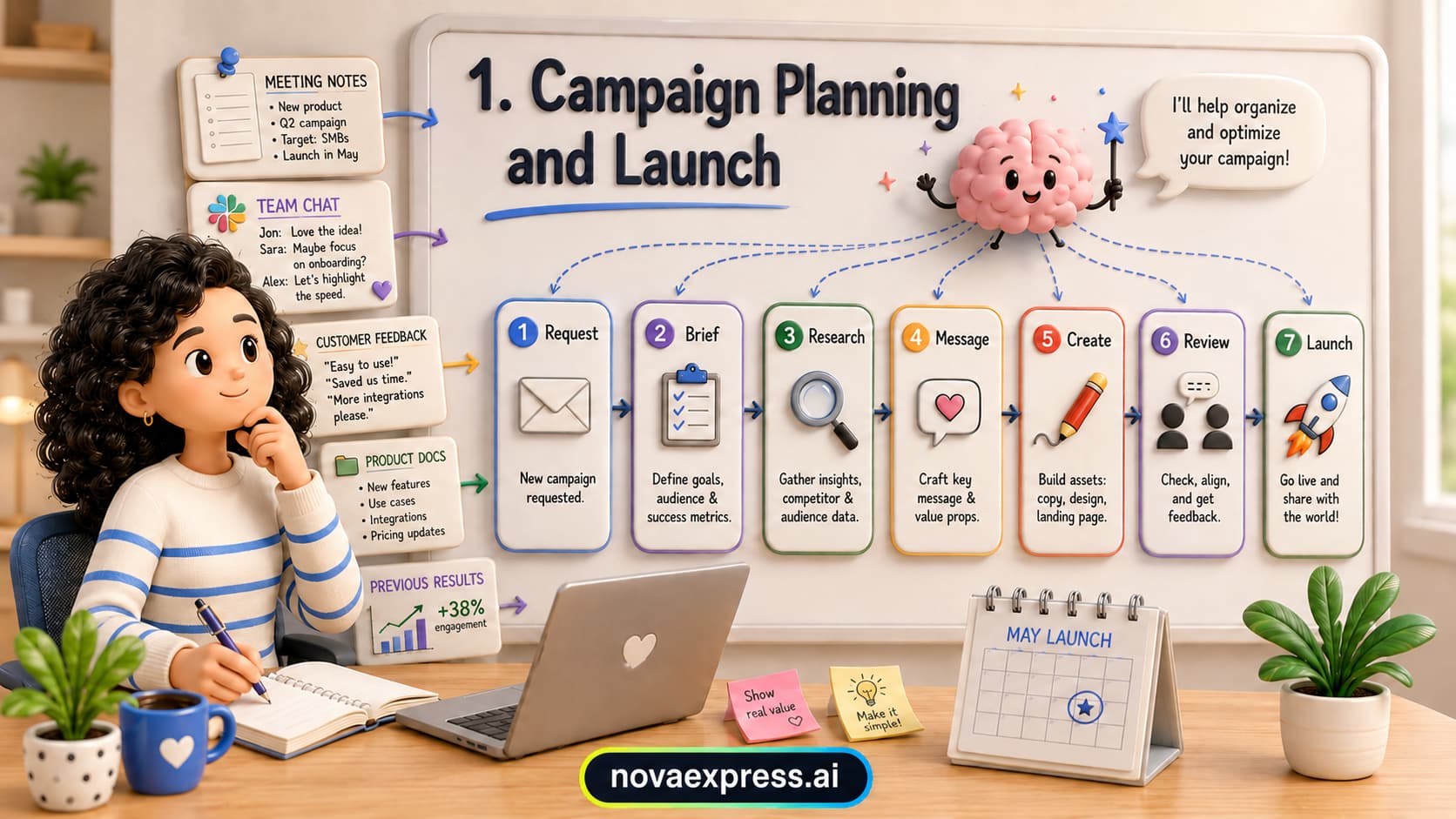
Workflow: Request → Brief → Research → Messaging → Copy and Creative → Review → Approval → Launch → Results
A team should measure whether the new process shortens brief-to-launch time, reduces revision rounds and approval delays, and improves the KPI defined for the campaign.
2. Competitor Monitoring to Action
Competitor monitoring becomes a burden when it produces a stream of updates without helping anyone decide what deserves attention.
AI can compare selected competitor pages, messaging, campaigns, content, or pricing over time and group meaningful changes for review. A new blog post may need no response. A pricing change could affect sales conversations. A major positioning shift might deserve discussion across marketing and product.
The useful workflow therefore continues beyond detection.
Workflow: Change detected → Compare → Assess relevance → Summarize evidence → Human decision → Marketing action
Imagine a competitor changes its homepage from feature-led messaging to a strong “built for small teams” position. The system flags the change and shows what was different. The marketer can then decide whether it affects an active campaign, sales enablement, or the company’s own positioning. The AI has reduced monitoring work without pretending to make the strategic decision.
Our guide to competitor analysis goes deeper into deciding which competitive signals actually matter.
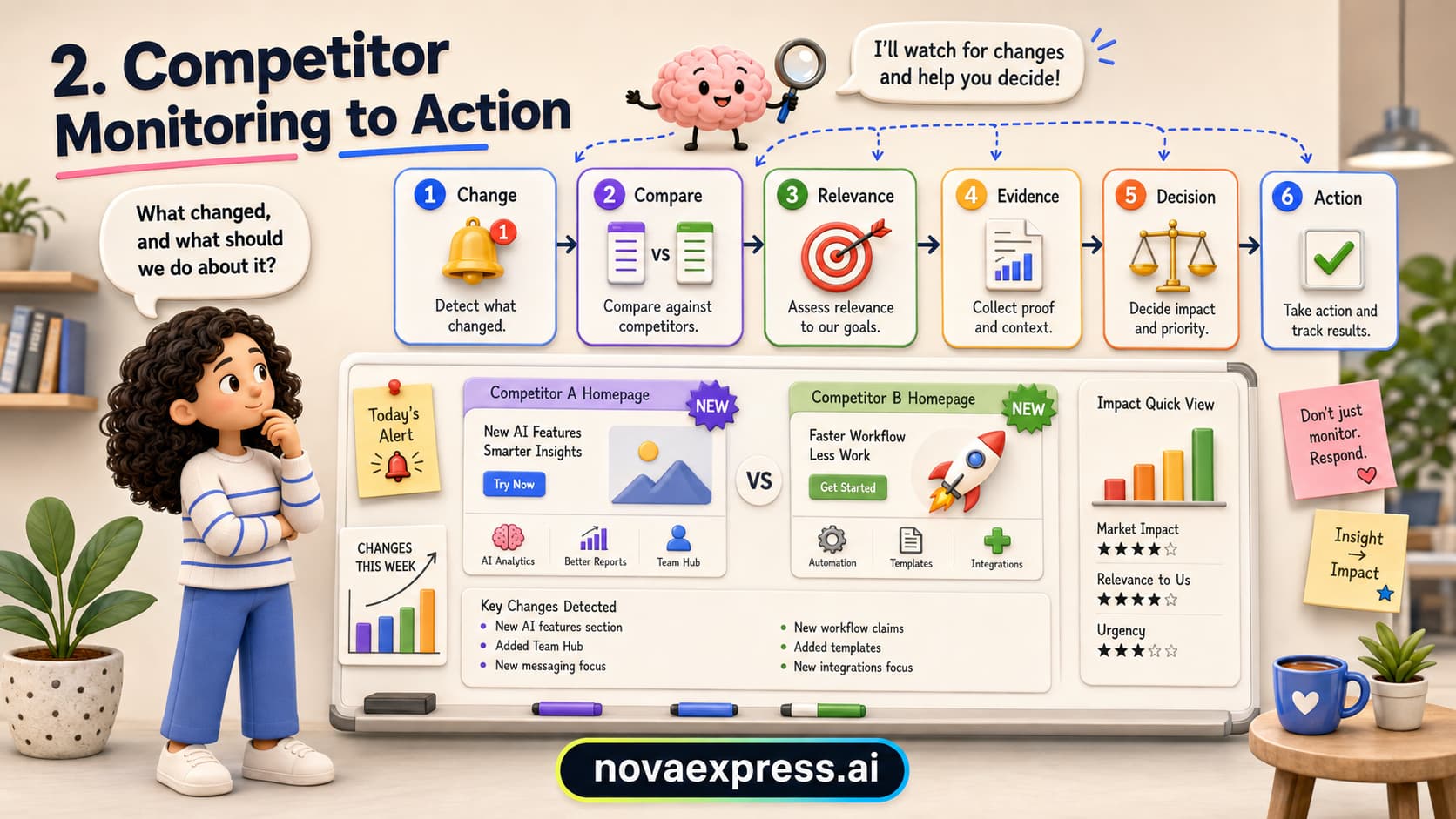
Useful measures include research hours saved, relevant changes reviewed, alerts that lead to action, and time from signal to decision.
3. Customer Research to Messaging
Good marketing depends on understanding how customers describe their problems in their own words. The difficulty is keeping up with the evidence.
Reviews, support tickets, sales notes, surveys, Reddit discussions, and social comments can contain useful patterns, but reviewing them continuously is difficult for a solo marketer or small team. AI can group recurring themes, identify repeated objections, surface questions, and preserve examples of the language customers use.
Evidence still matters. A label such as “customers want simplicity” tells a marketer very little unless the underlying conversations show what “simplicity” means in a real buying situation.
A SaaS company, for example, might discover the same concern appearing in sales calls, support conversations, and Reddit threads: prospects understand the product but worry that setup will take too long. That finding can move directly into a landing-page test, onboarding message, campaign brief, or new content piece.
Workflow: Customer evidence → Theme detection → Evidence review → Marketing implication → Messaging or content
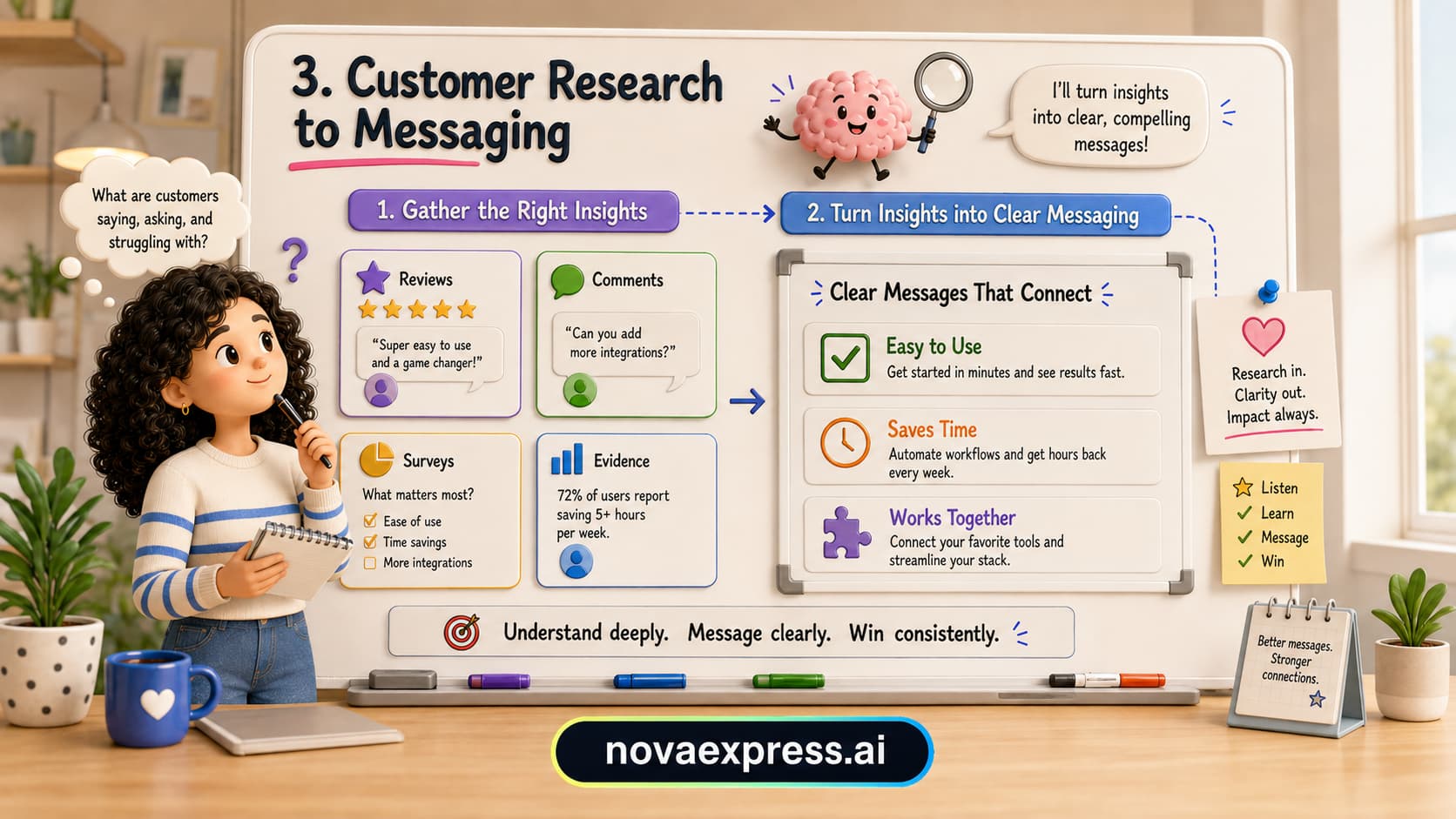
Our article on customer pain points explains how to turn those signals into usable marketing inputs.
For measurement, track research time, validated themes used in campaigns, tests created from those themes, and changes in conversion or engagement where the relationship can be measured responsibly.
4. SEO and Content Planning
AI can generate more content ideas than any team could reasonably publish. The more valuable job is deciding which opportunities deserve investment.
An AI-assisted planning workflow can bring together search demand, customer questions, existing content, competitor coverage, current performance, and business priorities. It can group related queries, identify gaps, find overlap with existing URLs, and surface pages that may be better candidates for an update than another new article.
The result should be a manageable decision queue. For each opportunity, the marketer needs to understand the audience question, search intent, business relevance, existing coverage, evidence available, internal-link opportunities, and recommended action.
That action might be creating a new page, updating an existing one, merging overlapping content, or leaving the topic alone.
Workflow: Search and audience signals → Existing content check → Opportunity review → Cannibalization check → Human selection → Brief or refresh plan
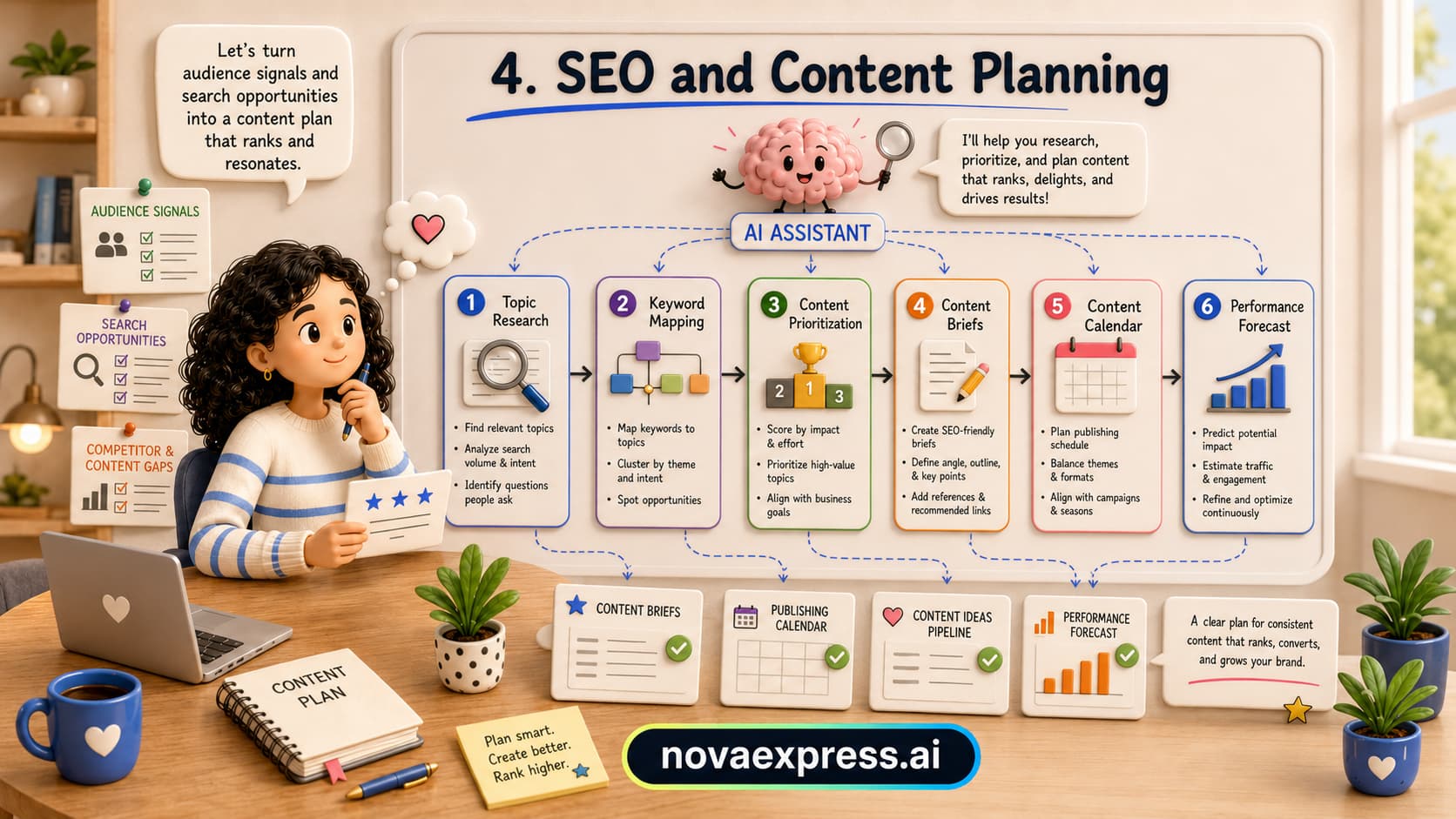
This is especially useful for solo marketers because it turns SEO into a recurring operating process instead of a race to publish more URLs. Our 4-loop system for running marketing solo offers a broader structure for managing recurring marketing work.
Measure research time, opportunity-to-brief time, qualified organic traffic, conversions, performance of refreshed pages, and unnecessary duplicate URLs avoided.
5. Content Production and Repurposing
Once the topic and brief are approved, AI can reduce much of the mechanical production work.
It can organize sources, prepare an outline, build a first draft, suggest internal links, generate metadata, and create variations for review. The editor remains responsible for the argument, evidence, examples, accuracy, brand voice, and whether the finished piece is useful enough to publish.
After publication, the approved asset can become the source for distribution. A blog article might support a newsletter, LinkedIn post, X post, sales email, or campaign asset without requiring the marketer to rebuild the idea from memory.
Workflow: Approved brief → Research package → Draft → Human edit → Approval → Publish → Channel adaptations
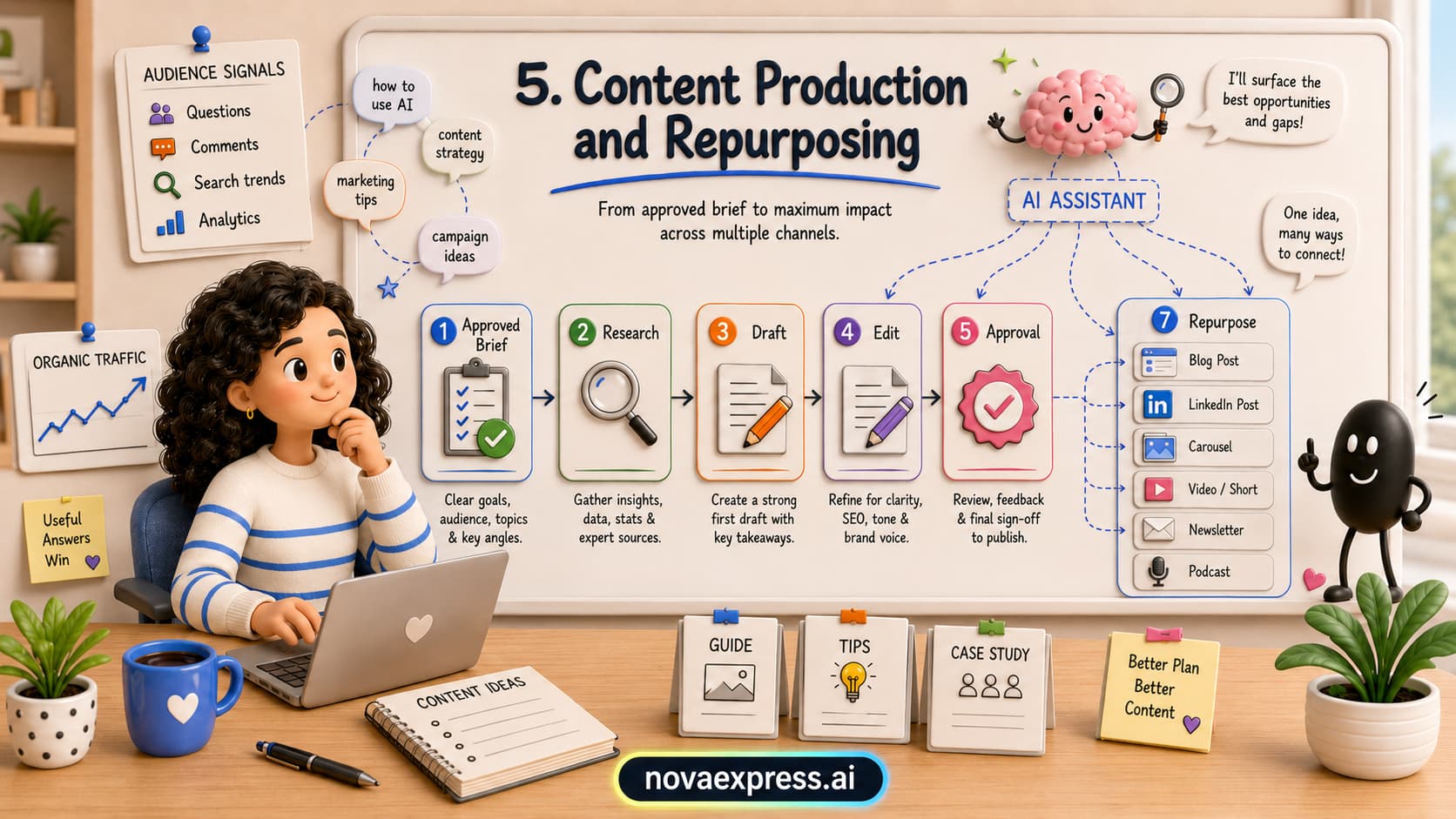
The operational detail matters here. Repurposed content should come from the approved source so that messaging and claims remain consistent across channels.
Track brief-to-publish time, editing time, revision rounds, how often approved content is successfully reused, and performance by distribution channel.
6. Email and Lead Nurturing
Email automation is already familiar to marketers. AI adds value when it helps the workflow respond to more context without requiring someone to manually prepare every variation.
A traditional sequence may send the same series of messages after a form submission. An AI-assisted workflow can use available lead signals to help identify intent, select relevant approved content, and prepare an appropriate message within defined rules.
Someone who repeatedly reads SEO guides may need different follow-up content from a prospect who has already visited pricing and product pages. The workflow can reflect that difference while still using approved claims, templates, and brand language.
Workflow: Lead signal → Intent or segment check → Content selection → Message preparation → Approval rules → Send → Response → Next step
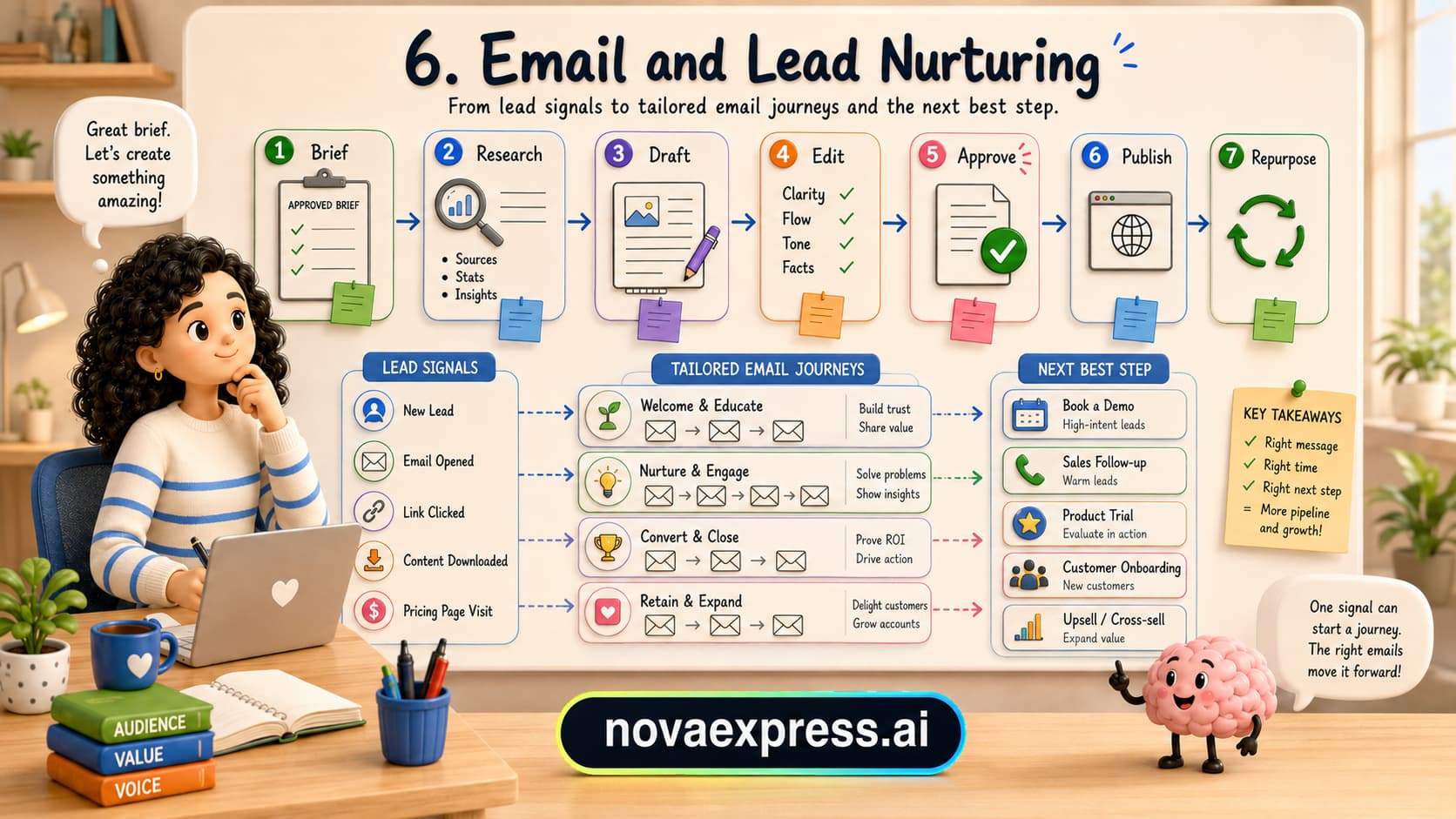
Human involvement should increase with the sensitivity and value of the interaction. A routine educational nurture sequence can operate with tighter predefined rules, while a high-value sales conversation deserves more individual judgment.
Useful measures include campaign preparation time, qualified responses, conversion rate, lead-to-opportunity progression, and unsubscribe rate.
7. Weekly Performance Review to Next Actions
Reporting is one of the clearest opportunities to remove repetitive work because marketers often spend more time gathering numbers than interpreting them.
A weekly review may require data from analytics, search, email, social, paid media, and campaign systems. AI can help collect or organize agreed metrics, compare periods, identify unusual changes, and prepare a concise summary for review.
The marketer then applies business context. An increase in traffic may come from rankings, seasonality, a campaign, or an unexpected referral. A drop in conversion might reflect weaker traffic quality rather than a problem with the landing page.
Workflow: Collect data → Compare → Flag changes → Add context → Human interpretation → Next actions
Columbia Business School has highlighted the same broader issue in its research on AI deployment: measurable productivity depends on strong data foundations, well-designed workflows, and human judgment, especially when people have to evaluate what AI recommends.
The workflow should be evaluated by reporting preparation time, meaningful issues surfaced, decisions recorded, and progress against the business KPIs the team already uses.
What Should AI Handle, and What Should Stay Human?
The line does not need to be complicated. Repetitive work with clear inputs and clear review criteria is usually easier to delegate to AI. Decisions involving strategy, customers, reputation, money, or important public claims need stronger human ownership.
| Marketing work | AI is useful for | Human responsibility |
|---|---|---|
| Campaign planning | Organizing inputs, first-pass briefs | Objective, offer, positioning, approval |
| Competitor research | Monitoring, comparison, summaries | Strategic response |
| Customer research | Clustering themes and language | Interpretation and prioritization |
| SEO planning | Research, grouping, gap analysis | Investment decision |
| Content production | Research, drafts, variations | Argument, accuracy, editorial judgment |
| Email nurturing | Intent support, content selection, variations | Strategy and sensitive communication |
| Reporting | Collection, comparison, summaries | Interpretation and next actions |
Research from Harvard Business School provides a useful warning here. Generative AI can help people work faster and stretch into adjacent tasks, but expertise still affects the quality of execution. AI assistance does not automatically give a novice the judgment of an experienced practitioner.
For marketers, that means automation should make expertise easier to apply rather than burying the marketer under more output to review.
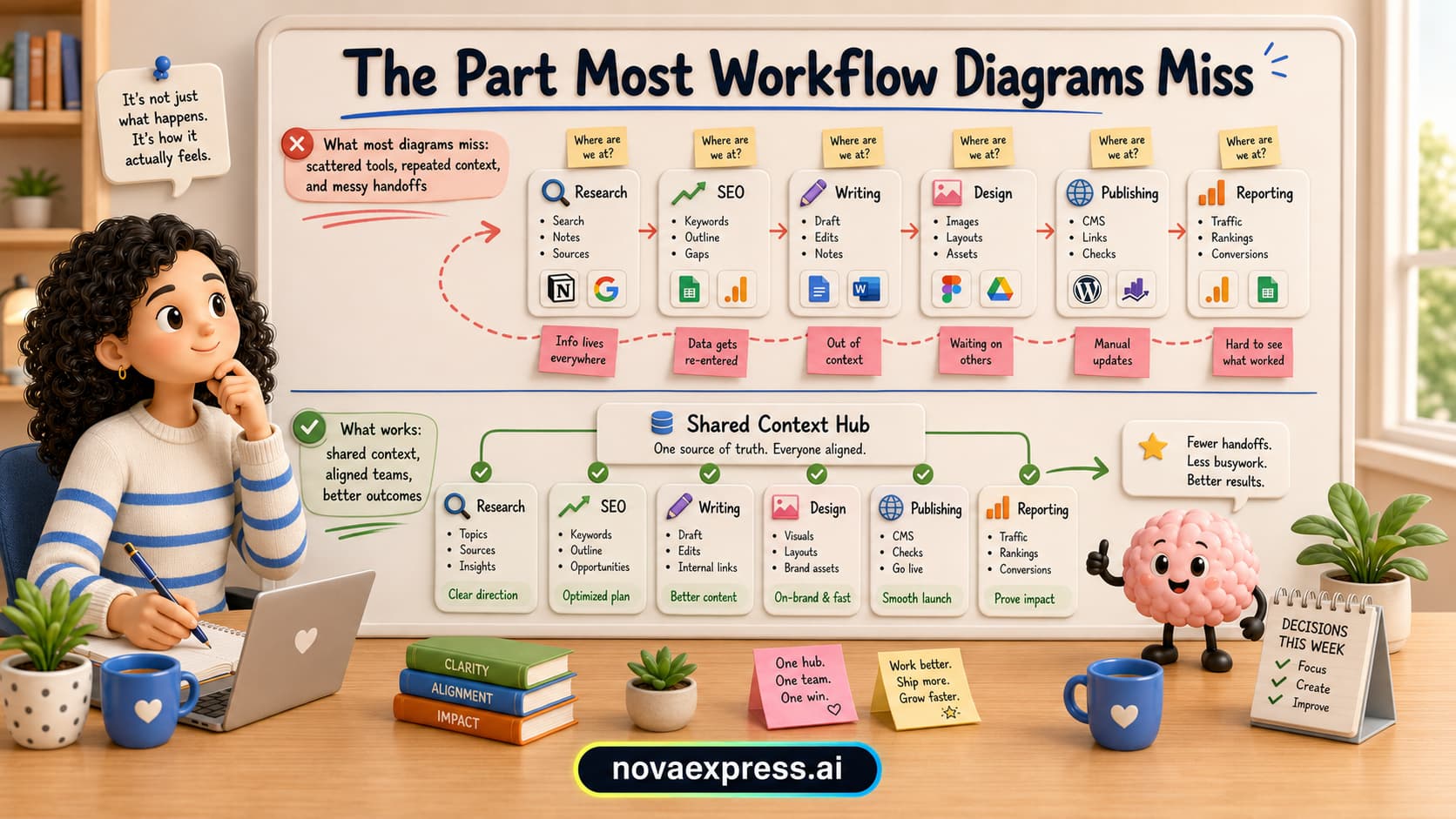
The Part Most Workflow Diagrams Miss
A large amount of marketing friction lives between the visible stages of a workflow.
Research may happen in one platform, SEO analysis in another, writing somewhere else, visual production in another tool, publishing in another system, and measurement across several dashboards. Each product may perform its individual task well while the marketer remains responsible for moving the context between them.
Those handoffs create small pieces of work all week: copying research into a brief, locating an approved version, repeating the audience description, checking which claim changed, moving finished copy, and briefing another system on information the previous one already had.
Shared context becomes more valuable as AI appears in more parts of the workflow. Audience, positioning, products, competitors, approved claims, brand voice, and current priorities need a reliable home so each task can use the context it needs without recreating the business from scratch.
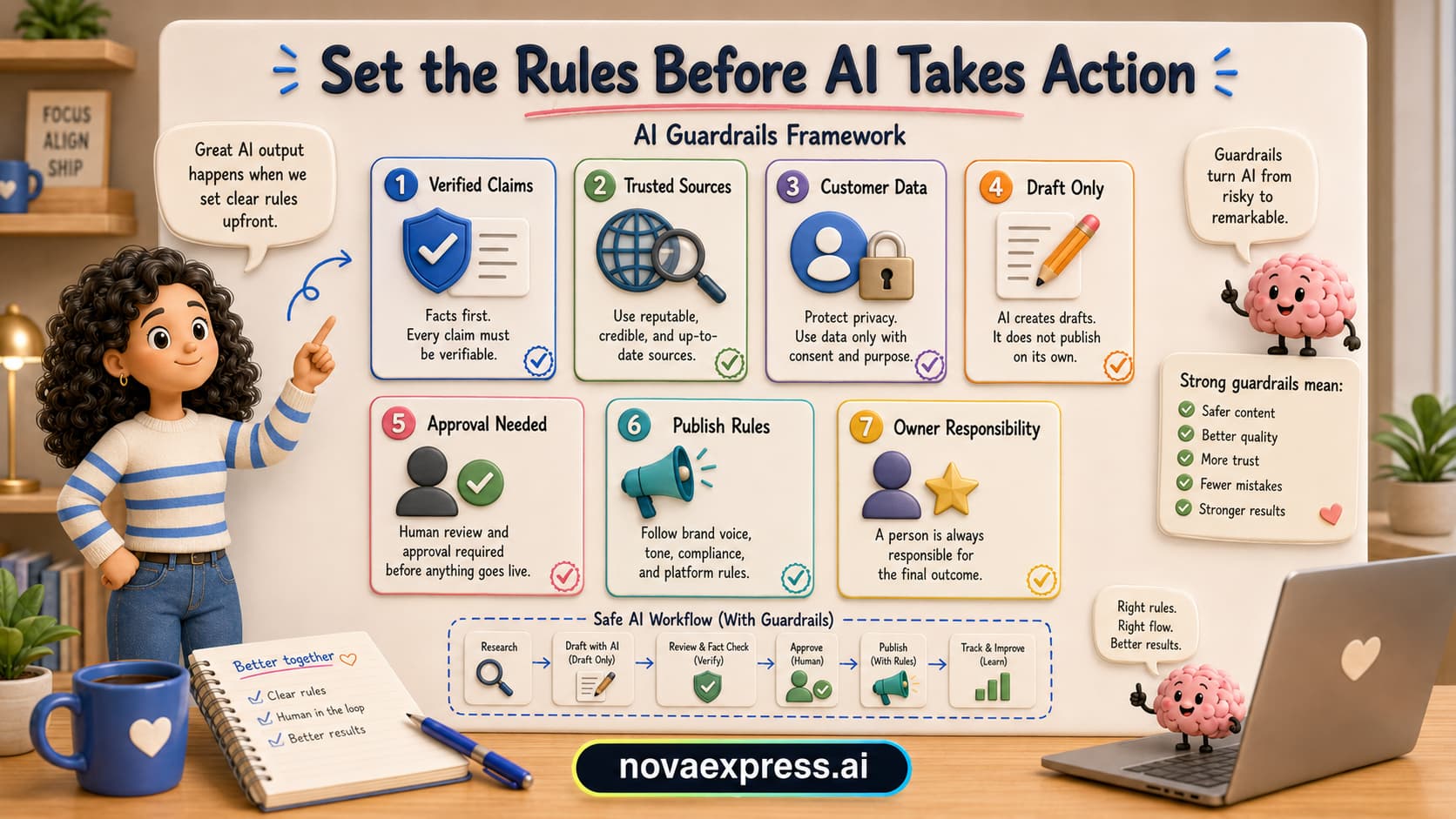
Set the Rules Before AI Takes Action
A connected workflow also needs clear boundaries.
Teams should know which claims require verification, which sources can be trusted, what customer information may be used, what AI can prepare automatically, what can move forward without another review, and who owns the final decision.
Kellogg includes governance alongside shared memory and orchestration in its AI-first marketing architecture for the same reason: coordination without control creates a different kind of operational problem.
For a solo marketer or small team, governance does not need to become another corporate process. A few explicit rules about evidence, approvals, publishing, and ownership are often enough.
How to Choose Your First AI Marketing Workflow
Start with a marketing process you already repeat and understand well. Map how it happens today, including the parts people rarely put into diagrams: copying information, waiting for approval, hunting for versions, rebuilding context, preparing reports, and transferring completed work into another tool.
Then choose one bottleneck. If reporting consumes two hours every Friday, begin there. If campaign briefs create three rounds of clarification before anyone can start, fix the brief workflow first.
Run the improved process several times before expanding it. Compare completion time, manual handoffs, revision effort, and the marketing result with the previous way of working.
A useful workflow should make the marketer’s job easier to operate. If automation produces more drafts, alerts, dashboards, or recommendations without reducing the work required to manage them, the workflow needs simplification.
Why We Are Building Nova Express Around This Problem
The same operational problem is shaping Nova Express.
We are designing the product around seven marketing intelligence areas covering competitors, trends, customer pain points, influencers, SEO, social media, and sentiment. Those functions are intended to work from a shared brand and business context, with execution tools for content ideas, copy, editing, and visual prompts available in the same workspace.
Nova Express is still in development. The product is being built around a problem marketers already face today: Individual AI tasks have become fast, while the coordination between research, context, decisions, approvals, and execution still consumes a significant amount of time.
If you are trying to build a more connected marketing system yourself, we are working on the same problem and documenting what we learn along the way at Nova Express.
Start With One Process
Pick one recurring workflow this week and map it as it actually happens. Look closely at repetitive work, handoffs, approval delays, and places where the same context has to be explained again.
Improve one bottleneck and measure the next few cycles.
A workflow that consistently gives a marketer useful time back is worth keeping. Complexity can come later.
Nova Express Resources
If you are working on the same problems, these guides are useful next steps:
- How to Run Marketing Solo in 2026: The 4-Loop System That Replaced My To-Do List
- What Is an AI Marketing Agent?
- Brand DNA: The Missing Piece Between Your Brand and AI
- What Competitor Analysis Reveals About You (Not Just Them)
- Customer Pain Points: Why Your Marketing Isn’t Working
- The 2026 Marketing Audit: 15 Questions to Ask Before You Spend Another Dollar
- 50 Places to Find Your First Client (Most People Only Check 3)
- How to Use AI to Build a Marketing Strategy From Your Website
- Best AI Video Generators for Marketers in 2026
- What Are AI Tokens? A Marketer’s Guide to Context, Cost, and Limits
About the author
Serafima Osovitny is a Marketing Manager at Nova Express, where she focuses on digital marketing, search visibility, content strategy, and marketing workflows. She writes practical guides that help marketing teams research their audiences, develop strategies, and put their plans into action.
Explore her work at serafima.digital and follow her on X: @OSerafimaA.








Leave a Comment