

A freelancer or solo service-based business posts on LinkedIn on Monday. Updates their Upwork profile on Tuesday. Sends four Fiverr proposals on Wednesday. By Friday, still nothing, and the conclusion is usually “there’s no demand for what I do.”
That’s rarely true. Most people trying to find freelance clients search 3 places while ignoring dozens of others where someone is actively looking for exactly what they offer. Client acquisition for freelancers isn’t about being everywhere; it’s about being in the right places.
Key takeaways:
- Job boards and freelance marketplaces are the most crowded, most competitive places to find a client, not the only ones.
- Directories, local groups, and niche communities carry buying intent that never shows up on a marketplace search.
- The fastest first client usually comes from a personal connection or an inbound signal, not a cold application.
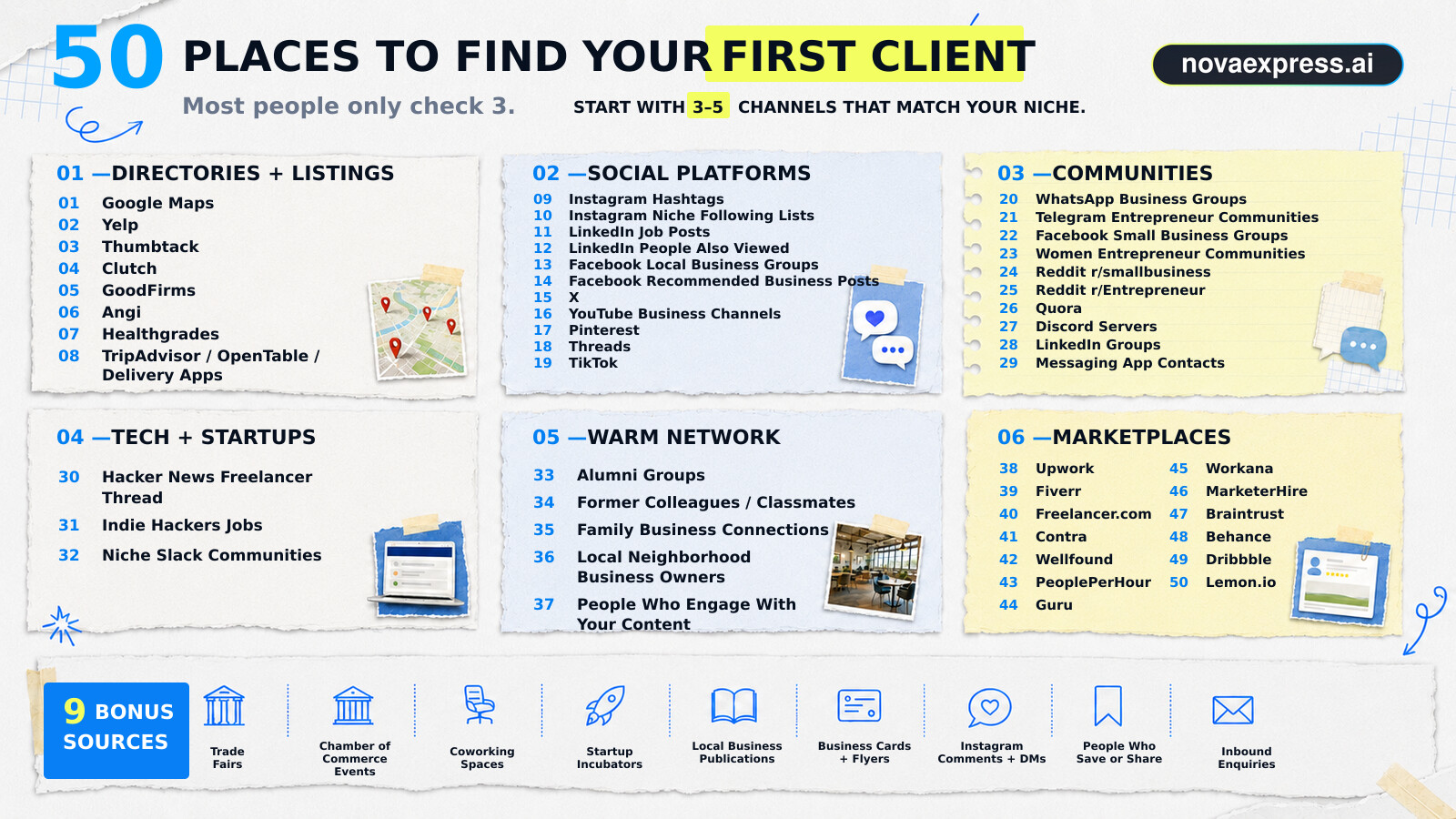
Why Directories and Listings: Where to Find Freelance Clients Online
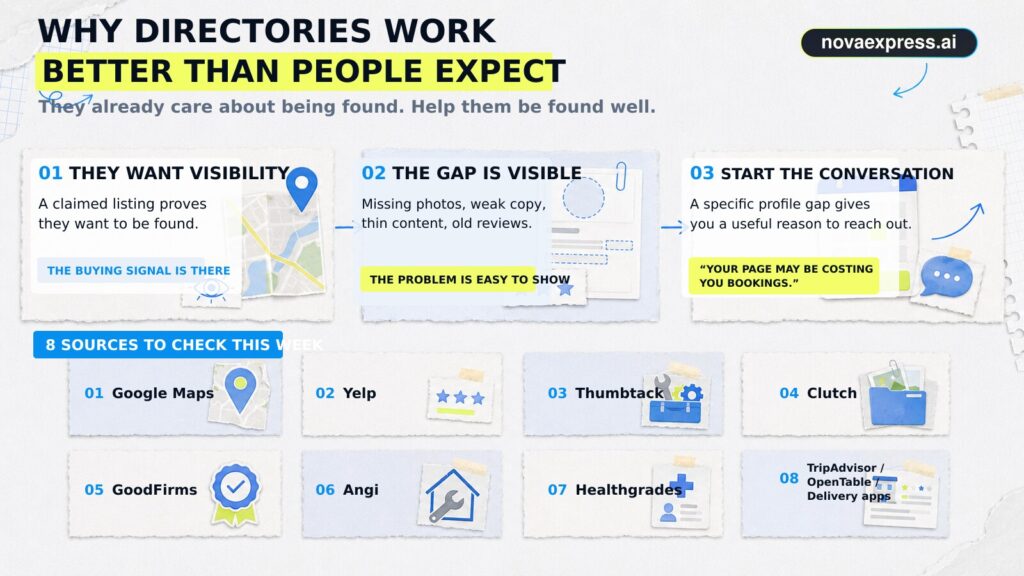
Businesses that list themselves on directories already have a visibility mindset. That’s the whole reason to start your prospecting here: they’ve shown they care about being found.
Google Maps is the clearest example. Local businesses depend on it for calls and directions, and most profiles are still half-filled out, missing photos, missing a real description, and missing recent reviews. Yelp works the same way. Anyone who claims a profile there already values reputation, which makes “your page is costing you bookings” an easy conversation to start.
Thumbtack is full of service pros who rely on the platform but have no brand outside it. Clutch and GoodFirms carry the same pattern for agencies: everyone cares about credibility, but few have the content to back it up. Angi shows the identical gap for local trades. Healthgrades covers healthcare providers who care about trust but stop at a basic listing. TripAdvisor, OpenTable, and delivery apps are where hospitality businesses get reviews and traffic while their own site sits untouched.
Eight sources to check this week: Google Maps, Yelp, Thumbtack, Clutch, GoodFirms, Angi, Healthgrades, and TripAdvisor / OpenTable / delivery apps.
Social Media Platforms to Find Your First Client
Most people treat social media as somewhere to publish. It also works as a live map of who needs help right now and as a free lead generation channel if you use it that way.
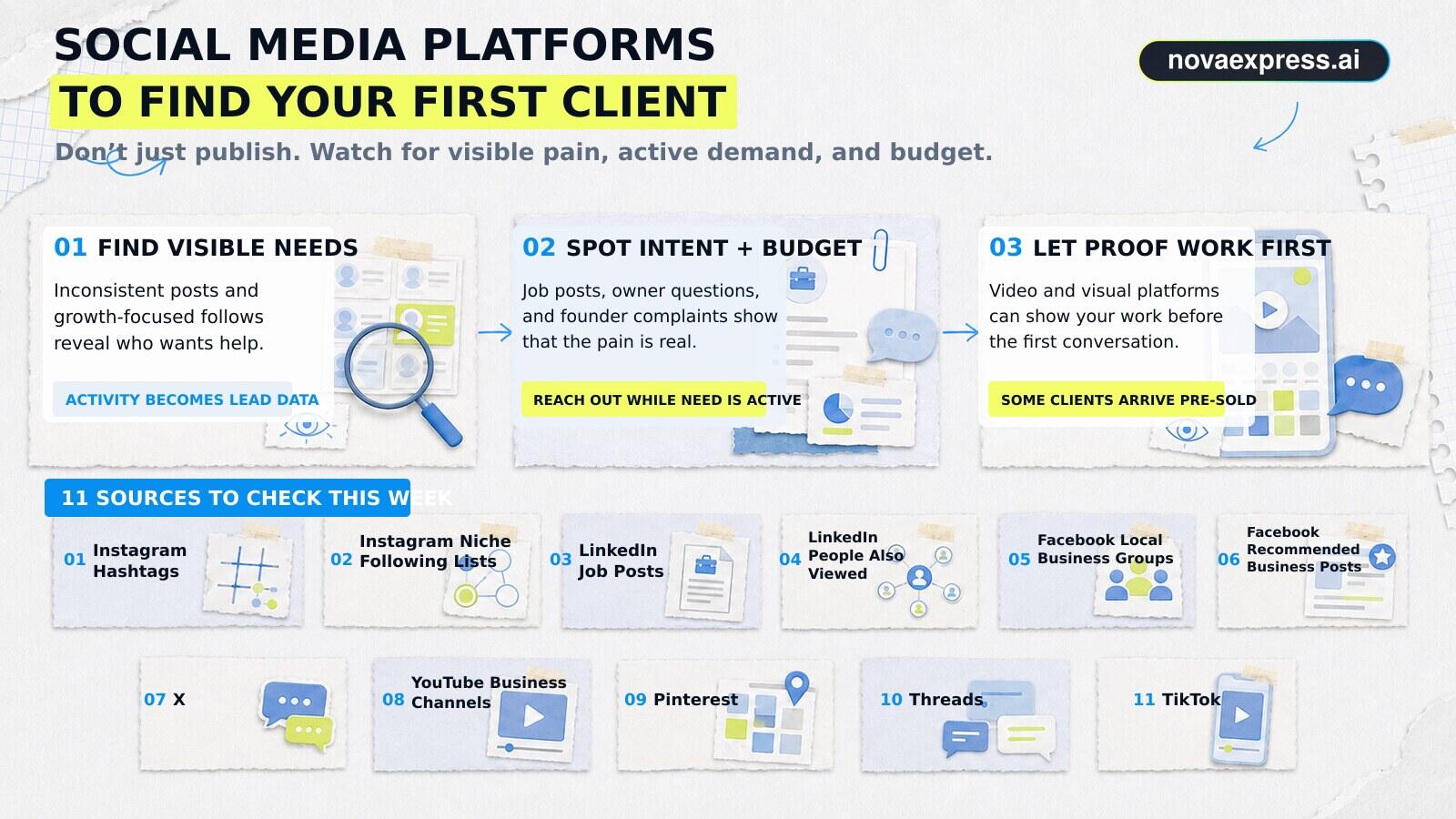
Instagram hashtags surface small businesses posting inconsistently with no system behind it. Their following lists are even more useful: a business already following growth-focused accounts is signaling that it wants to level up.
LinkedIn does a lot of quiet work here. A job posting for a marketing or growth role means the pain is real, and some of those companies would rather hire a freelancer than fill the seat. For B2B lead generation, this is often the fastest signal that there is budget. “People Also Viewed” on a strong founder profile turns into a shortcut to a dozen similar decision-makers.
Facebook local business groups are where owners ask the blunt, practical questions they’d never post somewhere “professional.” Recommended business posts show the same gap from a different angle: high reach that never turns into bookings.
X is where founders vent about real problems in real time, which makes intent easy to spot early. For freelance marketing specialists, this is often the first place a pain point becomes public. YouTube has plenty of business channels running with no strategy behind them. Pinterest still performs well in visual niches like interiors, food, and weddings. Threads already has genuine business conversations happening, with less competition for attention than on older platforms.
Worth adding for visual niches: TikTok has stopped being just a platform for younger audiences. For designers, video editors, and social media specialists, it works as a living portfolio, one where an algorithm handles the distribution for you. Some clients show up already having watched you work, before you’ve said a word to them.
Eleven sources to check this week: Instagram hashtags, Instagram following lists of niche accounts, LinkedIn job postings, LinkedIn “People Also Viewed,” Facebook local business groups, Facebook recommended business posts, X, YouTube business channels, Pinterest, Threads, and TikTok.
Online Communities and Groups for Client Prospecting
People go to these places to talk, not to be sold to, and that’s exactly why they work as a source of clients.
WhatsApp Business groups are where local owners already spend time, right where their buying decisions actually start. Telegram entrepreneur communities skew a little more ambitious: founders, creators, and operators who are actively exploring how to grow. Facebook groups for small business owners are where the real, unfiltered version of a problem gets posted, not the polished one. Women’s entrepreneur communities tend to be unusually collaborative and open to introductions, which makes a direct approach land better than in most spaces.
Reddit’s r/smallbusiness surfaces direct, honest questions that reveal what people actually need help with. r/Entrepreneur runs a level up from that: founders openly discussing growth, scaling, and how to get customers. Quora is where people look for answers before they’ve decided to hire anyone, which makes it a good place to be the answer that leads them there. Discord servers work well for startup teams talking about product, growth, and hiring in real time. LinkedIn groups gather decision-makers around a shared topic, which beats searching for individuals one by one. And the most skipped channel on this entire list is the one already sitting in your phone: your messaging app contacts, full of warm relationships and referral paths you haven’t used yet.
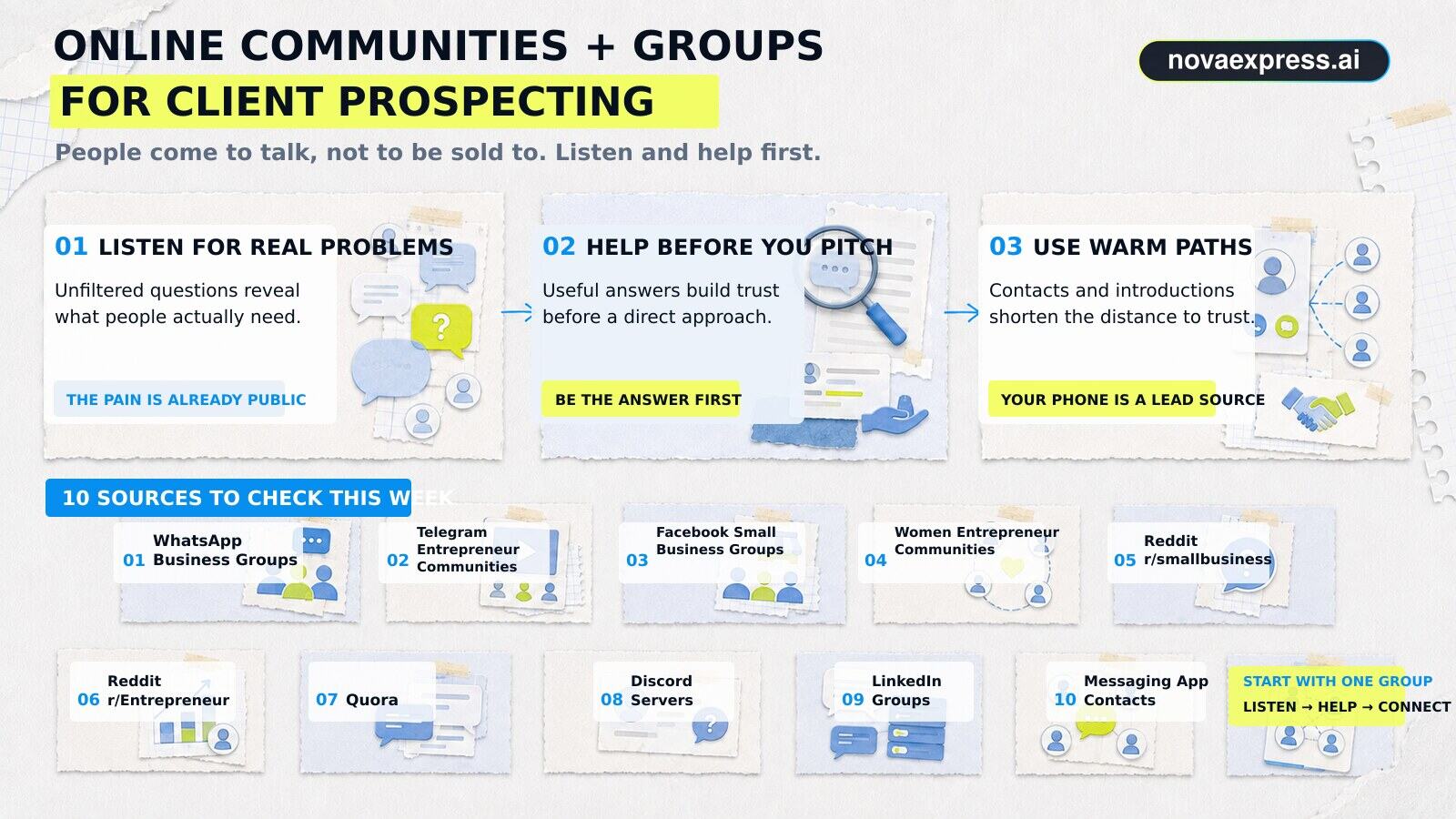
Ten sources to check this week: WhatsApp Business groups, Telegram entrepreneur communities, Facebook groups for small business owners, women entrepreneur communities, Reddit r/smallbusiness, Reddit r/Entrepreneur, Quora, Discord servers, LinkedIn groups, and your messaging app contacts.
Tech and Startup Communities Are Underused for a Reason
These places reward specificity, which is exactly why fewer freelancers bother showing up in them.
Hacker News runs a monthly thread where startup founders, many of them YC-backed, post that they’re hiring a freelancer or looking for one directly, with no platform fee sitting between you and the client. It’s especially strong for developers, designers, and growth-focused marketers. Indie Hackers has a jobs section that stays under most people’s radar, which usually means fewer applicants per post. Solo founders post there when they need help with a landing page, copy, or automation, and they’re often paying out of pocket, so the conversation is direct.
Niche Slack communities work the same way from a different angle. Groups built around a specific skill- marketing, growth, no-code, writing- tend to produce warm referrals with a real budget behind them, because everyone in the room already trusts whoever’s making the introduction.
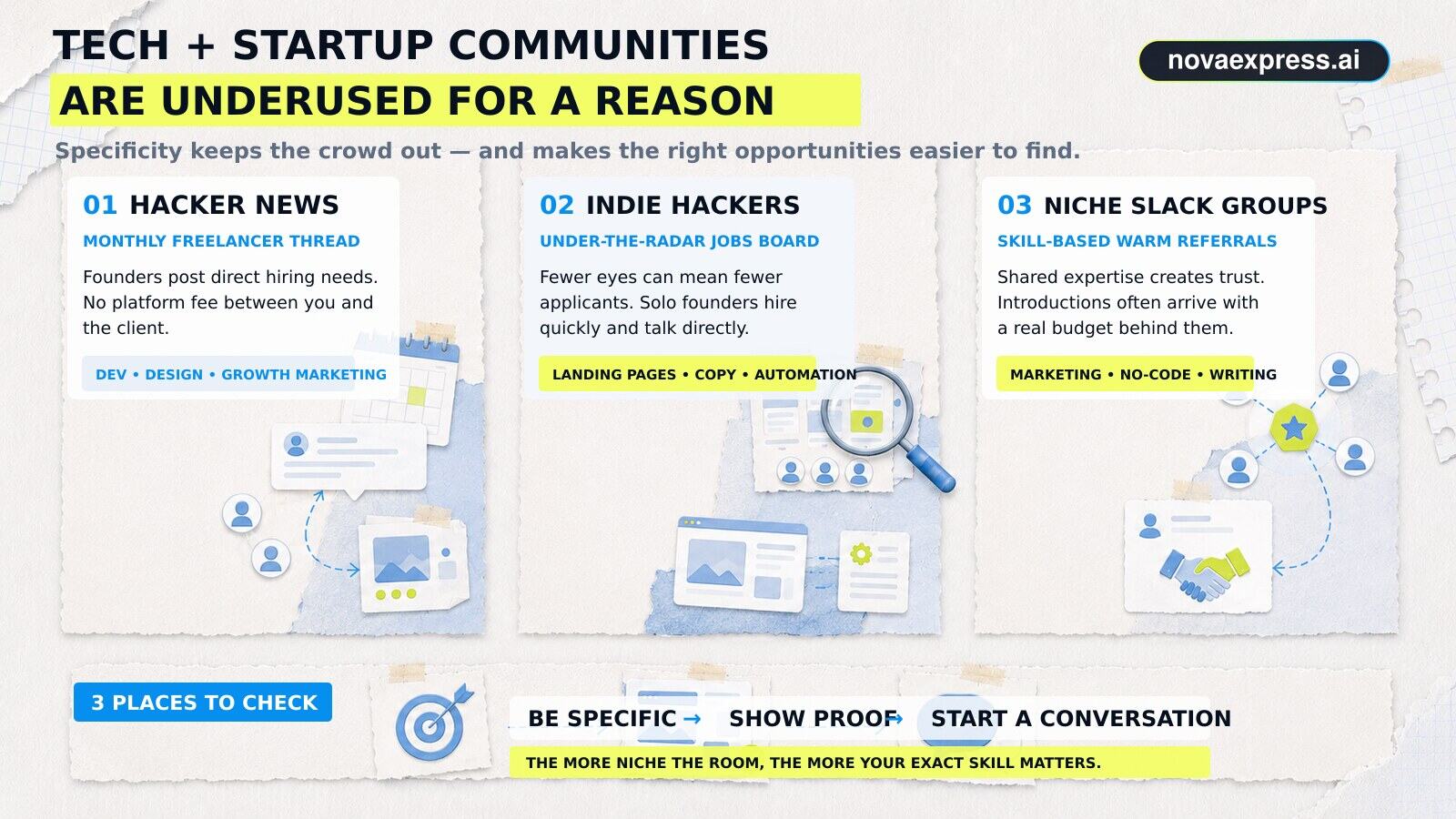
Three more places to check: Hacker News’s monthly freelancer thread, the Indie Hackers jobs board, and a Slack community built around your specific skill.
Your Personal Network Converts Faster Than Anything Cold
This is the fastest path to a first client because the trust already exists.
Alumni groups work because a shared background builds trust faster than any cold message could.
Former colleagues and classmates who started a freelance business or agency of their own give you the same advantage. Familiarity lowers the barrier before you’ve pitched anything.
Family connections go further still. Trust transfers almost instantly through an introduction, which is why family and friends end up being so many people’s first clients.
Local neighborhood owners are worth a real conversation. In-person trust carries weight with businesses that rarely get thoughtful outreach from anyone.
People who already engage with your content deserve a direct follow-up. They know your name and have shown interest. That puts them ahead of a cold lead before you’ve said a word.
Check these five this week:
- Alumni groups
- Former colleagues or classmates who started businesses
- Family business connections
- Local neighborhood business owners
- People who engage with your content
Spotting that interest is only half the job. If your outreach reads like a pitch instead of a conversation, even a warm lead goes cold. The exact gap is covered in Customer Pain Points: Why Your Marketing Isn’t Working.
A Note on Cold Messages
Sometimes there’s no connection to lean on, and cold outreach is the only option. The ones that get a reply follow the same shape.
Mention something specific about their product or business. Reference a similar result you delivered for someone else. Ask for fifteen to twenty minutes. That’s it. Three sentences. Generic outreach gets ignored. Specific outreach gets read and often gets a short reply, even when the answer is no.
Best Freelance Marketplaces for Beginners
Upwork works because the client already has a need and is actively searching for someone to fill it; no convincing required. Fiverr works differently: it rewards a narrow, outcome-focused offer that’s easy to understand at a glance, not a broad list of services. Freelancer.com sees demand across almost every industry but only pays off once you’ve picked one niche and made that positioning obvious. Contra, Wellfound, PeoplePerHour, Guru, and Workana round out the list, each with its own niche and pay band. The mistake isn’t using these platforms. It’s using only one and assuming the algorithm owes you a client.
A few niche alternatives are worth a look depending on what you do. MarketerHire skips bidding entirely for marketing specialists: clients reach out to you directly, with no commission taken off your rate. Braintrust runs a similar no-commission model for enterprise clients through a token-based system. Designers usually do better on Behance and Dribbble, where inbound interest builds around a portfolio instead of a cold pitch. And Lemon.io vets candidates upfront and matches developers with startups without any bidding involved.
Once a project wraps, don’t treat the relationship as closed. A short check-in two or three weeks later, just asking how the work is performing, opens the door naturally. If that conversation goes well, it’s the moment to suggest a small monthly retainer. It costs one message and does more for long-term revenue than chasing a brand new lead.
Check these thirteen:
- Upwork, Fiverr, Freelancer.com, Contra, Wellfound
- PeoplePerHour, Guru, Workana
- MarketerHire, Braintrust — no-bidding models
- Behance, Dribbble—portfolio-led
- Lemon.io — developers
The 50 are above. These last two sections are extras: channels that work but that almost nobody counts as a source of clients.
Bonus: Offline Presence Still Closes Deals
Business exhibitions and trade fairs put you in a room full of businesses actively pursuing growth and customers, which is a different energy than a cold DM. Chamber of Commerce events run the same way, full of owners and the people connected to them who make decisions. Coworking spaces hold founders, startups, and growing teams who need outside support more often than you’d think. Startup incubators and accelerators are even more direct: early-stage companies there are actively looking for growth support and traction, which is exactly what you’re offering.
Local business publications and listings are worth a look too. Plenty of advertisers there believe in promotion but still lack real online visibility. Business cards and flyers in local venues are the simplest tactic on this list, and they still work, mostly because offline discovery rarely gets matched with a strong online follow-up. That gap is where you come in.
Bonus: The Channel Almost Everyone Ignores
Comments and DMs on your own Instagram posts are far warmer than any cold lead, because whoever’s writing already knows who you are. People who save or share your content are sending an even stronger signal: saves and shares point to real intent in a way a like never does. And inquiries that show up on their own, because you’ve been publishing useful, consistent content, are close to pre-sold before they’ve said a word. Keep showing up, and some clients find you without being chased at all.
How to Start Finding Clients This Week: Action Plan
Don’t try to work all 50 at once. If checking channels ad hoc feels chaotic, Solo Marketing in 2026: The 4-Loop System That Replaced My To-Do List covers a lightweight system for deciding what to do each week without redeciding from scratch every time.
A simple rhythm helps more than the list itself. Aim for 10 new contacts a week, 10 people you actually research first so the outreach lands as relevant instead of generic, and 10 follow-ups on conversations already in motion. Pair that with a short daily habit: 20 to 30 minutes each morning spent purely on outreach, before anything else on the list, regardless of how the day looks otherwise. That rhythm is what turns a list of 50 places into an actual habit instead of a one-time scroll.
Try this in the next 30 minutes:
- Pick one audience: local small business, B2B and agencies, or your own existing following.
- If local: check 3 Google Maps or Yelp profiles in your area and note what’s missing.
- If B2B: search Clutch or LinkedIn for one company that fits your niche and read their last 5 posts.
- If you already have a following: go through your last 20 comments and DMs and reply to the 3 most relevant ones.
- Pick one personal connection from your network you haven’t reached out to in 6 months. Send a message today.
FAQ
Do I need to be active on all 50 channels? No. Most freelancers get their first few clients from 3 to 5 channels that match their niche. The list is here so you know your options, not so you work through it in order.
Which channel converts fastest for a first client? Personal network and inbound engagement, in most cases. There’s already trust or proven interest, so the conversation starts warmer than a cold application ever does.
Are freelance marketplaces worth the effort given the competition? Yes, but not as the only channel. They work best combined with a directory, a community, and your personal network, so you’re not depending on one algorithm for all your leads.
Your first client rarely comes from the one channel you bet everything on. It comes from showing up consistently in a few places at once.
Next up: The 2026 Marketing Audit: 15 Questions to Ask Before You Spend Another Dollar. Once you’ve got clients coming in, this is where to check that your spend isn’t leaking.
Nova Express Resources
- Solo Marketing in 2026: The 4-Loop System That Replaced My To-Do List
- Customer Pain Points: Why Your Marketing Isn’t Working
- 9 Copywriting Tricks That Sell
- The 2026 Marketing Audit: 15 Questions to Ask Before You Spend Another Dollar
- AI Marketing Workflows: 7 Practical Examples for 2026
- How to Use AI to Build a Marketing Strategy From Your Website
About the author
Serafima Osovitny is a Marketing Manager at Nova Express, where she focuses on digital marketing, search visibility, content strategy, and marketing workflows. She writes practical guides that help marketing teams research their audiences, develop strategies, and put their plans into action.
Explore her work at serafima.digital and follow her on X: @OSerafimaA.








Leave a Comment