

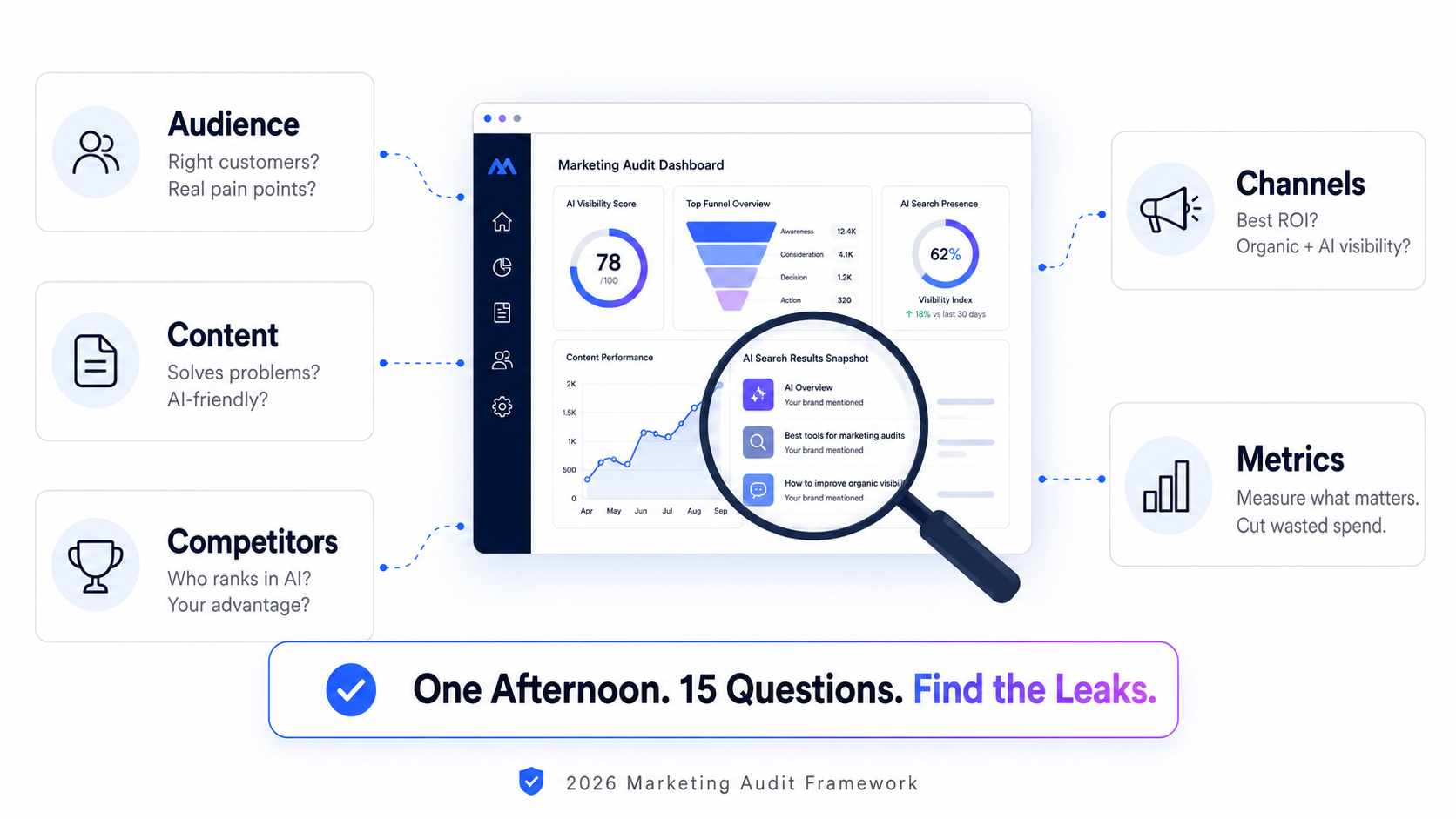
A practical marketing audit for 2026: 15 questions across audience, content, channels, competitors, and metrics. Find the leaks in your strategy in one afternoon. No tools, no consultants required.
A marketing audit is a structured review of your audience, content, channels, competitors, and metrics to find what is working, what is wasting budget, and what needs to change.
In 2026, a complete audit must also include AI visibility: how customers discover brands through AI search and which companies get recommended.
Most marketing budgets don’t fail because of bad ideas. They fail because no one stopped to check if last year’s assumptions are still true. In 2026, that gap gets expensive fast. AI search is already reshaping how buyers discover brands, and most teams are still operating on a 2024 playbook.
This audit is a fast reality check: 15 questions you can answer in one afternoon to find exactly where your budget is leaking and what to fix before you spend another dollar. If you can answer all 15 with evidence, spend away. If you can’t, you just found where your next dollar is leaking.
Here they are, grouped into the five areas where budgets quietly die: audience, content, channels, competitors, and metrics.
Why Audit Now? (The 2026 Problem)
AI search is changing how customers discover brands before they ever visit a website. Buyers now ask assistants for recommendations, comparisons, and solutions—and some brands appear while others disappear.
Google’s own AI optimization guidance confirms that generative results run on the same core ranking systems as classic Search, but what gets extracted and cited follows different rules than what gets clicked.
If your strategy was last stress-tested in 2024, you’re navigating a new map with old directions. The 15 questions below are the stress test.
Answer each one in writing. One or two sentences. “I think so” doesn’t count; “Yes, and here’s the document” does.
Block 1: Audience (Questions 1–3)
1. Can you describe your best customer in the exact language they use when searching for a solution?
The words customers use in search, reviews, and conversations are not just research. They are the foundation for content, positioning, and AI visibility.
Not “small businesses that want to grow.” Something like: “solo marketers at 10 to 50 person companies who handle everything alone and lose most of their week to routine.” Specific enough that a stranger could point them out in a crowd. If your positioning maps to no concrete question a buyer would actually ask, AI assistants can’t recommend you and ads can’t target you.
2. When did you last hear a customer describe their problem in their own words?
Not a rating scale. Not a multiple-choice form. Their actual words, from a review, a support ticket, a Reddit thread, a sales call recording, a chat log.
If your last real quote is more than a month old, your audience picture is a memory, not a fact. Three sources of raw voice will update it. Your next headline is already there: the exact phrases, the pauses, the words they repeat.
3. Do you know where your buyers actually research?
Google? ChatGPT? Reddit? A niche community? YouTube? “Everywhere” isn’t an answer, it’s a way to burn budget with no focus. Identify the two channels that brought your last five customers and focus your effort there. Not all of it (see question 10), but enough to stop spreading thin.
Block 2: Content (Questions 4–6)
4. Does your content answer real questions or fill a calendar?
Open your last five posts. For each one, name the specific question it answers and who asked it. If the honest answer is “we needed to publish something on Tuesday,” that’s calendar-filling. It costs money and earns nothing.
5. Can an AI engine extract an answer from your key pages?
Open your most important page. Is the core answer right there in the first two sentences, or is it buried under four paragraphs of fluff? AI assistants only cite pages they can easily quote. That’s exactly what we break down in What Is AEO?
Search is no longer just about ranking pages. It’s about creating clear, trustworthy information that both people and AI systems can understand and use.
6. Is anything on your site embarrassingly outdated?
Pricing from last year. A “2024 trends” post ranking for your brand name. A team page with two people who left. Outdated content doesn’t just look bad; it erodes the trust signals both Google and AI engines use to decide whether you’re a source worth citing.
Block 3: Channels (Questions 7–10)
7. Which channel produced your last ten customers?
Not impressions. Not traffic. Customers. Write the list. Most teams that do this discover the large majority of customers come from one or two channels, while the budget is split across six. That mismatch is the single most common leak an audit finds.
(If your channel attribution is guesswork rather than data, tagging your links with UTM parameters fixes that going forward.)
8. Are you visible where AI sends buyers?
Analytics shows visits. It does not show when AI recommends you or your competitor to a buyer who never clicks through.
Ask ChatGPT and Perplexity the 3 questions your customers ask most often before buying. Does your brand appear? Do your competitors? This 20-minute exercise is the fastest reality check in modern marketing.
Two things to check while you’re there: mentions vs. citations — is your brand just named, or does the AI actually link to your page as a source? And if you’re invisible, don’t panic yet — check whether it’s a content gap (no page answers that exact question) or a structure gap (the answer exists but isn’t extractable). If your brand is invisible to AI, we break down the exact mechanics in How AI Search Decides Which Brands to Show in Answers.
9. Is any channel running on autopilot?
The newsletter nobody has rethought since 2024. The paid campaign that renews monthly because turning it off feels risky. Autopilot channels are where budget goes to hide. Each one gets a decision: reinvest with a plan or kill it and reallocate.
10. Does your channel mix survive your worst week?
Teams shrink. Priorities shift. Attention fragments. A strategy that works only at full capacity isn’t a strategy; it’s a bet against reality. Build loops that keep running when bandwidth drops. We break this down in Solo Marketing in 2026: The 4-Loop System.
Block 4: Competitors (Questions 11–12)
11. What are your competitors saying that you aren’t — and where are they saying it?
Not just what they promise, but how they structure it. Three quick checks:
- Format: do they win with short, scannable bullet points (optimized for AI extraction) or long-form storytelling (built for human trust)?
- Citations: pull up their 3 most-cited pages in Perplexity. Are they using FAQ schemas?
- Cadence: are they publishing 5 times a week or once a month?
The gap between their content mechanics and yours is your cheapest strategic asset.
The full playbook is in What Competitor Analysis Reveals About You (Not Just Them).
12. When did you last check? (Honestly.)
Competitor analysis done once a year is archaeology. Markets shift in weeks now: pricing pages change, positioning pivots, new players appear. If your last real look was more than a quarter ago, you’re competing against a snapshot that no longer exists.
Block 5: Metrics (Questions 13–15)
13. Do you have one number that tells you if marketing worked this month?
Not a dashboard with 30 colorful charts. One number that moves when money moves: qualified leads, trials started, revenue influenced. If everything is a priority, nothing is. Pick the one. Let every other metric explain why it moved.
14. Do you know your cost per customer by channel?
Total spend per channel divided by customers from that channel. Approximate is fine. Most teams skip this math and miss the ugly truth: one channel at $40 per customer, another at $900 both funded the same. HubSpot’s State of Marketing report shows year after year that proving ROI is a top struggle. This division is where it starts.
15. Are you measuring visibility you can’t see in analytics?
Zero-click answers. AI citations. Brand mentions in communities where your tracking code doesn’t exist. Buyers meet your brand in places Google Analytics never records. If your measurement stops at sessions, you’re grading half the test and calling it a report card.
How to Score Yourself
Count your confident, evidence-backed answers:
- 13–15: Your foundation is solid. Spend with confidence, re-audit in six months.
- 8–12: Normal, and fixable. Take the three weakest answers and make them next month’s priorities.
- 0–7: Pause acquisition spend this week. Every dollar is leaking through the gaps you just found. Start with Block 1 (Audience, questions 1–3), one evening to go through your sales, support, and conversations. That locks in the foundation everything else depends on.
The point of the audit isn’t the score. It’s that you now know exactly where the leak is, and it’s almost never where the budget conversation was pointed.
The new marketing challenge: continuous visibility
A marketing audit shows where you are today.
But markets don’t stay still.
Competitors change. Customer language evolves. AI search changes how people discover brands.
The next challenge is not only knowing where you stand.
It is knowing what changed since yesterday.
Modern marketing teams need continuous visibility: the ability to see new signals, understand what matters, and act before opportunities disappear. The audit gives you a clearer picture of today. The next step is building the ability to monitor what changes tomorrow.
FAQ
What is a marketing audit?
A marketing audit is the process of checking whether your audience data, content, channels, and metrics still match reality. The 15 questions in this guide are a ready-to-use version you can run in one sitting, without hiring anyone.
How often should you audit your marketing?
Run a full 15-question audit twice a year, and a light check on channels and metrics (questions 7, 13, 14) quarterly. If you’re a one-person team handling everything, quarterly is enough. If you have a dedicated marketing hire or team, run the light check monthly, since markets and AI search behavior shift too fast for a once-a-year review to catch it.
Do I need a consultant or a tool to run a marketing audit?
No. The highest-value audit questions require honesty, not software: who your customer is, where your last ten customers came from, and what one number defines success. Tools help later, at the fixing stage.
I scored 0-7 — where do I actually start?
Block 1 first: Audience, questions 1-3. It’s the fastest to fix, one afternoon and one customer call, and every other block depends on getting this right. Fixing channels or content before you know your audience is building on sand.
What’s different about a marketing audit in 2026?
Three things:
- Speed: markets and AI models update in weeks, so an audit from January is archaeology by summer.
- AI visibility: ask ChatGPT and Perplexity your buyers’ questions and see who gets named.
- AI-ready structure: audit whether your key pages are built for extraction, not just rankings.
Block one afternoon this week. Answer all 15 questions in writing. Pick the three weakest answers and fix one before you spend anything new.
That’s how you stop guessing and start reallocating budget with confidence. New AEO and marketing guides go up on blog.novaexpress.ai every week; bookmark it if this was useful.
Related Reading
- What Is AEO? Answer Engine Optimization Explained Simply
- What Competitor Analysis Reveals About You (Not Just Them)
- How AI Search Decides Which Brands to Show in Answers
- 50 Places to Find Your First Client (Most People Only Check 3)
- AI Marketing Workflows: 7 Practical Examples for 2026
- Solo Marketing in 2026: The 4-Loop System That Replaced My To-Do List
- Best AI Video Generators for Marketers in 2026
- What Are AI Tokens? A Marketer’s Guide to Context, Cost, and Limits
- The Pre-Launch Content Sprint: A 30-Day Plan to Build an Audience Before Launch
- Why AI Engines Trust Reddit More Than Brand Content (And How to Change That)
About the author
Serafima Osovitny is a Marketing Manager at Nova Express, where she focuses on digital marketing, search visibility, content strategy, and marketing workflows. She writes practical guides that help marketing teams research their audiences, develop strategies, and put their plans into action.
Explore her work at serafima.digital and follow her on X: @OSerafimaA.








Leave a Comment