
You ask ChatGPT: “What’s the best CRM for a 10-person sales team?” Five seconds later, it names a brand, explains why it fits, and cites a source. No results page. No ten blue links. One answer.
That brand didn’t get there by accident.
It got there because its content was built to be the answer. That practice has a name: Answer Engine Optimization, or AEO.
And that answer is becoming the norm. 68% of US Google searches now end without a single click, up from 60.45% just two years ago (SparkToro, June 2026). When an AI Overview triggers, it cuts the click-through rate for position one by 58% (Ahrefs, December 2025). Gartner’s February 2024 prediction of a 25% decline in traditional search volume by end of 2026 (Gartner) is playing out on schedule. Your customers are not abandoning search, they’re abandoning the results page.
If your growth strategy still ends at “rank on page one,” you’re playing by rules the market has already rewritten. Here’s exactly how to become that brand, plus eight things you can fix on your site this quarter.
Key takeaways:
- AEO ≠ SEO. AEO is about being the answer, not ranking on page one.
- 68% of Google searches now end without a click (SparkToro, 2026).
- Eight practical steps below, no paid tools required.
What Is AEO? (One-Sentence Definition)
AEO is the practice of structuring your content so that AI answer engines (ChatGPT, Perplexity, Gemini, Copilot, and Google’s AI Overviews) choose it as the source when they answer a question.
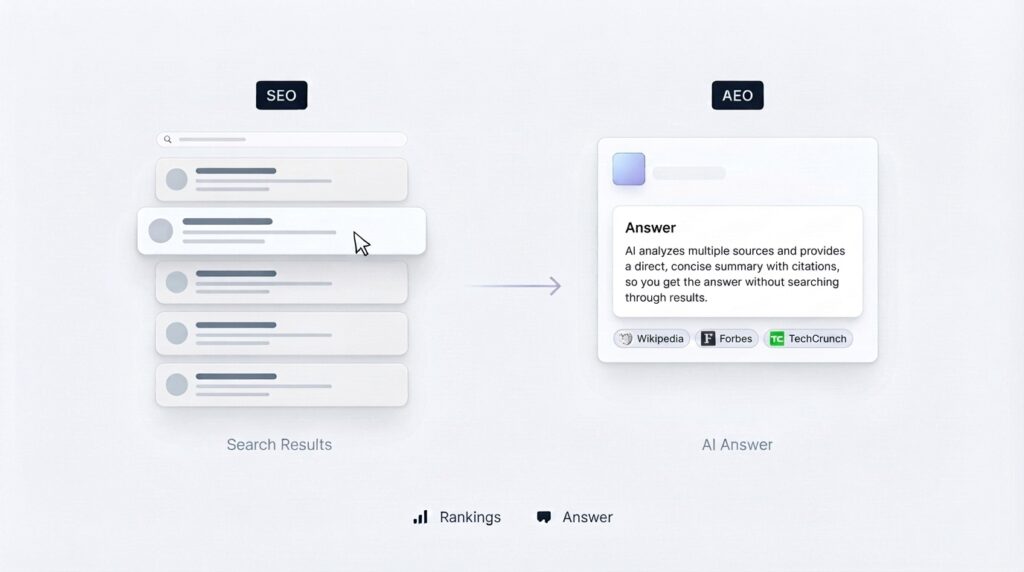
The distinction matters. Traditional SEO is a competition for position on a results page. AEO is a competition to become the source of AI paraphrases, quotes, or links when someone asks a direct question.
Two versions of the same search:
- The SEO version. Someone types “best CRM small business.” Google shows ten articles. They click on one, maybe two, compare, and decide.
- The AEO version. Someone asks, “What’s the best CRM for a 10-person sales team?” The AI answers directly, names two or three options, and cites the pages it trusted.
In the second version, there is no page one. There is only the answer. You’re either in it or you don’t exist.
What’s the Difference Between AEO, SEO, and GEO?
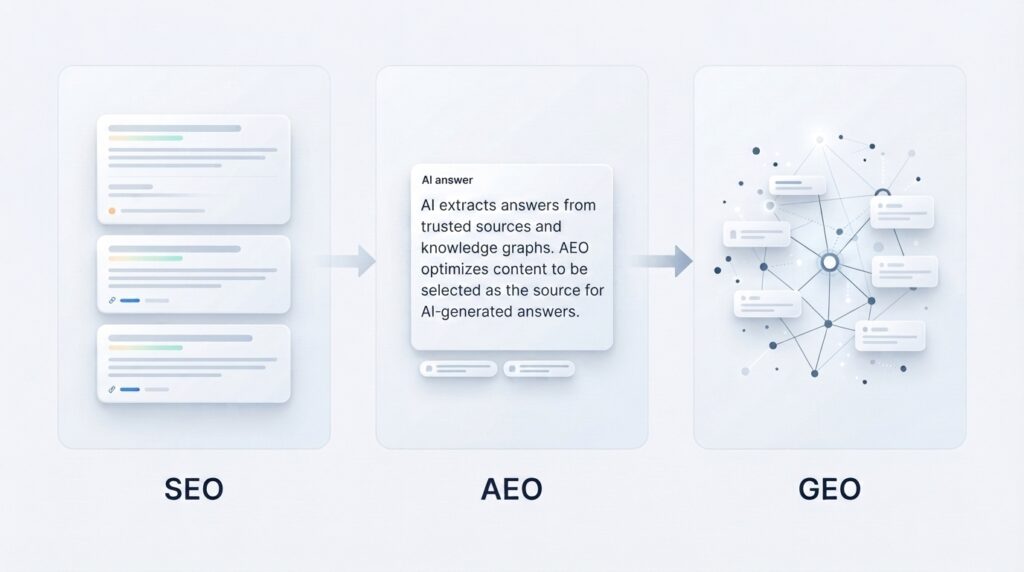
You’ve probably seen all three acronyms thrown around as if they were interchangeable. They’re not. They’re three layers of the same problem.
- SEO gets you found by search engines. Keywords, backlinks, technical health. Still the foundation: AI engines pull heavily from pages that already rank.
- AEO gets you chosen as the answer. Clear definitions, a direct question-answer structure, and extractable facts.
- GEO gets your brand understood across the AI ecosystem. Consistent entity data, mentions on third-party sources, presence in the places AI models learn from.
Think of it as a funnel: SEO makes you visible, AEO makes you quotable, GEO makes you recommendable.
We’ve covered the full comparison, including where a small team should spend its hours first, in AEO vs SEO vs GEO: What’s the Difference and Where to Start in 2026. This article goes deeper on the AEO layer, specifically.
How AI Engines Actually Pick an Answer
Most AEO guides skip this part, which is a shame, because once you see the mechanics, the tactics become obvious.
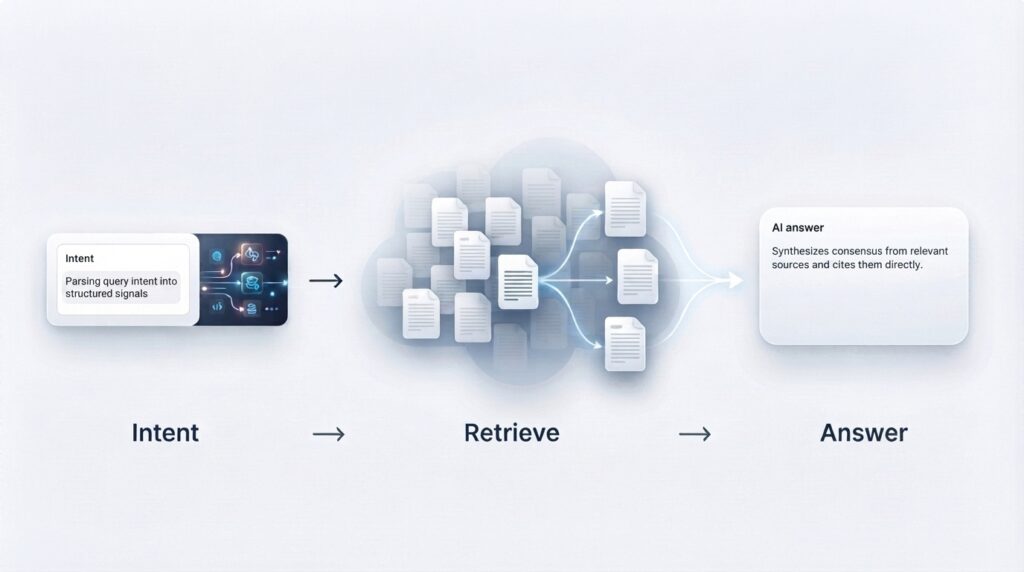
When you ask an AI assistant a question, three things happen in roughly a second:
1. It interprets the question. Not the keywords. The intent. “Best CRM for a 10-person sales team” gets parsed as product category, company size constraint, and use case. Vague content that never commits to a specific question can’t match a specific intent.
2. It retrieves candidate sources. Modern assistants don’t answer purely from memory. They run live retrieval, a technique called RAG (retrieval-augmented generation), pulling pages from search indexes and shortlisting the ones that address the intent most directly. Google confirms this in its official AI optimization guide: its generative features are rooted in the same core ranking systems as classic Search. There is no separate AI index. Which is why your SEO foundation still matters.
3. It synthesizes and cites. The engine compares the shortlisted sources, looks for consensus, and composes an answer. Sources that state facts plainly, agree with other trusted sources, and are easy to extract from get cited. Sources that bury the answer in paragraph 12 get skipped.
That third step is where most content fails. The AI found your page. It just couldn’t use it.
If you want the full picture of what “trusted source” means to a language model (authority signals, entity consistency, third-party corroboration), we broke it down in Why AI Cites Some Brands and Ignores Others: The Citation Stack Explained.
Research from Princeton University and Georgia Tech backs this up. They tested thousands of pages across real AI systems and found that simple structural changes dramatically increase citation rates. Adding quotation marks around key claims lifts AI citations by 41%. That was the single most effective tactic they tested.
How Different AI Engines Cite Differently
Not all answer engines play by the same rules. Understanding the platform you’re optimizing for changes your priorities.
ChatGPT is the most selective: it pulls from just 2–3 sources per answer and heavily favors content younger than 10 months. It also prioritizes consensus. If your claim appears on multiple trusted pages, you’re more likely to get cited.
Perplexity is more generous with citations, averaging 6+ sources per response, but it heavily favors Reddit, YouTube, and Wikipedia. If your brand isn’t discussed on these platforms, Perplexity may skip you even if your own page is well-optimized.
Google AI Overviews draw from the same index as classic Search: 76% of cited sources already rank in the top 10 organic results. This is why your SEO foundation is non-negotiable. AEO builds on ranking; it doesn’t bypass it.
Gemini and Copilot lean toward authoritative domains (.edu, .gov, major publishers) and fresh content. They also favor structured formats like tables, lists, and step-by-step guides over dense paragraphs.
Google AI Overviews also favor multimodal content: pages that combine text with tables, images, and video see a 156% higher selection rate than text-only pages. YouTube presence is one of the strongest correlating factors for AI Overview citations. If you have product demos, comparison tables, or explainer videos, embed them directly on your key pages, don’t hide them behind links.
8 Practical AEO Steps for Any Site
No platform, no subscription, no developer required for most of these. Just decisions.
1. Answer the question in the first two sentences
Open every article by directly answering the question in the title. Definition first, context after. AI engines extract answers; they don’t reward suspense. (Notice how this article started.)
2. Write question-shaped headings
Turn your H2s into the literal questions people ask: “What is AEO?”, “How do AI engines choose answers?” A heading that matches the query, followed by a direct answer, is the single most extractable pattern you can create.
3. Add an FAQ block to key pages
Three to five real questions, each answered in two to four sentences. Mark them up with FAQ schema if you can, but even without markup, the format itself is AI-friendly. Pull the questions from your sales calls and support inbox. Those are the queries people take to ChatGPT.
House them in a help center on your main domain, not a subdomain. AI engines treat subdomains as separate entities, which splits your authority. Cross-link related articles so AI crawlers see the full context of your expertise. Write for the edge cases: the specific integration failure, the unusual use case, the comparison your sales team answers three times a week. Specificity signals expertise.
4. State facts in standalone sentences
An AI can’t cite a claim it can’t isolate. “Our onboarding takes five minutes” is citable. A 60-word sentence where that fact hides between two qualifiers and a metaphor is not. One claim, one sentence, as often as you can stand it.
5. Use structured data where it counts
Article, FAQPage, and Organization schema are the big three. But for AEO specifically, add three more:
- HowTo schema. For step-by-step guides. AI engines extract steps directly into answers.
- Speakable schema. Marks up sections optimized for voice answers. Critical as voice search and AI assistants converge.
dateModifiedproperty (inside Article or WebPage schema). Tells engines when you actually updated the content, not just changed the date in the CMS.
Also, allow AI crawlers in your robots.txt:
User-agent: GPTBot
Disallow:
User-agent: ClaudeBot
Disallow:
User-agent: PerplexityBot
Disallow:
And consider creating an llms.txt file, a lightweight standard that tells AI systems what your site is about, similar to how sitemap.xml works for search engines. This is a one-time technical task, not an ongoing chore.
6. Show a Real Author and a Clear Brand Identity
Show a real author, and a clear brand identity. AI engines weigh credibility signals the same way Google’s quality raters do: a named author with a bio, credentials, and a track record beats an anonymous marketing blog. If your posts don’t have a proper author page yet, that’s a one-afternoon fix with compounding returns.
But don’t stop at the author. Create a single canonical proof page for your brand: an “About” or “What We Do” page that states who you are, what you solve, and who you serve in one unmistakable paragraph. Add a “How to describe us” line: one sentence you want AI engines to repeat verbatim. Use that exact wording across your homepage, About page, and key landing pages. Consistency is how AI engines build confidence in your entity.
7. Use dateModified to Signal Real Updates
Answer engines prefer fresh sources for anything that changes, and Google’s own guidance on succeeding in AI search keeps coming back to the same theme: unique, satisfying, people-first content wins across both classic and AI results. Update your cornerstone articles quarterly, but do it meaningfully. One signal that works: include the year in your title when the topic evolves fast. “Best CRM for Small Business” gets stale; “Best CRM for Small Business in 2026” signals freshness to both readers and AI engines. Just make sure you actually update the content when you update the year. Empty year-swapping is a trust killer. AI engines detect cosmetic updates.
A real refresh includes:
- New statistics and research (replace anything older than 12 months)
- Updated examples and case studies
- Revisited competitor context (what’s changed in the market?)
- A clear changelog at the top: “Updated July 2026: added new Perplexity citation data, refreshed tool recommendations”
Use dateModified schema to signal real updates. Fake freshness gets detected; real freshness gets cited.
None of these steps are exotic. That’s the point. AEO in 2026 is less about hacks and more about writing the way machines read. Which, conveniently, is also the way busy humans read.
8. Get mentioned where AI engines learn
Here’s a counterintuitive fact: 84% of AI citations come from earned media third-party coverage, not brand-owned pages (Muck Rack, 2026). If your only presence is your own website, you’re invisible to most citation algorithms.
Three places to show up:
- Review platforms (G2, Capterra, Trustpilot). Brands mentioned consistently across several independent platforms are significantly more likely to appear in ChatGPT responses than brands visible only on their own site. The reviews themselves become source material.
- Reddit and Quora. Perplexity cites Reddit more than almost any other domain. Genuine discussions about your product not astroturfing build trust signals that AI engines weigh heavily.
- Wikipedia and knowledge bases. For established brands, a well-sourced Wikipedia page is a citation magnet. For newer brands, focus on getting listed in industry roundups and comparison articles on authoritative publishers.
💡 Proactive move most brands skip: find the listicles and comparison articles that already appear in AI answers for your target queries. Search “best [your category]” in Perplexity, note which articles get cited, then pitch those publishers on why you belong on their list. AI engines cite what already ranks; getting into existing high-citation content is faster than building authority from zero.
This is GEO territory, but it directly feeds AEO: the more places AI finds consistent, positive mentions of your brand, the more likely it is to choose you as the answer.
How Do You Track AI Citations?
Start with a manual audit, then automate what works.
The monthly manual audit. Run the 10–15 questions your customers actually ask through ChatGPT, Perplexity, and Gemini. Track four metrics over time:
- Citation frequency: how often your brand appears across questions.
- Share of voice: what percentage of answers mention you vs. competitors.
- Citation position: are you named first, second, or buried in the list?
- Answer sentiment: is the AI’s description of you positive, neutral, or negative?
The GA4 setup. Create a custom channel group that captures traffic from perplexity.ai, chatgpt.com, and gemini.google.com as “AI Referrals”. Track two signals: volume (how much traffic) and engagement (how long they stay). Visitors arriving from AI platforms spend 68% more time on sites than organic search visitors — about 9 minutes per session vs. 5.5 (SE Ranking, 2026). If your AI traffic bounces in under 2 minutes, your landing page doesn’t match the promise the AI made in its answer.
Repeat monthly: AI citation patterns shift as models update, and monthly tracking catches trends before they hurt you.
Does AEO Replace SEO? (What It Won’t Do)
A dose of honesty before you rebuild your content calendar.
AEO won’t replace SEO. Retrieval still runs on search indexes; a page that ranks nowhere rarely gets cited anywhere. It won’t produce overnight results either. Citation is a trust game, and trust accumulates. And it won’t save weak content.
Four common mistakes to avoid:
Using old KPIs. Tracking only organic sessions misses the point. Add AI citation frequency, share of voice, and referral engagement to your dashboard.
Publishing more instead of answering better. AI engines don’t reward volume. A single page that directly answers a question outperforms ten pages that circle around it.
Ignoring the trust layer. No author bio, no cited sources, no clear publication date. AI engines treat your content as untrusted by default.
Keeping content only on your domain. 84% of AI citations go to earned media, not brand-owned pages. If you’re not discussed on review platforms, Reddit, or industry roundups, you’re invisible to most citation algorithms.
What it will do is make sure that when the answer engines look at your topic (and they are looking, right now, every day) your pages are the easiest ones to quote.
Not every business needs AEO first. Here’s how to prioritize based on what you sell:
- E-commerce and local businesses: Start with SEO, layer in AEO. You still need foot traffic and product page visibility.
- Professional services and consultancies: Start with AEO. Your clients ask specific questions before they ever search for a vendor.
- SaaS and tech brands: Start with GEO. AI engines need to understand your entity across the ecosystem before they’ll recommend you.
- B2B enterprise: GEO and SEO in parallel. Long sales cycles mean brand consistency matters as much as discovery.
If you run marketing solo, regardless of industry, AEO is the engine behind your discovery loop: it decides whether new people find you at all while you work on everything else.
FAQ
What does AEO stand for? AEO stands for Answer Engine Optimization: the practice of optimizing content to be cited in answers generated by AI assistants and answer engines like ChatGPT, Perplexity, Gemini, and Google’s AI Overviews.
Is AEO the same as GEO? No. AEO focuses on making individual pages quotable in AI answers. GEO (Generative Engine Optimization) is broader: it’s about making your whole brand visible and consistent across generative AI systems. We compare them in detail in What Is Generative Engine Optimization?
Do I still need SEO if I do AEO? Yes. AI engines retrieve candidate sources largely from search indexes, so pages that rank well are far more likely to be cited. AEO builds on SEO; it doesn’t replace it.
How do I know if AI engines cite my brand? Run the 10–15 questions your customers actually ask through ChatGPT, Perplexity, and Gemini once a month, and note who gets named. Track four things: citation frequency, share of voice, citation position, and answer sentiment.
For a deeper look at why certain brands appear in those answers, see How AI Search Decides Which Brands to Show in Answers.
Want more practical guides on AI search and marketing? Follow the Nova Express Blog for new posts every week. No fluff, no spam.
Related reading:
- What Is an AI Marketing Agent?
- What Is Generative Engine Optimization?
- The Pre-Launch Content Sprint: A 30-Day Plan to Build an Audience Before Launch
- AEO vs SEO vs GEO: What’s the Difference and Where to Start in 2026
- Customer Pain Points: Why Your Marketing Isn’t Working
- AI Tools for Marketers in 2026
- GPT Image 2 for Marketers: How to Finally Get Readable Text in AI Images
- NotebookLM for Marketers
- The 2026 Marketing Audit
- Why AI Engines Trust Reddit More Than Brand Content (And How to Change That)
About the author
Serafima Osovitny is a marketing manager at Nova Express. Passionate about turning complex marketing tactics into simple, actionable guides, she shares insights about AI search visibility and generative engine optimization.
Explore her work at serafima.digital and follow her on X: @OSerafimaA








Leave a Comment