

Nano Banana is the image model inside Google’s Gemini app. Its newest version, Nano Banana 2.1, launched on October 6, 2026, and in Google’s side-by-side tests, people preferred its images over both Nano Banana 2 and Nano Banana Pro.
After a quick look at what changed and what it costs, this guide shows eleven real shoots made in the Gemini app: three Halloween scenes, six portraits in different lighting styles, two merch-tee lifestyle shots, and one portrait built from a reference photo. Each one includes the exact prompt, the image it produced, and what made it work, including what went wrong.
One caveat: the app doesn’t say which Nano Banana version made an image, so treat these as Gemini app results from October 2026, not a lab test of 2.1. For print work or dense small text, the Nano Banana Pro guide is still the better fit.
What’s new in Nano Banana 2.1
Nano Banana 2.1 is an update to Nano Banana 2, Google’s fast image model. Google’s model page in the Gemini API docs says it keeps “Flash-level speed and cost efficiency” and improves the following.
| What improved | What it means for you |
|---|---|
| Visual quality and prompt adherence | First drafts land closer to the brief, so fewer retries. |
| Text rendering | Short headlines on banners, ads, and posters come out right more often |
| Multi-turn character consistency | The same person keeps the same face across a series of edits in one chat. |
| Very wide and tall images (1:4, 4:1, 1:8, 8:1) | Tiling artifacts are fixed at 2K and 4K, so banners, email headers, and display ads come out cleaner. |
| Grounding with Google Search | The model can check Google Web and Image Search before drawing, which is useful for real products, places, and current events |
| Editing (per Google’s model card) | Change one element with plain words and keep the rest of the image |
In the human preference ratings on Google’s model card, 2.1 scored 1050, against 990 for Nano Banana 2 and 935 for Pro. These are Google’s own tests, not an independent benchmark. The shots below show where 2.1 holds up and where it slips, so test both models on your own assets before you switch.
Where to use Nano Banana 2.1 and what it costs
Google’s model card lists seven products that run Nano Banana 2.1. These are the ones most marketers will use. The rest are Google Flow for video (compare it with other AI video generators for marketers) and Google Stitch for UI design.
| Where | Good for | What to know |
|---|---|---|
| Gemini app | Fast drafts and edits in a chat | Rolling out gradually. Google hasn’t said which plans get 2.1. Pick the format in the aspect ratio menu under the prompt box. |
| AI Mode in Google Search | Trying it with zero setup | Listed by Google as a launch surface |
| Google Ads | Ad images inside your campaigns | Listed by Google as a launch surface |
| Google AI Studio and the Gemini API | Exact ratios, 4K output, batches, and a thinking level setting (minimal, medium, high) | Paid per image, no free tier for image output |
Price per image in AI Studio and the API, from Google’s pricing page as of October 20, 2026:
| Resolution | Nano Banana 2.1 | Nano Banana 2.1, Batch | Nano Banana Pro |
|---|---|---|---|
| 1K | $0.0336 | $0.0168 | $0.134 |
| 2K | $0.0504 | $0.0252 | $0.134 |
| 4K | $0.113 | $0.0567 | $0.24 |
So 100 banner drafts at 2K cost about $5, and Batch mode halves that if you can wait for results. There is no 512 px option on 2.1, and output defaults to 1K, so switch to 2K for anything with small text. Every image carries Google’s invisible SynthID watermark, per the image generation docs.
Which aspect ratio for which post?
The Gemini app offers five ratios in the menu under the prompt box (as of October 2026). Platform sizes come from the social media image sizes guide.
| Ratio in the app | Use it for |
|---|---|
| 1:1 | Square posts, profiles, and product images |
| 3:4 | Feed posts. Crop to 4:5 for Instagram and LinkedIn, or to 2:3 for Pinterest |
| 9:16 | Stories, Reels, and TikTok |
| 4:3 | Blog images and presentations |
| 16:9 | Website and blog headers, YouTube thumbnails |
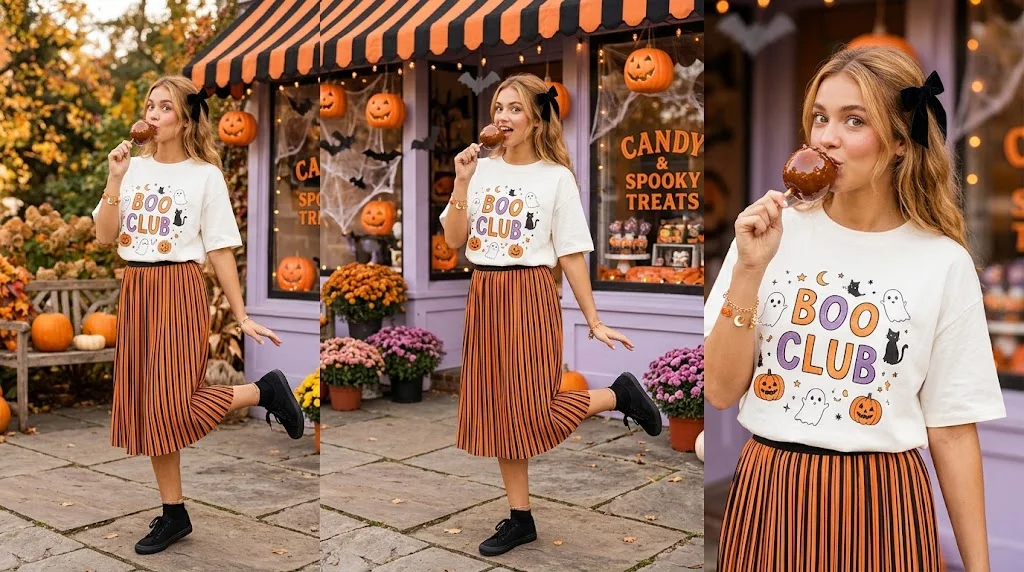
The menu decides the format, not the prompt. An early run of shoot 1 ended with “4:5 vertical” under a 16:9 menu and came back as three panels.
A mismatch can also pad the sides with blur or crop the subject. This sundae prompt asked for “9:16 vertical” under a 16:9 menu and lost the bottom of the tower.
Show the prompt
High-speed food photography, a deconstructed ice cream sundae levitating in a vertical stack: on top a swirl of whipped cream with a glossy maraschino cherry, below it a vanilla scoop dripping with caramel sauce, then a chocolate scoop, a big shiny cherry, and a strawberry scoop at the bottom. A thick ribbon of chocolate sauce swirls through the frame, caramel popcorn, chopped nuts and cherries fly around, frozen in motion. Blurred retro American diner in the background with red booths and warm lights. Bright punchy commercial light, crisp detail on melting textures, shallow depth of field, playful dessert ad, 9:16 vertical.
Avoid: text, logos, glass, spoon, hands, watermark.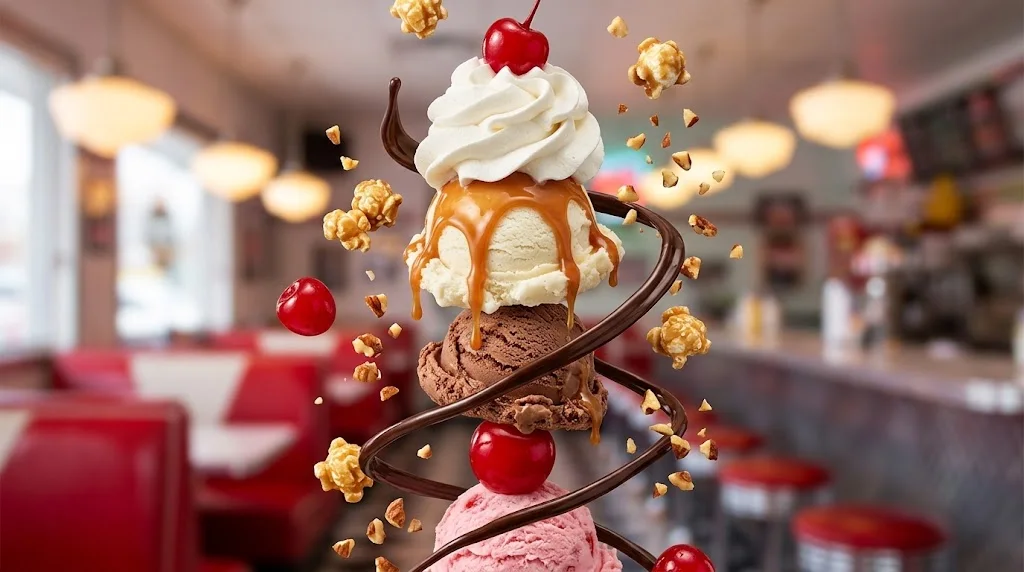
Changing only “9:16 vertical” to “16:9 horizontal” fixed it, and the whole tower now fits the wide frame.
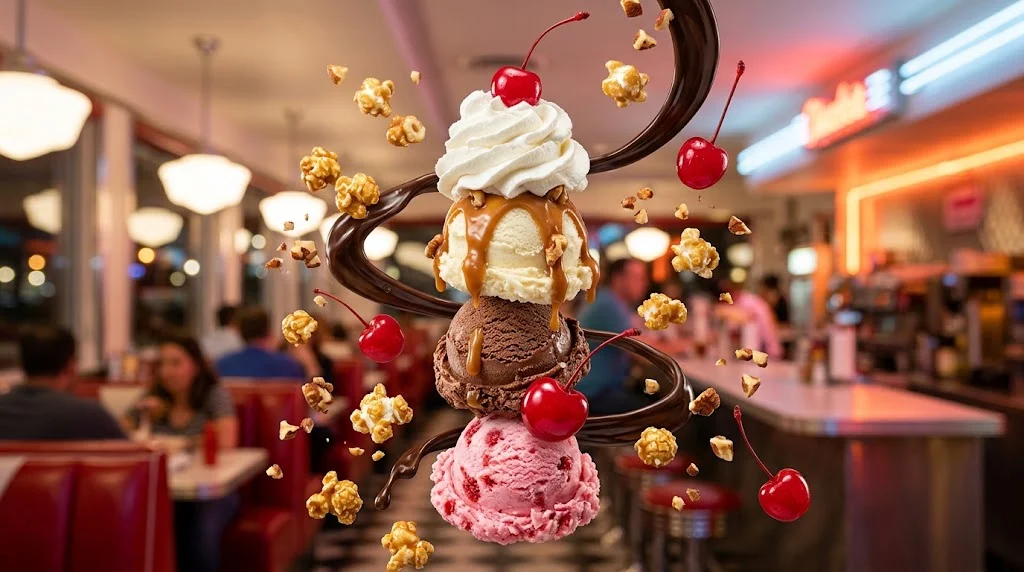
The subject matters too. A macaron prompt built around “a vertical tower” still split into panels under the 16:9 menu, so describe a subject that fits the frame you picked.
For Stories and Reels, keep key details out of the top 14% and bottom 35% of the frame, where Meta’s Reels ad guidance says captions and buttons sit. Ratios like 4:1 and 8:1 exist only in AI Studio and the API, so in the app, make a LinkedIn banner at 16:9 and crop it.
The shoots, part 1: scenes built from text alone
These ten use no reference photo. All were made in the Gemini app with the menu at 16:9. Several prompts name another ratio, and the menu won every time, so match the ratio words to your own menu when you copy one. The new portraits (shoots 3 to 7) share one habit worth copying: they describe the subject like a casting sheet, then the light like a photographer would, then the lens.
1. Halloween merch on a shop street (16:9)
Scenario: a boutique or a candy shop wants a cheerful Halloween post with its merch tee. Timing tips are in the 2026 holiday marketing calendar.
Show the prompt
Playful Halloween fashion photo, beautiful young woman with lightly tanned skin, big doe-like light-brown eyes, rosy cheeks, and long honey-blonde waves tied with a black velvet ribbon bow. Gold anklet and charm bracelets with tiny pumpkin and crescent-moon charms.

She wears an oversized white tee with a hand-painted graphic reading “BOO CLUB,” featuring cute ghosts, pumpkins, black cats, and little stars, tucked into an orange-and-black striped pleated midi skirt, with black sneakers.

Pose: standing on tiptoe on one foot, the other leg kicked back, taking a playful bite of a glossy caramel apple, eyes wide and mischievous, looking directly at the camera.

A charming Halloween candy shop behind her, with a striped awning, glowing jack-o’-lanterns, hanging paper bats, and pots of autumn chrysanthemums. Warm autumn daylight, a whimsical palette of pumpkin orange, lavender, cream, and black, cheerful Halloween atmosphere.

3:4 vertical.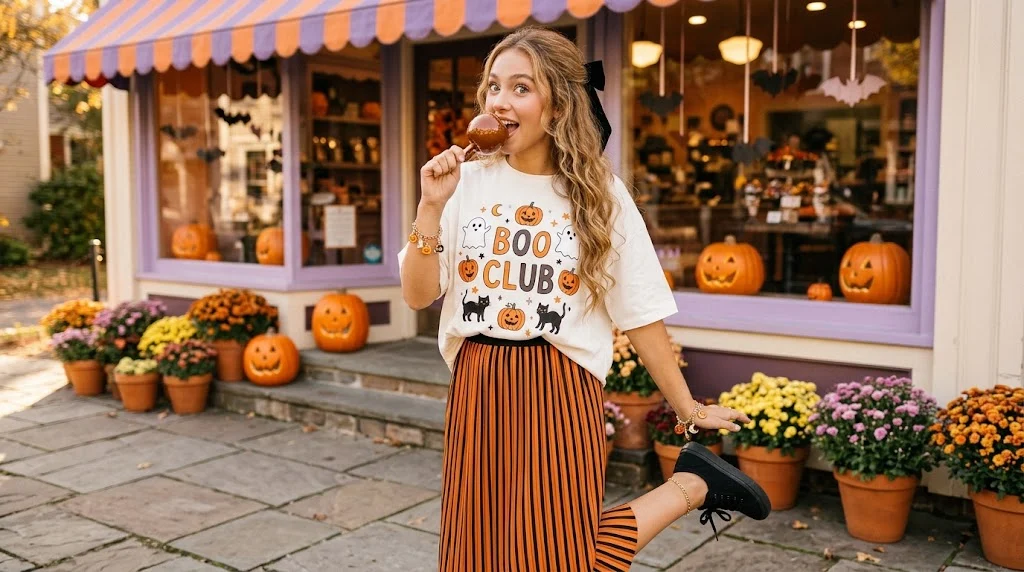
What to notice:
- Quoted words hold on the second run. “BOO CLUB” is letter-perfect here. The first run turned one O into a ghost, so add “exact letters, no decorative substitutions” when every letter matters and be ready to rerun once.
- Unquoted signs get invented. The first run put “The Sugar Goblin” on the awning without being asked. This run kept the shopfront text-free, but for a real shop, quote its name or add “no other text.”
2. A black-and-white portrait on a pier (16:9)
Scenario: a fashion or beauty brand wants a moody campaign image that feels like real film.
Show the prompt
Black and white fine art fashion photograph, monochrome, full-bleed vertical 3:4 image with no border, no frame, no white margin, edge-to-edge composition. High-end art-directed fashion editorial, natural sunlight only. Extreme close-up of a 21-year-old Parisian fashion model standing on a weathered wooden pier by the sea at golden hour, cropped from her forehead to her lips, her face filling the left two-thirds of the frame, shot at eye level on a vintage Meyer-Optik Trioplan 100mm f/2.8 lens wide open. A natural moment: a strong gust has blown thick strands of her long dark hair across her whole face, and only one eye shows clearly through a gap in the tangled strands, looking straight into the lens with a still, intense, magnetic gaze, her lips just visible and softly closed. Her face is naturally visible where the hair parts: realistic skin texture, clear glass-skin complexion, natural straight brow, dark eye with a bright catchlight, bare lips. The hair strands across her face are backlit by the low sun into glowing silver threads, some sharp, some soft. The edge of her black wool blazer collar is visible at the bottom corner. Signature effect, on the water only: the sea behind her fills the right third of the frame with Trioplan soap-bubble bokeh from sun glitter: circles with razor-thin, intensely bright outer rims and nearly transparent see-through centers, varied sizes, overlapping and layered, uneven brightness and imperfect edges. No orbs on her face or in the air. Deep inky blacks, glowing silver-white highlights, high contrast with gentle midtones on her skin, subtle film grain, mysterious, magnetic mood. No text, no watermark, no signature, no border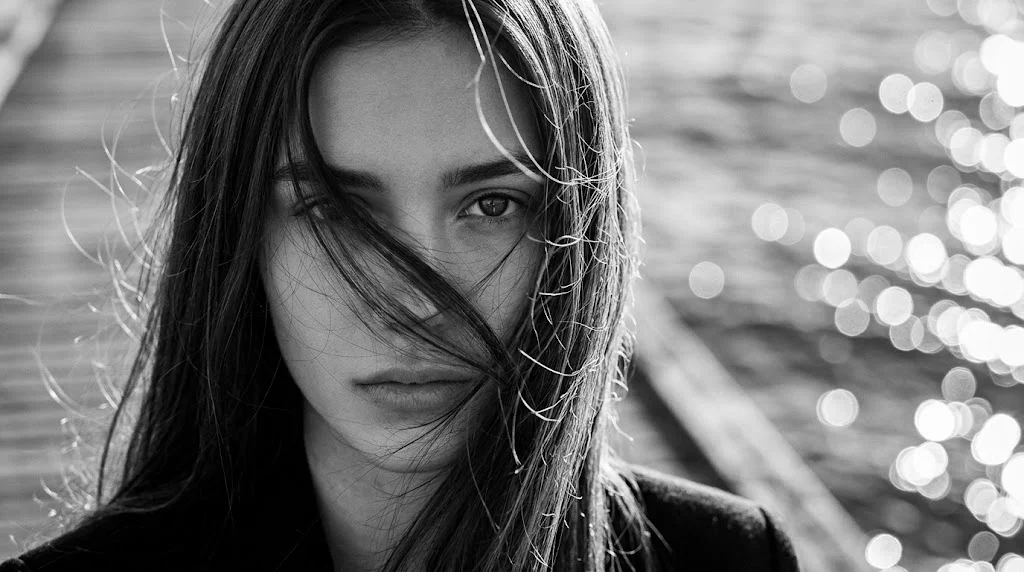
What to notice:
- A named lens brings its look. The Trioplan 100mm is known for soap-bubble bokeh, and “on the water only” plus “no orbs on her face” kept the bubbles where they belong.
- Not every instruction lands the first time. The prompt asks for only one eye showing. The first run showed both; this rerun got it. Check the details that carry the idea and rerun when they’re missing.
3. A getting-ready glamour portrait (16:9)
Scenario: a beauty brand, a salon, or a lipstick launch wants a cinematic “before the party” shot with a bit of attitude.
Show the prompt
Cinematic portrait of a woman seated at a white tablecloth, dark hair set in oversized pink velcro rollers, sharp winged eyeliner, matte deep red lips, holding a red metal lipstick bullet up beside her face while the other hand touches a roller. Black velvet choker, layered fine silver chains with a heart-key charm and a crystal cross pendant, black spaghetti-strap tank, long nude almond nails, silver rings. On the table: a whiskey bottle, a glass of dark wine, amber votive candles. Bare warm lamp light casting a hard graphic shadow on the beige wall. 50mm lens, waist-up, moody getting-ready glamour, film grain, deep contrast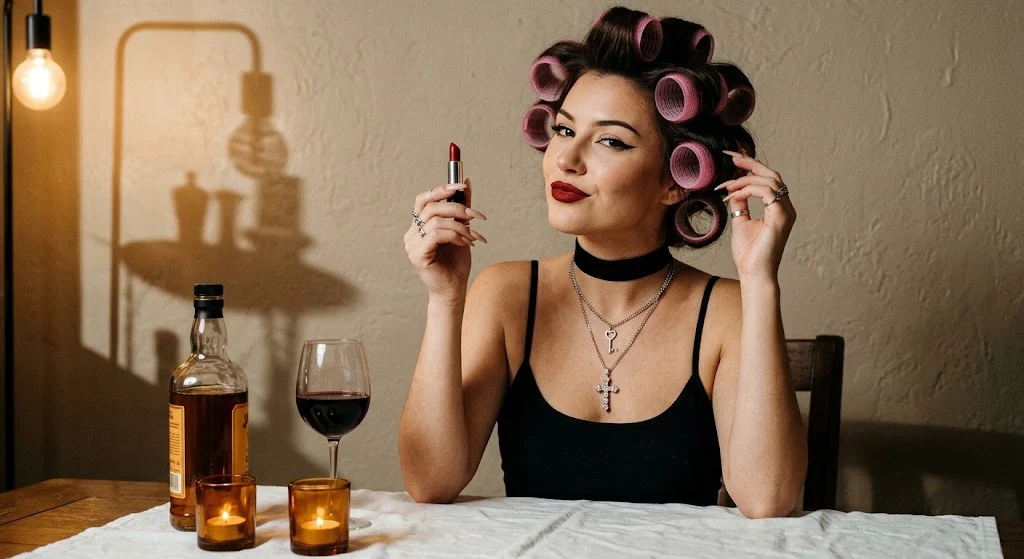
What to notice:
- Every prop in the list showed up. The rollers, the lipstick, the choker, the key and cross pendants, the bottle, the wine, and the two candles. A flat inventory of objects is the most reliable part of any prompt.
- “A whiskey bottle” came with a label. The model drew a brown bottle with a black label that read “Famous Brand” from across the room. For an ad, add “plain unlabeled bottle” or “no logos.”
- Name the shadow, and get the shadow. “Hard graphic shadow on the beige wall” produced the lamp silhouette that makes the frame feel like a film still.
4. A flash-lit snarl against concrete (16:9)
Scenario: a streetwear label or a music act wants a raw, slightly unhinged casting-style portrait for a feed post.
Show the prompt
Tight flash-lit portrait of a woman with a shaggy dark brown mullet and micro baby fringe, hair flicking mid-motion, nose scrunched, one eye squeezed shut in a wink, upper lip curled back baring teeth in a playful snarl. Silver crystal cluster clip earrings, small silver nose hoop, layered thin silver chains with a black ring and a yellow square pendant, pastel blue cotton tee with red screen print at the hem. Grey concrete tile wall directly behind. Direct on-camera flash, hard falloff, punchy shadow outline, slight highlight sheen on skin. 50mm lens, head-and-shoulders crop, raw street-cast energy, 2000s snapshot fashion look.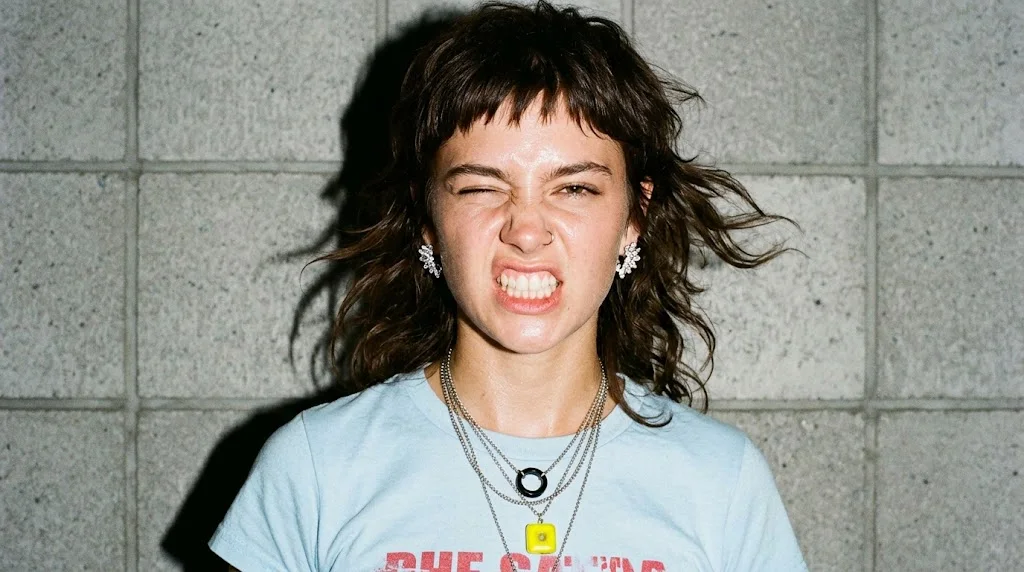
What to notice:
- Expressions work when you describe muscles, not moods. “Nose scrunched, one eye squeezed shut, upper lip curled back” is a face the model can build. “Playful snarl” alone usually returns a smile.
- “Direct on-camera flash” is a complete lighting recipe. It brought the flat frontal light, the thin shadow outline on the wall, and the sheen on the skin in one phrase.
- The hem print got cropped. “Red screen print at the hem” fought the “head-and-shoulders crop,” and the crop won. Don’t describe details the framing will cut off.
5. A high-key candy beauty shot (16:9)
Scenario: a sweets brand, a lip gloss, or a pair of sunglasses needs a clean, bright commercial image with one loud color.
Show the prompt
High-key beauty portrait of a woman with a full voluminous curly afro backlit into a soft halo, wearing narrow red-tinted oval sunglasses, mouth open mid-lick around a glossy red swirl lollipop. Glossy red-stained lips, dewy highlighted cheekbones, long pale almond nails, stacked crystal and enamel cocktail rings. Oatmeal knit tie-front cropped cardigan with distressed slashes at the sleeve. Clean off-white studio wall, bright even flat lighting, soft shadowless bounce. 85mm lens, waist-up framing, crisp commercial sharpness, warm neutral palette with one loud red accent. Playful candy editorial, cheeky and confident.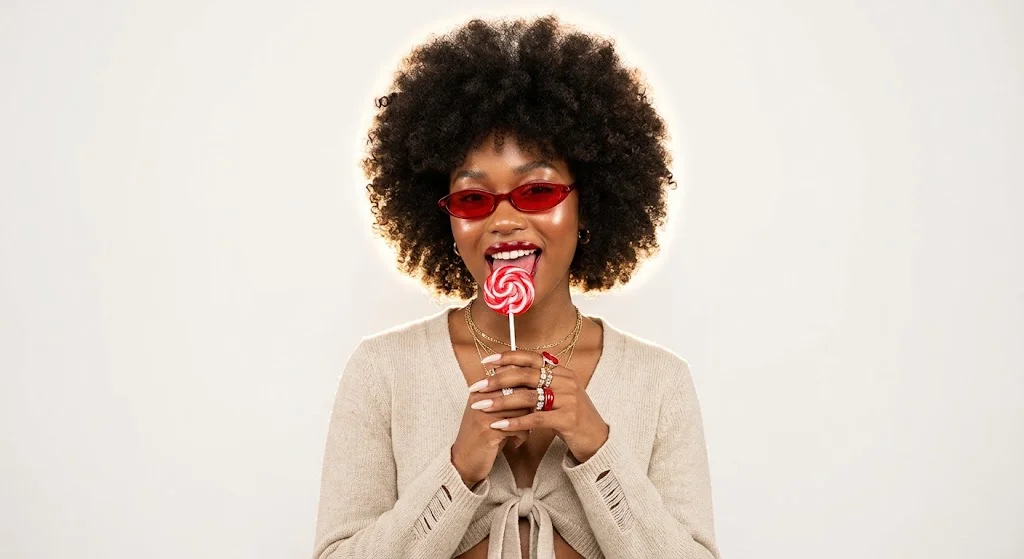
What to notice:
- State the palette as a rule. “Warm neutral palette with one loud red accent” kept everything beige and cream except the glasses, the lips, the rings, and the candy. That is the whole visual idea, in one sentence.
- Hands around a stick are a risk. They came out right here, but check the fingers on every rerun. Objects held near the mouth are where extra fingers tend to appear.
6. A black-and-white casting portrait with a joke (16:9)
Scenario: A hair salon, a jewelry brand, or a casting agency wants a portrait that shows personality, not just a face.
Show the prompt
Black and white studio portrait of a young woman with a cropped pixie buzz cut and blunt choppy fringe, both index fingers raised above her head like little horns, thumbs tucked in, eyes rolled hard to the side, lips pushed forward in an exaggerated pout. Silver hoop earrings, washed cotton crew-neck tee with ribbed shoulders. Seamless pale grey paper backdrop with a soft shadow falling to the right. Single large softbox at 45 degrees, gentle contrast, visible skin texture, freckles, natural pores, no retouching. 85mm lens, chest-up crop, shallow depth of field. Monochrome editorial casting portrait, grainy analog film feel, playful and unbothered.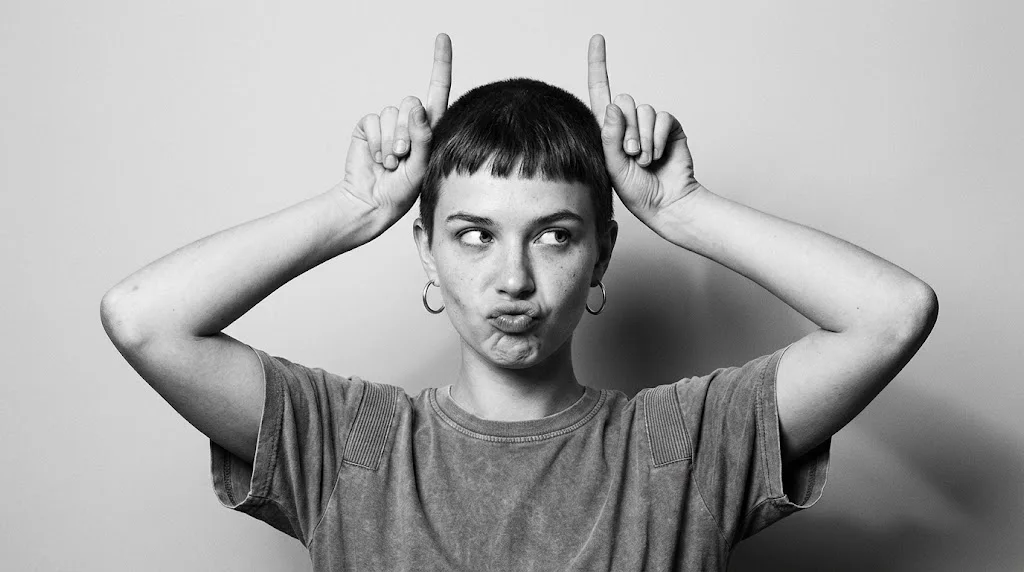
What to notice:
- Gestures need finger-level detail. “Both index fingers raised, thumbs tucked in” is specific enough to draw. “Making horns” would have been a coin toss.
- “Soft shadow falling to the right” and “softbox at 45 degrees” agree with each other. When the light direction and the shadow direction match in the prompt, the model doesn’t have to guess.
- “No retouching” is doing real work. Freckles and pores survived. Leave it out, and most portraits come back with plastic skin.
7. A sunny street scene with a snack (16:9)
Scenario: a cinema, a snack brand, or a sweatshirt label wants a laid-back lifestyle post that feels like a scanned negative.
Show the prompt
Sunny outdoor portrait of a woman with platinum bleached wavy bob and flyaway strands, seated on a red wooden bench, holding a red and yellow striped popcorn tub in her lap and lifting a piece toward her parted lips. Powder blue oversized crewneck sweatshirt, dark washed straight-leg jeans, pale blue cat-eye sunglasses. Background is a sunlit California strip mall street with palm trees, red awnings and a blurred pastel storefront. Harsh midday sun, deep palm shadows on pavement, faded warm colour grade, kodak film look. 35mm lens, full torso framing, casual off-duty cool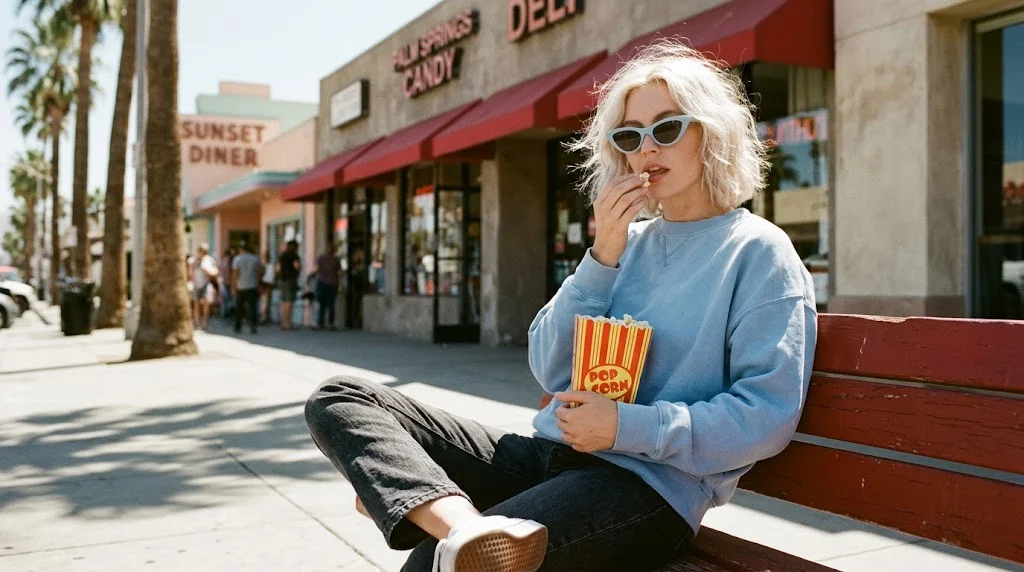
What to notice:
- Unquoted storefronts come with invented names, again. This run wrote “PALM SPRINGS CANDY,” “DELI,” and “SUNSET DINER.” An earlier run of the same prompt wrote “STARBURST DONUTS,” a real candy trademark, which is why it was rerun. Add “no readable signs” or quote the names you want.
- “Strip mall street” brings a crowd. Shoppers filled the sidewalk behind her. For an empty frame, add “no other people.”
- “Deep palm shadows on pavement” sold the midday sun. One concrete shadow detail is worth more than three adjectives about brightness.
8. A matcha merch tee in a Japanese garden (16:9)
Scenario: a tea brand or a merch shop wants a spring lifestyle image built around a printed tee. Same template as shoot 1, different season.
Show the prompt
Dreamy fashion photo, beautiful young Thai woman with warm golden skin, big dark almond eyes, soft rosy lips, long silky black hair with a fresh pink orchid behind her ear, wearing an oversized white tee with a hand-painted graphic reading "MATCHA TIME" with a matcha bowl, cherry blossoms and a koi fish, tucked into a matcha-green-and-cream striped flowy maxi skirt. Pose: sitting on the edge of a small red wooden arched bridge, legs dangling over a koi pond, holding a matcha latte with both hands, looking down at the fish with a gentle smile. Props: a bento box and wagashi sweets on a cloth beside her, a paper parasol leaning on the railing, floating cherry blossom petals, orange and white koi swimming below. Traditional Japanese garden, mossy stones, soft spring light, serene pink-and-green palette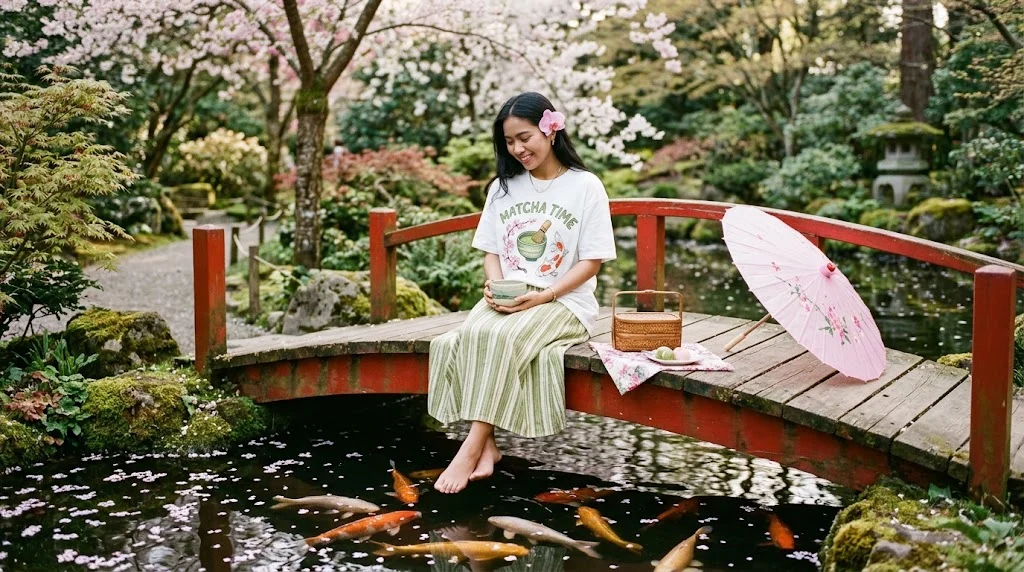
What to notice:
- The tee print is the hard part, and it held. “MATCHA TIME” with the bowl, the blossoms, and the koi all landed on the shirt, legible and in the right order. Short quoted phrases on fabric are reliable; paragraphs are not.
- The pose line did the composition. “Sitting on the edge of a bridge, legs dangling over a koi pond” fixed the camera height, the horizon, and where the fish go. One pose sentence replaces a paragraph of camera notes.
- “Holding a matcha latte with both hands” came back as a bowl. Close enough for a lifestyle shot, but if the cup is the product, describe the cup.
9. A bookshop window, short prompt (16:9)
Scenario: a bookshop, a tea brand, or a cozy-aesthetic merch line wants a window-display scene. This is the short version; shot 10 is the same idea written out in full, so you can compare what the extra words buy.
Show the prompt
Cozy aesthetic fashion photo, beautiful young Japanese woman with porcelain skin, big dark doe eyes, soft peach blush, glossy black hair in a low bun with loose strands and a ribbon, wearing an oversized white tee with a hand-painted graphic reading "READING ROOM" with stacked books, a cat and a teacup, tucked into a sage-green-and-cream striped pleated midi skirt. Pose: lying on her stomach inside a big bookshop display window, legs kicked up and crossed behind her, chin in her hands, reading an open book, glancing up at the camera through the glass. Props: stacks of colorful books around her, a teacup and saucer, a sleeping tabby cat, a vintage reading lamp, fairy lights and hand-lettered book tags. Green-painted shopfront, soft golden afternoon light, cozy muted palette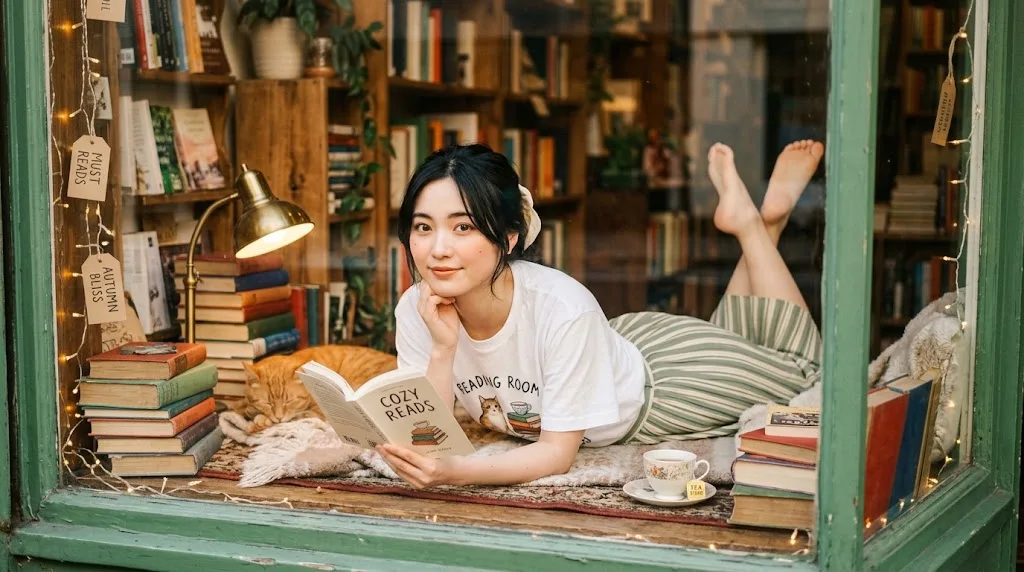
What to notice:
- Five proper nouns built the whole window. Books, teacup, cat, lamp, tags: each one is there, and the model arranged them itself. For a scene, list the objects and let the model do the set dressing.
- The book cover got a title nobody asked for. “COZY READS” appeared on the open book. Harmless here, but one more reminder that any blank surface gets text unless you say “no other text”.
- “Through the glass” did half the lighting. The faint window reflections and the soft glare come from those three words.
10. The same window, Halloween edition, long prompt (16:9)
Scenario: the same bookshop wants the October version with a named sign, pumpkins, and witch hats.
Show the prompt
Shot Type: High-resolution, cinematic editorial fashion photograph, taken from outside a bookshop, looking through the glass window pane.
Subject: A beautiful young Japanese woman with porcelain skin, big dark doe eyes, and soft peach blush. Her glossy black hair is styled in a loose, low bun with soft strands framing her face, tied with a black velvet ribbon.
Clothing: She is wearing an oversized white cotton tee, neatly tucked into a sage-green and cream striped pleated midi skirt. The tee features a detailed screen-printed graphic (with a hand-painted aesthetic) that reads "READING ROOM" in whimsical script, featuring illustrations of stacked books, a black cat, and a vintage teacup.
Pose: Lying comfortably on her stomach inside the window display, legs kicked up and crossed playfully behind her. Her chin is resting in her hands, and she is looking up with a gentle, curious gaze directly at the camera through the glass, holding an open, antique book in front of her.
Props & Decor (inside window): Dense stacks of colorful vintage books, a functional antique brass reading lamp (on, casting warm light), a sleeping black tabby cat on a plaid blanket, a steaming ceramic teacup on a saucer, tiny orange and white pumpkins, scattered autumn oak and maple leaves, several lit candles in amber glass jars, whimsical miniature witch hats perched on book tops, and hand-lettered cards with "Halloween Book Recommendations."
Setting (exterior): The green-painted wooden shopfront, labeled with a gold script sign "THE READER'S NOOK EST. 1982" on the glass. The shopfront frame is decorated with a garland of autumn leaves, small gourds, and glowing fairy lights. The view through the window should have soft, golden-orange reflections of the street and autumn trees.
Lighting & Atmosphere: Soft, warm, golden afternoon light from the outside mixed with the warm amber glow from the internal candles, fairy lights, and lamp. A whimsical, inviting, cottagecore Halloween aesthetic; cozy, magical, and highly detailed. Muted autumn color palette of sage green, cream, pumpkin orange, deep burgundy, and dark wood. Shot on 35mm film, natural depth of field, subtle film grain. --ar 3:4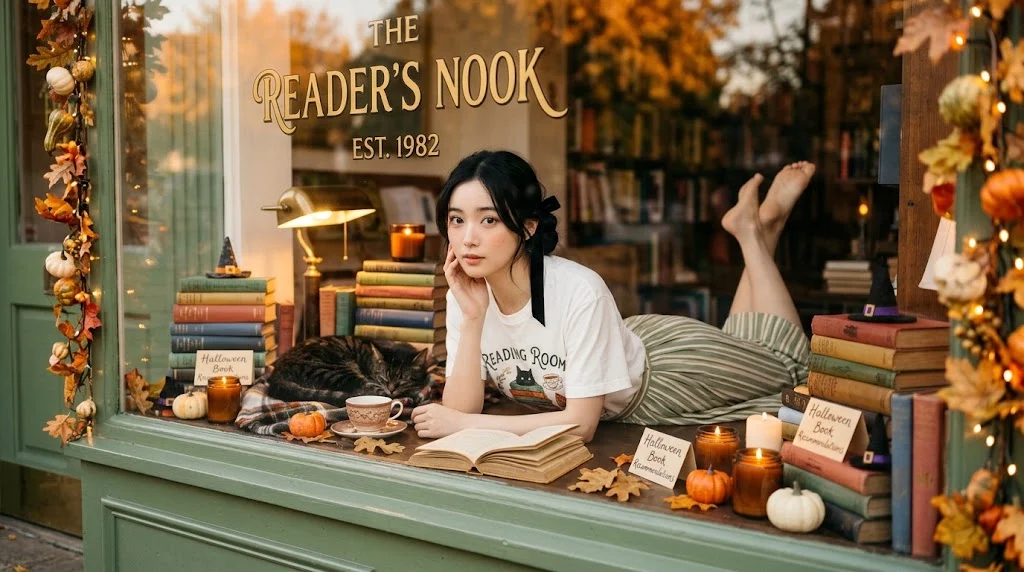
What to notice:
- Three separate pieces of text, all correct. The sign, the tee, and the card each came out letter-perfect because each one is quoted and each has its own sentence. Put two quoted strings in one sentence and one of them usually breaks.
- The long version bought precision, not quality. Compare with shot 9: the short prompt gave an equally good photo. The extra 220 words fixed the sign, the pumpkins, the witch hats, and the reflections. Write long when you need control over specific objects, not for “better” images.
- Flags from other tools do nothing here. “–ar 3:4” is Midjourney syntax. The Gemini app reads it as text, and the menu sets the format, so the image came out 16:9.
- Plurals are taken literally. “Hand-lettered cards” produced three identical Halloween Book Recommendations cards. Write “one card” if you want one.
The shoots, part 2: keeping a real face from a reference photo
This one starts from a photo of a real person. Nano Banana 2.1 accepts up to 4 character images, and face consistency across edits is one of its main upgrades. Get written permission from anyone whose face you use, and compare every result with the original.
11. A Halloween portrait (16:9)
Scenario: a creator or a fashion brand wants a styled Halloween portrait that keeps a real person’s face.
Show the prompt
Subject: Same woman from the reference image, identical face, features and proportions, with one change: her eyes are light blue, clear icy-blue irises instead of brown. Only one person in the image.
Pose: She sits on a giant orange pumpkin in a half-turned pose, body angled to the right, head turned toward the camera, looking straight into the lens with a calm, confident expression. Her right hand holds an old twig witch's broom upright, her left hand rests on her knee.
Outfit: Short, form-fitting black leather corset dress with wide straps and no sleeves, visible corset seams. Flat round black disc earrings. Glossy black nails with square tips.
Hair and makeup: Long, loose light-brown hair with subtle caramel highlights, softly waved. Glowing light tan, defined brows, dusty rose lipstick, flawless makeup.
Scene: Rustic Halloween barn set behind her: hay bales, pumpkins of different sizes, white spider webs stretched across dark wooden planks, red and orange autumn leaves in the upper right corner.
Style: Direct on-camera flash, dark background, subtle film grain, editorial Halloween portrait, framed from her head to just below the knees, 9:16 vertical.
Avoid: brown eyes, second person, altered face, plastic skin, extra fingers, text, watermark.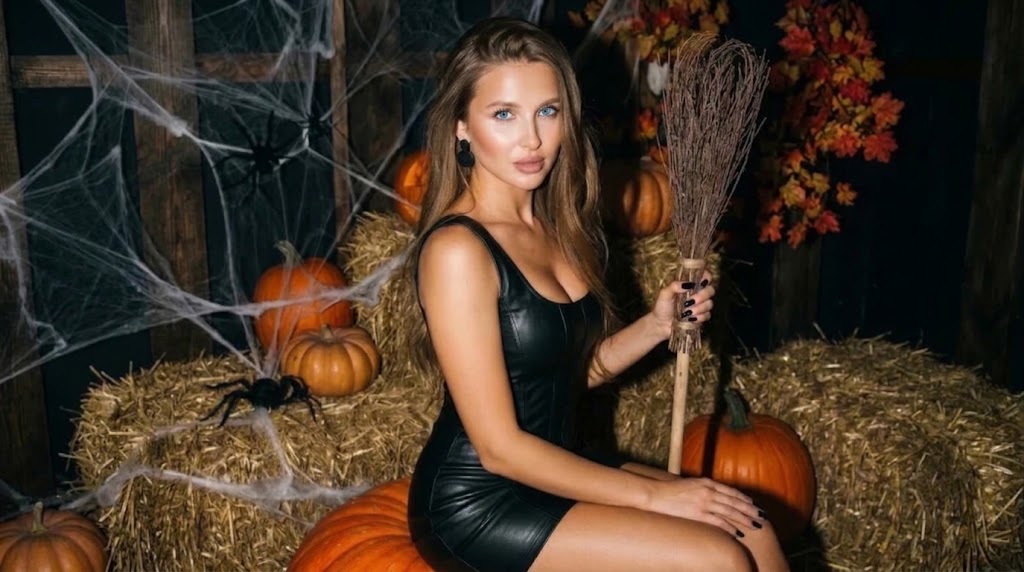
What to notice:
- Change one thing, then check it. “One change: her eyes are light blue” kept the face, but the eyes came out grey-hazel. Zoom in on small details before you post.
- Name the crop and give each hand a job. “Framed from her head to just below the knees” and a broom in one hand, the other on her knee, all landed as written.
8 rules these prompts share
Put the eleven shoots side by side and the same habits keep showing up.
- Quote every word you want in the image, one string per sentence. Three quoted strings in shoot 10 all came out right because each had its own sentence. Add “exact letters” when spelling matters; the fix for shoot 1’s ghost O.
- Say what you don’t want, and where. Without “no other text”, the model invents shop signs (shoots 1 and 7), book titles (shoot 9), and bottle labels (shoot 3). “No orbs on her face” kept an effect in place (shoot 2).
- Name gear, not fashion brands. A lens or a film stock only shapes the look (Trioplan in shoot 2, “Kodak film look” in shoot 7), but anything brand-shaped becomes a logo. An earlier run of shoot 7 put “STARBURST DONUTS”, a real trademark, on a shop sign without being asked, so add “no logos, no brand names” by default.
- Describe expressions and gestures by muscles and fingers. “Nose scrunched, one eye squeezed shut, upper lip curled back” (shoot 4) and “both index fingers raised, thumbs tucked in” (shoot 6) land. A mood word like “playful” gives the model nothing concrete to draw; the actions next to it do the work.
- Name the technique, not the look. Direct on-camera flash (shoots 4 and 11), a single softbox at 45 degrees (shoot 6), a bare lamp casting a hard shadow (shoot 3), flat shadowless bounce (shoot 5). A lighting recipe beats a mood word every time.
- Keep the palette to three or four colors and state it as a rule. “Warm neutral palette with one loud red accent” (shoot 5), “pink-and-green” (shoot 8), “sage green, cream, pumpkin orange, deep burgundy” (shoot 10). The AI image color palette guide shows how to build one.
- List the props as nouns and let the model dress the set. Five nouns built the whole bookshop window in shoot 9; the inventory in shoot 3 came back complete. Long prompts with labeled blocks (shoots 10 and 11) buy control over specific objects, not prettier pictures.
- Set the format in the menu. Ratio words like “3:4” or “9:16” in the prompt don’t change the output, and Midjourney flags like “–ar 3:4” are ignored (shoots 1, 2, 10 and 11 all asked for vertical and came out 16:9). Make the prompt match the menu.
Google’s model card also lists what still breaks: small text (often blurry at 1K), long paragraphs, imperfect face matches with reference photos, edits that only partly follow the instruction, and occasional left-right mix-ups. If an image has to carry a price list or fine print, add the text in your design tool, or use Nano Banana Pro or GPT Image.
One more Gemini app habit: start a new chat for each idea
One prompt asked for a pink knit top, a mint-green skirt, and long dark brown hair. It came back in the outfit from an earlier travel triptych in the same chat: a Breton striped top, cream trousers, and a red scarf, likely because it ran right after that triptych and the app carried the earlier image over. A new chat starts clean. Here is its character block.
Show the prompt
CHARACTER AND OUTFIT (identical in all three panels)
A young woman with long straight dark brown hair, pale skin, soft natural makeup, rosy lips. A light pink short-sleeve knit top with a thin coral-red silk scarf draped around her neck. A flowing mint-green pleated midi skirt. A natural straw boater hat with long cream ribbons.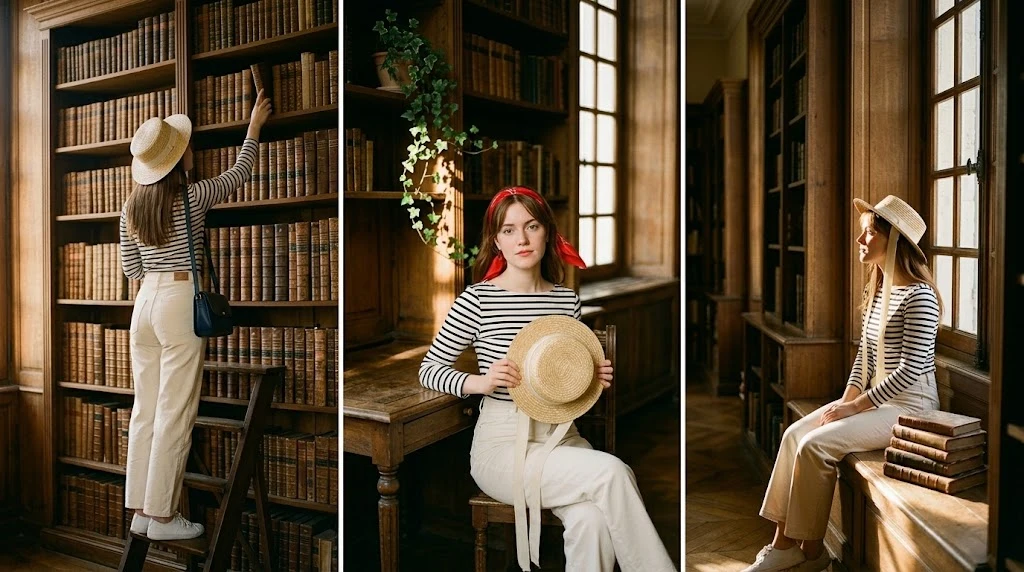
When to use Nano Banana Pro or GPT Image instead
Google recommends Nano Banana 2.1 for new projects and calls Pro “the premium choice for the most complex visual tasks”. In practice, pick by the job.
| The job | Pick | Why |
|---|---|---|
| Social posts, lookbook and editorial shots, quick drafts | Nano Banana 2.1 | Cheapest per image and top-rated in Google’s tests |
| Many products in one image | Nano Banana 2.1 | Up to 10 object references, against 6 on Pro |
| Matching a look from example images | Nano Banana Pro | Accepts up to 3 style reference images; 2.1 accepts none |
| Print, dense small text, complex layouts | Nano Banana Pro | Google positions it for professional asset production |
| Text-heavy graphics when you already work in ChatGPT | GPT Image 2.5 | See the GPT Image 2 and 2.5 guide |
A simple workflow: draft in Nano Banana 2.1, pick the winners, and rerun only the few that need print quality in Pro. For a different style, try these Midjourney prompts for marketing, and see how image models fit a wider stack in AI tools for marketers.
FAQ
Is Nano Banana 2.1 free? Not through the Gemini API: image output has no free tier, and a 1K image costs $0.0336. In the Gemini app, it is rolling out gradually, and Google hasn’t said which plans include it.
How is Nano Banana 2.1 different from Nano Banana Pro? 2.1 is the faster, cheaper model for everyday images, and it scored higher in Google’s preference tests. Pro is built for print, fine text, and matching a style from reference images.
How do I keep the same face across images? Attach up to 4 photos of the person, write “same woman from the reference image, identical face”, keep one series in one chat (and start a new chat for the next idea), and check each result against the original. Get the person’s written permission first.
Start with one shoot
Pick the shoot closest to what you need, swap in your product, your client or your brand ambassador, and run it once. Then change one thing at a time: the pose, the light, the palette.
A model can draw anything you describe. Deciding what to show is the harder part: which offer, which customer pain, which angle competitors haven’t used yet. That research is the job Nova Express’s AI marketing agents are being built for. Follow the blog for launch news.
Want more prompts to copy? The Nano Banana Pro guide has five more, each as a free PDF download, and new prompt guides land on this blog first.
Download The Prompt, Edit · PDF
Further Reading:
- Brand DNA: The Missing Piece Between Your Brand and AI
- Nano Banana Pro: The Complete Guide for Marketers 2026
- GPT Image 2 for Marketers: How to Finally Get Readable Text in AI Images
- 7 Midjourney V7 Prompts for Marketing Ads, Products, and Social Media
- Social Media Image Sizes in 2026: Official Specs and Practical Templates
- Garbage in, garbage out
- Best AI Video Generators for Marketers in 2026
- What Are AI Tokens?
- AI Tools for Marketers in 2026
- AI Image Color Palette: How to Borrow One From Nature
About the author
Serafima Osovitny is a Marketing Manager at Nova Express, where she focuses on digital marketing, search visibility, content strategy, and marketing workflows. She writes practical guides that help marketing teams research their audiences, develop strategies, and put their plans into action.
Explore her work at serafima.digital and follow her on X: @OSerafimaA.





Leave a Comment