
An AI marketing agent is not a chatbot. It researches, analyzes, and executes marketing tasks on its own. Without you prompting every step. Here’s exactly how it works.
You’ve used ChatGPT to write a caption. You’ve asked it to summarize an article. You’ve copied and pasted a brief and asked it to rewrite your headline. That’s useful. It saves minutes.
That’s not what people mean when they talk about AI marketing agents.
An AI marketing agent doesn’t wait for you to tell it what to do. It figures out what needs to be done, goes and does it, and comes back with results. Or in some cases, just takes action. You don’t manage every step. You set a goal.
The difference is not a matter of degree. It’s a different category of tool entirely. One is a calculator. The other is closer to an employee.
The Simplest Way to Understand the Difference
An AI tool responds to what you ask it. An AI agent figures out what needs to be done and does it.
Here’s the same task done both ways. You need competitive intelligence on five rivals.
With an AI tool: You open ChatGPT. You type a prompt about one competitor. You read the output, copy what’s useful, open a new tab, and type another prompt for the next competitor. Repeat five times. You organized the research, directed every step, and assembled the final picture yourself.
With an AI marketing agent: You tell it your brand, your market, and your goals. It identifies your competitors, visits their websites, maps their positioning and pricing, analyzes their content strategy, tracks their social engagement, and delivers a structured comparison. Without you managing a single step.
Same outcome. A very different amount of work is required from you.
AI Agent vs. AI Tool vs. AI Chatbot
These three terms get used interchangeably. They describe fundamentally different things.
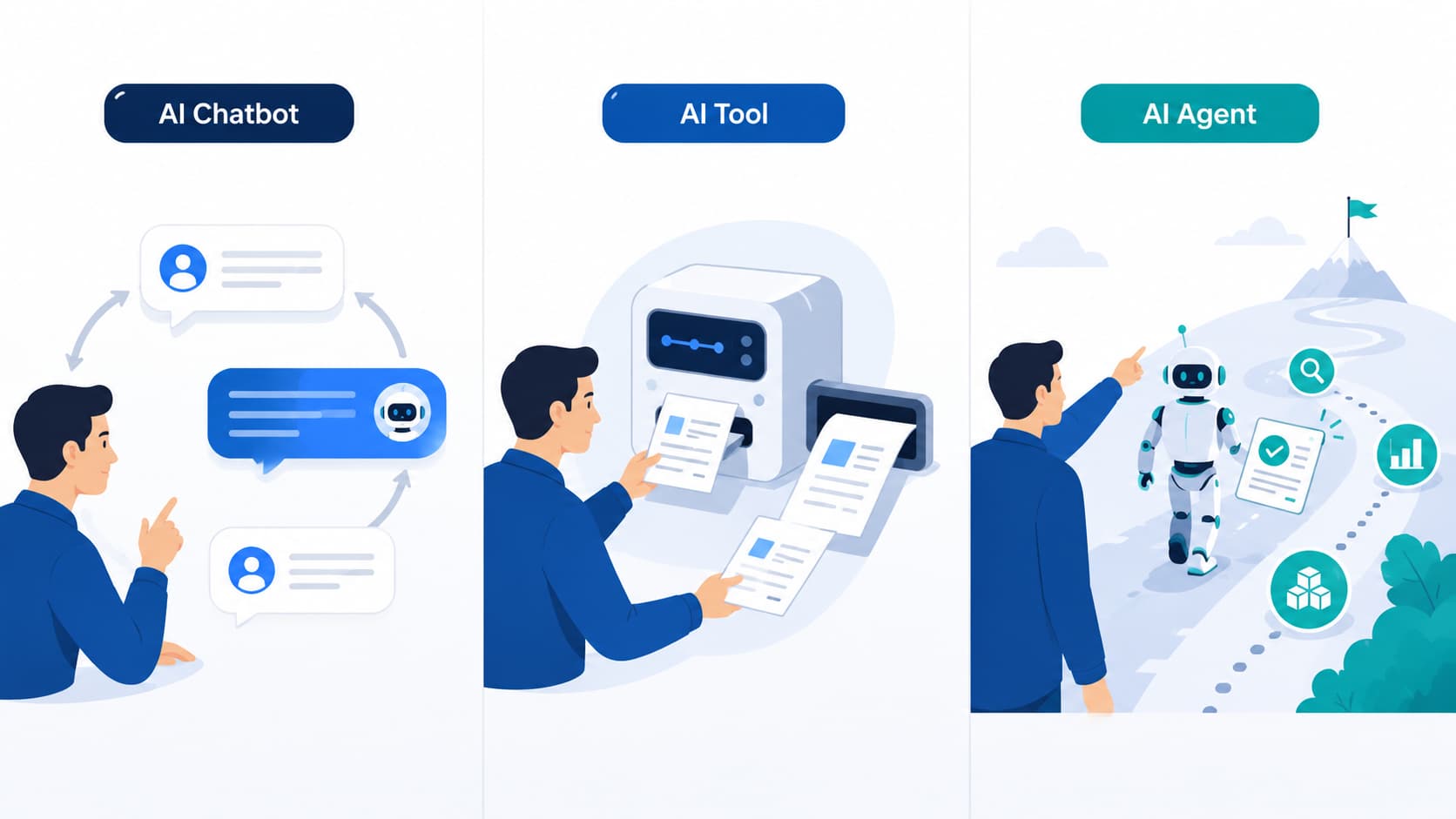
An AI chatbot is designed for conversation. You ask; it answers. It has no memory between sessions, no ability to take action in the world, and no goal beyond responding to your last message. Most early AI assistants, including early ChatGPT, were chatbots.
An AI tool is designed for a specific task. You give it an input, and it produces an output. An AI image generator, a grammar checker, and a headline tester. These are AI tools. Useful. But they require you to direct every step. You provide the brief, review the output, and decide what to do next.
An AI agent is designed to complete goals, not respond to inputs. You give it an objective and the context it needs to operate. It figures out the steps, uses tools, searches for information, makes decisions along the way, and delivers a result. Or takes action without you managing the sequence.
The practical difference: with an AI tool, most of the thinking is yours. With an agent, you delegate the thinking itself.
What AI Marketing Agents Actually Do
Competitor research agents
A competitor research agent doesn’t give you a list of company names. It visits their websites, extracts their positioning and pricing, analyzes their content strategy, maps their social presence, and builds a structured comparison across 5, 10, or 20 competitors. In the time it would take you to manually research two.
Most marketing teams know who their 2–3 obvious competitors are. Agents surface the ones growing in the background that haven’t made it onto your radar yet.
Trend discovery agents
A trend discovery agent monitors news feeds, social platforms, forums, and search patterns to surface what’s emerging in your market before it peaks. Instead of you manually scrolling Reddit and Twitter looking for signals, the agent does it continuously and brings you what’s relevant.
Pain point discovery agents
A pain point discovery agent analyzes reviews, forum threads, and social conversations to find what your target customers are frustrated about. Expressed in their own words, scored by how often and how intensely the problem appears. The output isn’t a summary. It’s the exact language your customers use to describe their pain, ranked by urgency.
This matters because, as we covered in Customer Pain Points: Why Your Marketing Isn’t Working, addressing someone’s pain in their own words is the difference between copy that feels like an ad and copy that feels like recognition.
SEO and content intelligence agents
An SEO insights agent doesn’t give you a keyword list. It maps keyword opportunities by search intent, identifies where competitors rank and you don’t, surfaces content gaps you could fill, checks whether your brand appears in ChatGPT and Perplexity answers, and delivers a prioritized action list. Not a spreadsheet of raw data you then have to interpret.
Social media insights agents
A social media insights agent analyzes your performance across platforms, benchmarks it against competitors, identifies what’s working and what’s underperforming, and builds a distribution plan. Including optimal posting times and format recommendations per channel, without you pulling data from five separate dashboards.
Sentiment and monitoring agents
A sentiment agent aggregates what people are saying about your brand across reviews, social media, forums, and news. It tracks how that sentiment changes over time and flags what’s getting worse. Before a problem becomes a pattern you’re chasing retroactively.
Four Things That Make an Agent Different From “Just AI”
1. It takes multiple steps without being prompted. A chatbot responds to one prompt. An agent breaks a goal into steps and works through them. Searching, analyzing, synthesizing, and deciding, without you managing the sequence.
2. It uses real-world tools and data sources. Agents can search the web, visit URLs, read documents, and pull current information. They’re not limited to training data or what you paste into a prompt.
3. It holds context across an entire task. An agent working on competitor analysis knows, on step four, what they found on step one. It uses that context to make better decisions. Rather than treating each action as an isolated prompt with no memory.
4. It can take action, not just produce text. The most useful agents don’t just give you a report. They do things. Publish a post. Update a document. Send an alert. The line between “AI that gives advice” and “AI that acts” is what defines a true agent.
What AI Marketing Agents Are Not Good At
Strategy. An agent can tell you what keywords to target, what content gaps exist, and what competitors are doing. It can’t tell you whether to pursue the enterprise market or stay focused on SMBs. Strategic judgment. The kind that requires understanding your business, your team’s capabilities, and your risk tolerance. Still belongs to you.
Context that isn’t documented. An agent that doesn’t know your brand, your audience, and your goals produces generic output. The more context you give upfront, the better everything it produces downstream. This is why Brand DNA, the documented foundation of your brand, is not optional when you start working with agents. Brand DNA: The Missing Piece Between Your Brand and AI covers exactly what to document and why agents need it before they can do useful work.
Creative judgment. Tone decisions, campaign strategy, and what makes a piece of content worth making. These require a human who understands the brand. Agents handle research and execution. Humans handle creative direction.
Relationships. A partnership conversation, a sales call, a customer interview. Agents don’t do these. They handle the work that doesn’t require them.
What Changes When You Start Using Them
Before AI agents, a solo marketer or small team had a ceiling. Competitive research was a once-a-quarter exercise because it took two days. SEO analysis was either outsourced or skipped. Social performance tracking was a spreadsheet you updated when you had time.
AI agents shift the ceiling. Not because the work disappears, but because the routine parts (the gathering, the organizing, the first-pass analysis) all happen automatically. What’s left for humans is judgment, decisions, and relationships.
For a freelancer managing five clients, that’s the difference between staying at five and being able to take on ten. For a small marketing team, it’s the difference between knowing what’s happening in their market and flying blind.
The shift isn’t “AI does marketing instead of you.” It’s “AI handles the parts of marketing that are repetitive and time-consuming so you can focus on the parts that require a human.”
How to Start (Without Overcomplicating It)
You don’t need to deploy seven agents at once to see results. One focused agent on your highest-friction task is the right starting point.
Good first applications:
- Competitor monitoring. If you currently check competitor websites manually, an agent that does it automatically and surfaces changes is an immediate win
- SEO research. Keyword gaps and content opportunities are time-intensive and scale well with AI
- Social performance tracking. Compiling engagement data and benchmarking against competitors is exactly the kind of synthesis agents handle well
What to avoid as a starting point:
Creative direction, brand voice decisions, and campaign strategy. Agents need clear parameters. Start with research and intelligence tasks where the output is information. Once you trust the output quality, expand from there.
FAQ
What’s the difference between an AI agent and ChatGPT?
They’re different categories entirely. ChatGPT is a conversational AI. You ask, it responds, and you decide what to do next. An AI agent is designed to complete multi-step goals autonomously. You give it an objective, and it figures out the steps, uses tools, gathers information, and produces a result or takes action without you managing each stage.
Can AI agents replace a marketing team?
No. Agents handle research, analysis, and repetitive execution well. They don’t handle strategy, creative judgment, relationship-building, or contextual decision-making. The accurate framing is that agents let a smaller team punch above their weight. Not that they replace the team.
What do agents need from me to produce good output?
Clear brand context: who you are, who your audience is, what you’re trying to accomplish, and what makes you different. The more specific you are upfront, the more relevant the output. Vague inputs produce generic results. This is why brands that document their brand DNA before activating agents consistently get better output than brands that skip it.
Related articles
On blog.novaexpress.ai:
- Why AI Cites Some Brands and Ignores Others: The Citation Stack Explained
- How to Use AI to Build a Marketing Strategy From Your Website
- The Pre-Launch Content Sprint: A 30-Day Plan to Build an Audience Before Launch
- Brand DNA: The Missing Piece Between Your Brand and AI
- AEO vs SEO vs GEO: What’s the Difference and Where to Start in 2026
- What Is Generative Engine Optimization?
- AI Tools for Marketers in 2026
- What Competitor Analysis Reveals About You (Not Just Them)
- What Is Generative Engine Optimization?
- The 2026 Marketing Audit
- Why AI Engines Trust Reddit More Than Brand Content (And How to Change That)
About the author
Serafima Osovitny is a Marketing Manager at Nova Express, where she focuses on digital marketing, search visibility, content strategy, and marketing workflows. She writes practical guides that help marketing teams research their audiences, develop strategies, and put their plans into action.
Explore her work at serafima.digital and follow her on X: @OSerafimaA.








Leave a Comment