

AEO vs. GEO vs. SEO: Explained for busy founders. One practical table, a 5- to 7-hour weekly plan, and zero fluff. Learn where to spend your time first in 2026.
TL; DR – if you have 30 seconds
- SEO = foundation (you get found). AEO = snippets (you get extracted). GEO = AI citations (you get cited).
- Order matters: without SEO, GEO collapses. This is not “or”; it is first, then.
- 5 to 7 hours a week is enough: Month 1 fixes SEO, Month 2 adds AEO, and Month 3+ builds GEO authority.
- Inside: comparison table, step-by-step plan, 3 common mistakes, and a 3-minute readiness check.
What each term means in 2026
- SEO (Search Engine Optimization): Making your page rank in traditional search results so people can find you.
- AEO (Answer Engine Optimization): Structuring content so Google, Alexa, or Siri can extract a direct answer and show it without a click (featured snippets, voice answers).
- GEO (Generative Engine Optimization): Optimizing so AI systems (ChatGPT, Perplexity, and Gemini) cite your brand in their generated answers.
Here’s the short version: SEO builds the base. AEO captures fast answers. GEO gets you into AI-generated responses. It is not a choice between three options. It is a sequence: discoverable → extractable → citable. Break the first link, and the rest stops working.
Why the order matters financially:
AI-referred visitors convert significantly higher than organic search visitors. The reason is pre-qualification: the AI has already compared options before the user clicks.
For founders, this means GEO is not just a visibility layer. It is a real distribution channel that can directly influence revenue.
Here’s how.
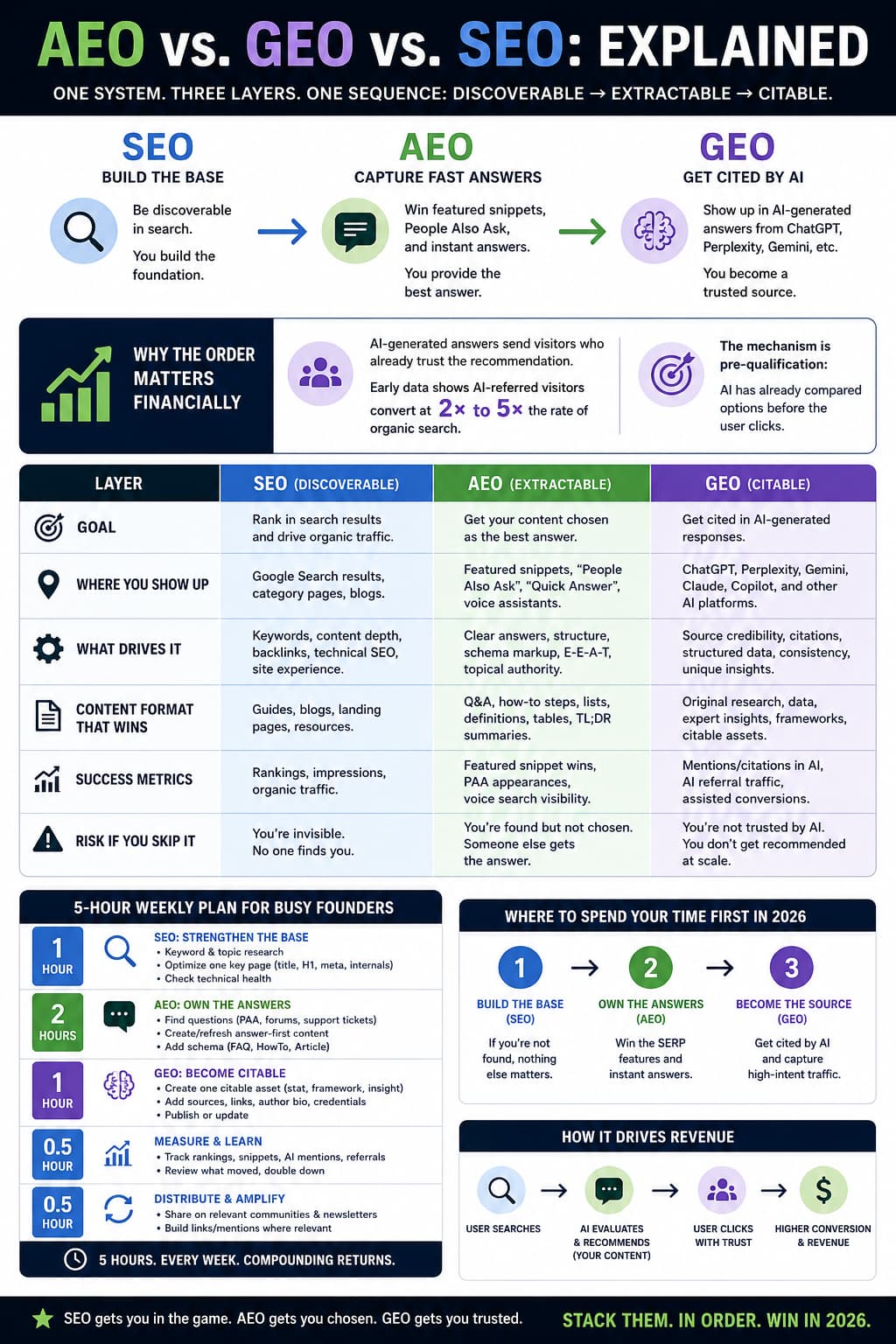
The One Table Worth Saving
Bookmark this. Every decision about where to spend your next hour starts here.
SEO, AEO, and GEO differ in what they optimize for, who decides the result, and how fast you see impact:
- SEO optimizes for organic rankings; Google/Bing decides; results in 3–6 months
- AEO optimizes for snippets; Google’s snippet logic decides; results in 2–4 weeks
- GEO optimizes for AI citations; LLMs decide; results in 1–3 months if SEO is solid
| Dimension | SEO | AEO | GEO |
|---|---|---|---|
| Optimization target | Visibility in traditional search results | Zero-click answers in snippets and voice | AI citations in ChatGPT, Perplexity, Gemini |
| Who decides | Google/Bing ranking algorithms | Featured snippet extraction logic | LLM synthesis and retrieval models |
| Key signals | Backlinks, technical performance, and how closely the content matches search intent | Direct answers, schema markup, FAQ structure | Entity clarity, E-E-A-T, evidence-backed claims |
| Content format | Long-form guides, pillar pages | FAQ blocks, how-to steps, definitions | Citable facts, original research, clear sourcing |
| Main metric | Organic traffic and ranking position | Snippet ownership and voice mentions | AI citation rate and brand mention frequency |
| Time to first result | 3 to 6 months | 2 to 4 weeks (on existing pages) | 1 to 3 months (if SEO base exists) |
| Effort per week | 3 to 4 hours (ongoing) | 1 hour (tactical edits) | 1 to 2 hours (content upgrades) |
| 2026 reality check | Still accounts for more than 60% of search traffic, which makes it the foundational layer | Nearly 56% of Google desktop searches end without a click (SparkToro/Datos, Q4 2025). AEO captures that. | Most AI Overview citations come from the top 10 organic results. GEO works better when SEO is solid. |
What’s a good AI citation rate?
| Your business type | Realistic goal |
|---|---|
| B2B, narrow niche | 3 to 5% of relevant queries |
| B2C, noisy category | 1 to 2% is a strong start |
| Enterprise with brand recognition | 8 to 12% |
Don’t chase absolutes. Measure growth month over month.
If you simplify it into practical terms, SEO determines whether you are found at all. AEO determines whether you appear in the answer itself. GEO determines whether AI systems include you in their responses.
If the first layer is missing, everything built on top of it becomes unstable. Skipping SEO and going straight to GEO usually leaves AI systems without enough reliable material to work with.
How AI actually chooses what to cite
The process is called Retrieval-Augmented Generation (RAG). When someone asks a question, AI does not look for a single matching page. It works in three steps:
- Query decomposition: the question is broken into smaller, meaning-based sub-queries
- Retrieval: sources are pulled for each sub-query independently
- Synthesis: a final answer is assembled from all retrieved context
Ranking for a single keyword is rarely enough on its own anymore. For the full technical breakdown of how memory, retrieval, and citation work together, see Why AI Cites Some Brands and Ignores Others. You need to surface the subqueries that feed AI synthesis.
SEO: The Foundation That Still Pays the Rent
SEO in 2026 is not about trying to “game” algorithms. It is about making your page the clearest and most reliable answer to a specific query and making sure search engines can easily understand it, crawl it, and trust it.
If your site takes four seconds to load, has no clear heading structure, or targets keywords nobody is actually searching for, neither AEO nor GEO will fix it. SEO needs to work first. Everything else is built on top of it.
At this layer, E-E-A-T is your ranking currency: backlinks prove authority, credentials prove expertise, and deep content proves experience. No trust signals and no rankings, and no rankings mean nothing for AI to cite later.
What this looks like in practice. Ahrefs ranks in position one for “backlink checker” and hundreds of other high-intent keywords. Their strategy: comprehensive guides, free tools that earn backlinks naturally, and a site structure Google can crawl without friction. Everything else they do is built on top of that base.
AEO: The Snippet Layer
Answer Engine Optimization is structuring content so Google (or Alexa or Siri) can extract a direct answer and display it without the user ever clicking through. Featured snippets, People Also Ask boxes, voice responses.
AEO is the fastest win here. You can restructure an existing page and see improvements within two weeks. The mechanism itself is not complex. It comes down to structure: the question is clearly stated, the answer appears immediately, and it is complete enough that the user does not need to continue searching.
For AEO, expertise shows up in structure, not credentials. Google extracts answers from pages that give the complete response upfront, not from pages that hide it behind three paragraphs of preamble.
What this looks like in practice. Search “what is a wiki” on Google. Notion owns that featured snippet with a clean 40-word definition pulled from their help center. They did not write a new article. They simply restructured an existing one. The result is zero-click visibility that builds brand recall before the user ever visits the page.
GEO: The Citation Layer
Generative Engine Optimization is about being cited inside AI-generated answers. When someone asks ChatGPT, “What’s the best CRM for a small business?” and HubSpot appears in the response, that’s a GEO win.
AI retrieval systems look for three things: entity clarity (does the web know who you are and what you do?), consistency (is your brand described the same way across sources?), and evidence (do you publish original data that AI can actually quote?).
GEO runs on trust built outside your own site. When Wikipedia, Crunchbase, LinkedIn, and industry publications describe your brand the same way, AI systems treat you as a verified entity, not noise. Consistency across the web is what unlocks citation. This is exactly what Brand DNA documents, one place where your positioning is defined so every channel says the same thing.
What this looks like in practice. HubSpot consistently appears in ChatGPT’s answers on marketing automation and CRM. Not because they optimized for it directly, but because their entity is described identically across Wikipedia, Crunchbase, LinkedIn, and thousands of partner pages, and they publish original research (the annual State of Marketing report) that AI can cite with confidence.
How to measure GEO success
Track your brand mentions in AI answers manually once a week. Ask ChatGPT, Perplexity, and Gemini 5 to 10 core questions from your niche. Count how many times your brand appears. A good target: 3 to 5% for B2B, 1 to 2% for B2C. Don’t expect 50%. One citation this week vs zero last week is a win.
Freshness is now a citation factor. AirOps research found that 95% of ChatGPT citations come from content updated within the last 10 months. Even a page that ranks well on Google can become invisible to AI if it sits stale for a year. Update your key pages every six months, refresh statistics, swap examples, and add new data points.
The decay happens faster than most teams assume. Research indicates much of AI-cited content is relatively fresh, and pages not updated quarterly lose AI visibility significantly faster than those kept current. Six months is the outer limit; for competitive topics, refresh every 30 to 90 days.
Multiple studies confirm the same pattern. Ahrefs (863,000 keywords, February 2026) found 38% of AI Overview citations come from top-10 organic pages, down from 76% in mid-2025. Moz research on Google’s AI Mode puts that figure lower still, at 12% for that specific interface. The direction is clear: SEO authority correlates with citation frequency, but it is no longer the only factor that determines visibility in AI systems.
One practical implication: industry data suggests FAQ schema can double or triple citation rates, and entity optimization can improve citation rates by 30% or more. Structure and identity signals now matter as much as ranking position.
In 2026, AEO and GEO are converging: the same structured answer that wins a featured snippet increasingly feeds AI synthesis. Optimize for extraction, and you get both.
How Different AI Platforms Cite Your Content
Not all AI engines pull from the web the same way. Understanding the differences helps you prioritize where to invest first.
- ChatGPT pulls structured formats like bullet points and FAQs verbatim into its answers.
- Perplexity always includes inline citations and favors concise, well-structured content.
- Google AI Overviews / Gemini strongly favor pages already in the top 10 organic results.
- Claude relies more on training data and widely cited authoritative sources.
If your content is clear, factual, and structured, it gets cited across all four. If it is vague or unverifiable, none of them will touch it.
Now let’s look at the technical layer most teams skip.
What technical signals matter most for GEO in 2026?
GEO signals operate across three layers. Work through them in order.
Layer 1: Identity
Who you are across the web and whether AI retrieval systems recognize it as one consistent entity.
Knowledge Panel Consistency: Search your brand name in Google. Does the description match what you want AI to say? Fix your About page first, then make the identical description appear on Crunchbase, LinkedIn, and every partner directory.
Consistent NAP (Name, Address, Purpose): If LinkedIn calls you “an AI copywriting tool” and Crunchbase says, “a content marketing agency,” AI retrieval systems see two different entities. Pick one description. Use it everywhere.
Layer 2: Structure
How AI retrieval systems parse and trust your site.
SameAs Schema. Add sameAs links inside your organization schema, pointing to your LinkedIn, Crunchbase, Twitter/X, and Wikipedia pages. This tells AI retrieval systems that all these profiles refer to the same entity. Without it, your brand mentions across the web look like noise instead of a coherent signal.
{
  "@context": "https://schema.org",
  "@type": "Organization",
  "name": "Your Brand",
  "url": "https://yourdomain.com",
  "sameAs": [
    "https://www.linkedin.com/company/your-brand",
    "https://www.crunchbase.com/organization/your-brand",
    "https://twitter.com/yourbrand"
  ]
}
llms.txt, a proposed standard for AI crawlers. Most sites have a robots.txt. Almost none have an llms.txt yet, and that’s the gap worth closing right now.
Here’s what it looks like:
# llms.txt for example.com
# Updated: May 2026

/blog/seo-basics: Complete beginner’s guide to SEO (10 min read)
/blog/aeo-faq: FAQ-style answers for voice search (5 min read)
/research/2026-state-of-marketing: Original data, 45+ citable stats
/products/pricing: Current plans and features
Layer 3: Content and Surfaces
What AI retrieval systems actually pull when they cite you.
Citable data: specific numbers with named sources. “Many marketers’ struggles” get ignored. “62% of marketers spend 10+ hours a week on content” gets cited.
How to write a citable claim
AI flattens vague statements into noise. To survive summarization, structure your key points so they can be lifted without distortion:
- Claim: The statement you want repeated.
- Context: When it is true (and when it is not).
- Mechanism: Why it happens.
- Example: A real scenario from your work.
A claim built this way survives extraction. A claim buried in marketing language does not.
Multimodal GEO
GEO used to be mostly a text game. In 2026, that is no longer true. Search and AI systems can now work with more than just written content. Models like Gemini can understand images, GPT-4o can process video, and both rely on transcripts and surrounding context to make sense of what they see.
That changes how visibility works. If your content exists only as plain text, you are effectively competing on a single surface, while others are present across several.
This is why format matters now as much as the message itself. Images should include descriptive alt text that explains what is actually shown, rather than generic labels like “image1.jpg.” Videos should always have transcripts so their content can be read and indexed properly.
When you publish the same idea across multiple formats, each version becomes its own entry point, creating additional opportunities for discovery, understanding, and citation.
Conversational surfaces
AI systems do not only read your website. They read the conversation around your brand. Reddit, LinkedIn, and YouTube are among the most-cited domains by major LLMs. A helpful, detailed answer on Reddit or a well-structured LinkedIn post can serve as a citation source, just like your blog post. If your content strategy ignores these platforms, you are leaving citation surfaces empty.
If You Have 5 to 7 Hours a Week
Month 1: Fix the foundation (4 hours a week on SEO)
Start Monday by checking your site’s technical health. The goal is simple: ensure nothing is blocking visibility in search, from indexing issues to performance problems. This is often where the easiest gains come from.
Wednesday (1.5 hours): Map 10 high-intent keywords to existing pages. Rewrite titles and meta descriptions to match actual search intent, not what you wish people were searching for.
Friday (1.5 hours): Internal linking pass. Every page needs a clear H1, logical heading structure, and at least two internal links to related content.
Month 2: Add the snippet layer (1 hour a week on AEO)
Monday (20 min): Pull your top pages by impressions with below-average CTR. These are your AEO candidates.
Wednesday (20 min): Add a direct answer of 40 to 60 words immediately under the H1. Use the target question as the H2.
Friday (20 min): Append an FAQ section with three to five questions, marked up with FAQ schema.
Month 3 onward: Build citation authority (1 to 2 hours a week on GEO)
Monday (30 min): Audit one external profile. Make the description match your About page exactly.
Wednesday (45 min): Write one citable data point or mini case study. A specific number, a real result, something AI can actually quote.
Friday (30 min): Check that your sameAs schema is in place and your brand description is consistent across your top five external profiles.
After month three, your weekly split settles: three hours on SEO and content, one hour on AEO tweaks, and one hour on GEO authority building.
3 Mistakes That Kill 90% of GEO Attempts
Most brands try GEO and see nothing. Not because GEO doesn’t work, but because they skipped the things that make it work.
Mistake 1: Jumping into GEO without an SEO base
Modern AI retrieval systems surface sources they can confidently understand and trust. If your pages don’t rank, they’re not in the retrieval pool. GEO built on weak SEO is optimization for an audience of zero.
Mistake 2: Sending mixed signals about who you are
If your website, LinkedIn, and third-party profiles describe you differently, AI systems interpret this as multiple conflicting entities rather than one trusted source.
LinkedIn says one thing, Crunchbase says another, and your About page says a third. AI retrieval systems cross-reference these sources to verify entity identity. Inconsistency reads as low confidence. Low confidence means no citation. How AI Search Decides Which Brands to Show explains exactly how this filtering works.
Mistake 3: Publishing abstractions instead of data
AI systems cite data, not abstractions. Without concrete figures, your content becomes invisible in retrieval systems.
The 3-Minute Check
Run this on your homepage or top blog post before writing anything new.
- Citation readiness. Does the page contain at least one specific, quotable fact with a named source? If not, AI has nothing to cite.
- Snippet readiness. Copy the first 40 words after your H1 and paste them into a text message. Do they form a complete answer to the page’s main question? If not, restructure the opening paragraph.
- Entity readiness. Search your brand name plus “is a” on Google. Does the description match what you want AI to say about you? If not, update your About page first, then propagate that description across all external profiles.
These checks take only a few minutes, but they immediately show why most content fails. In most cases, the problem is not the topic; it is structure, clarity, and specificity.
We’re also building Nova Express, an AI platform with a dedicated SEO Insights Agent that tracks your brand’s visibility across ChatGPT, Perplexity, and Google AI Overviews. Follow the build on our blog.
What to Read Next
- How AI Search Decides Which Brands to Show in Answers
- The Pre-Launch Content Sprint: A 30-Day Plan to Build an Audience Before Launch
- Customer Pain Points: Why Your Marketing Isn’t Working
- Brand DNA: The Missing Piece Between Your Brand and AI
- What Is an AI Marketing Agent?
- What Is AEO?
- What Competitor Analysis Reveals About You (Not Just Them)
- What Is Generative Engine Optimization?
- The 2026 Marketing Audit
- Why AI Engines Trust Reddit More Than Brand Content (And How to Change That)
FAQ
Is SEO still relevant in 2026?
Yes. Most Google searches still end with a click to an organic result. Ranking authority also correlates strongly with AI citation frequency. SEO is evolving, not disappearing.
Can I do GEO without SEO?
Technically, yes, but it’s a lottery. Without SEO, you’re hoping AI stumbles across you by accident. SEO stacks the odds in your favor.
Which should I start with if I have zero search presence?
Start with SEO. Build 3–5 strong pages that answer your audience’s core questions. Then add AEO markup. Once you own snippets, layer in GEO signals. In that order.
How long until I see GEO results?
New content can enter AI citation pools within days, but stable authority takes 3–6 months of consistent effort. If your SEO is solid, it takes 1–3 months. The fastest wins come from publishing original, citable data and making your brand description consistent across the web.
Do I need a separate strategy for SEO, AEO, and GEO?
No. One content strategy, three lenses. Write for humans first, add a direct answer for AEO, and add citable specifics for GEO. Same article. Three layers.
What is the difference between AEO and GEO?
AEO is about getting into featured snippets and voice answers (extractable content). GEO is about being cited inside AI-generated responses in ChatGPT, Perplexity, and Gemini (citable content).
What is a good AI citation rate for my business?
- B2B, narrow niche: 3–5% of relevant queries
- B2C, noisy category: 1–2% is a strong start
- Enterprise with brand recognition: 8–12%
Measure growth month over month, not absolutes.
Sources
- SparkToro and Datos, “State of Search Q4 2025.” 56% of Google
Desktop searches result in zero clicks. - Ahrefs, “Search Rankings and AI Overview Citations,” February 2026.
Study of 863,000 keywords and 4 million AI Overview URLs. 38% of cited
pages ranked in the top 10, down from 76% in July 2025. - Google Search Central, Organization Schema
- Google Search Central, General Structured Data Guidelines
About the author
Serafima Osovitny is a Marketing Manager at Nova Express, where she focuses on digital marketing, search visibility, content strategy, and marketing workflows. She writes practical guides that help marketing teams research their audiences, develop strategies, and put their plans into action.
Explore her work at serafima.digital and follow her on X: @OSerafimaA.








Leave a Comment