

10 copywriting legends. 10 email rules that still convert. Real case studies, actionable tips, and zero fluff. Adapted for modern email marketers.
You have optimized your send times, tested your subject lines, and redesigned your templates. Yet your click rates refuse to move, and your emails still disappear into crowded inboxes without a trace.
The problem is not your tools or your technology. It is the words inside the email.
Long before email existed, ten copywriters figured out how to make strangers read, trust, and buy through nothing more than words on a page. Their campaigns sold billions of dollars’ worth of products across an entire century of marketing, and their methods still work today because they are rooted in human psychology rather than any specific platform or trend.
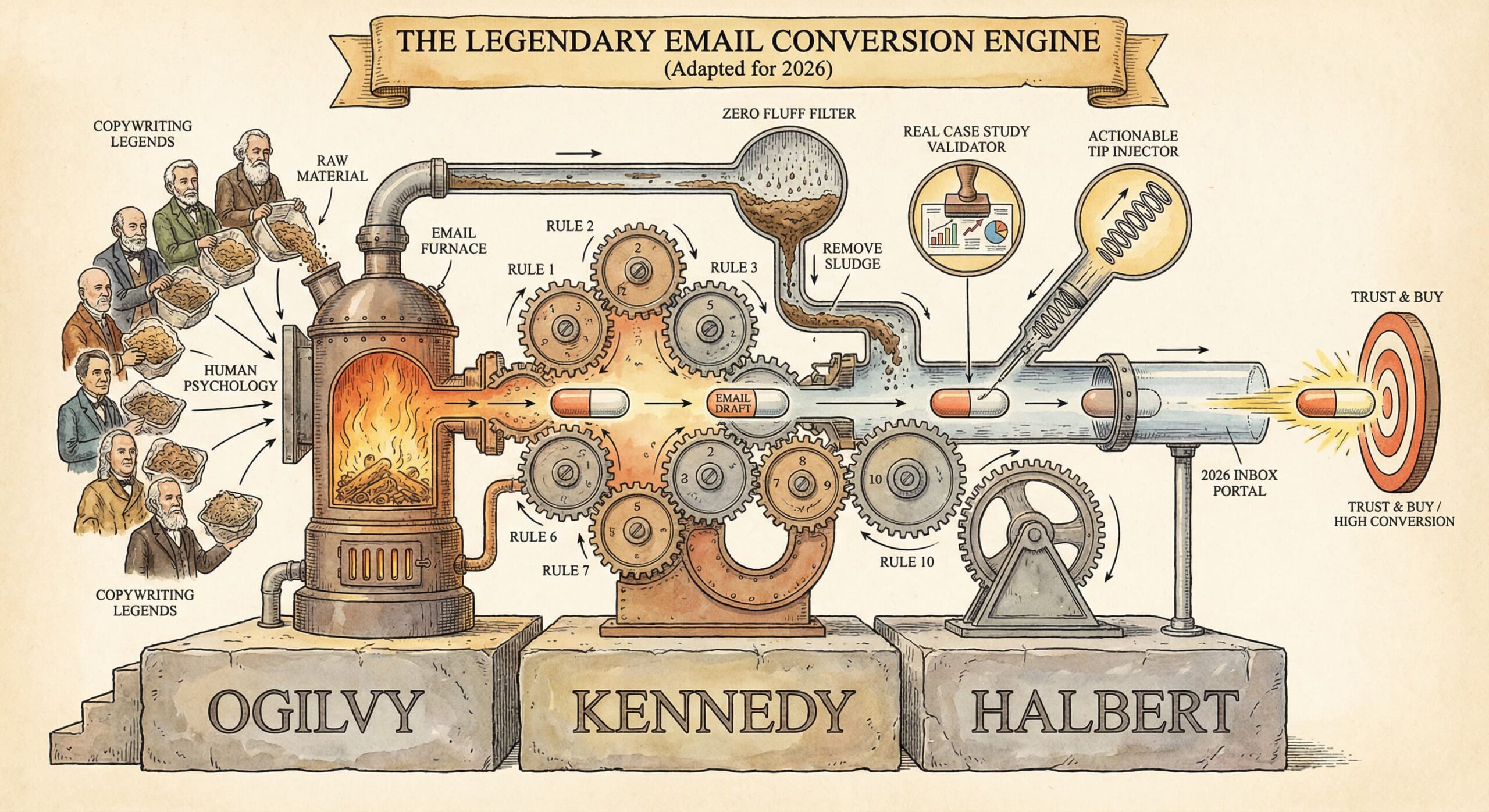
This guide takes one core rule from each of those ten legends and shows you how to apply it to your email marketing in 2026. Every rule includes a real case study with measurable results and a practical step you can take before your next send.
This is the fourth article in our legendary copywriters series. We have already published deep dives on David Ogilvy’s 11 email rules, Dan Kennedy’s email marketing principles, and Gary Halbert’s 10 copywriting rules. Think of this article as the map that connects them all.
1. David Ogilvy: Your Subject Line Is 80% of Your Budget
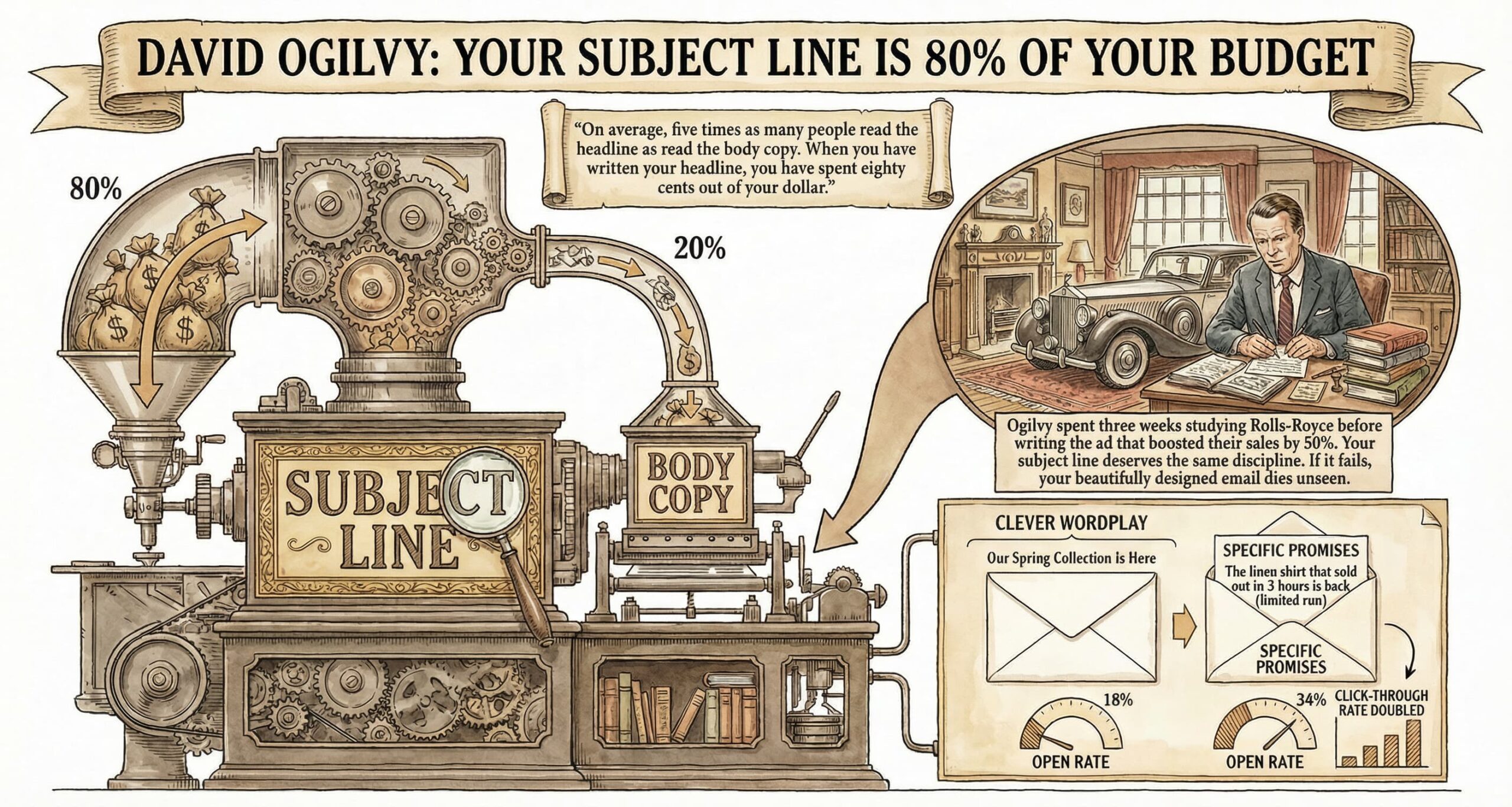
“On average, five times as many people read the headline as read the body copy. When you have written your headline, you have spent eighty cents out of your dollar.”
Ogilvy spent three weeks studying Rolls-Royce before writing the ad that boosted their sales by 50%. Your subject line deserves the same discipline. If it fails, your beautifully designed email dies unseen.
We helped an e-commerce client change nothing but subject lines, replacing clever wordplay with specific promises. “Our Spring Collection Is Here” became “The linen shirt that sold out in 3 hours is back (limited run).” Open rates jumped from 18% to 34%. Click-through doubled.
Try this: Pull up your last five subject lines. Does each one promise something the reader actually wants? If it just announces, rewrite it around a benefit. For the full breakdown, read our David Ogilvy email guide and How to Write Subject Lines That Get Opened.
2. Claude Hopkins: Test Everything. Assume Nothing.
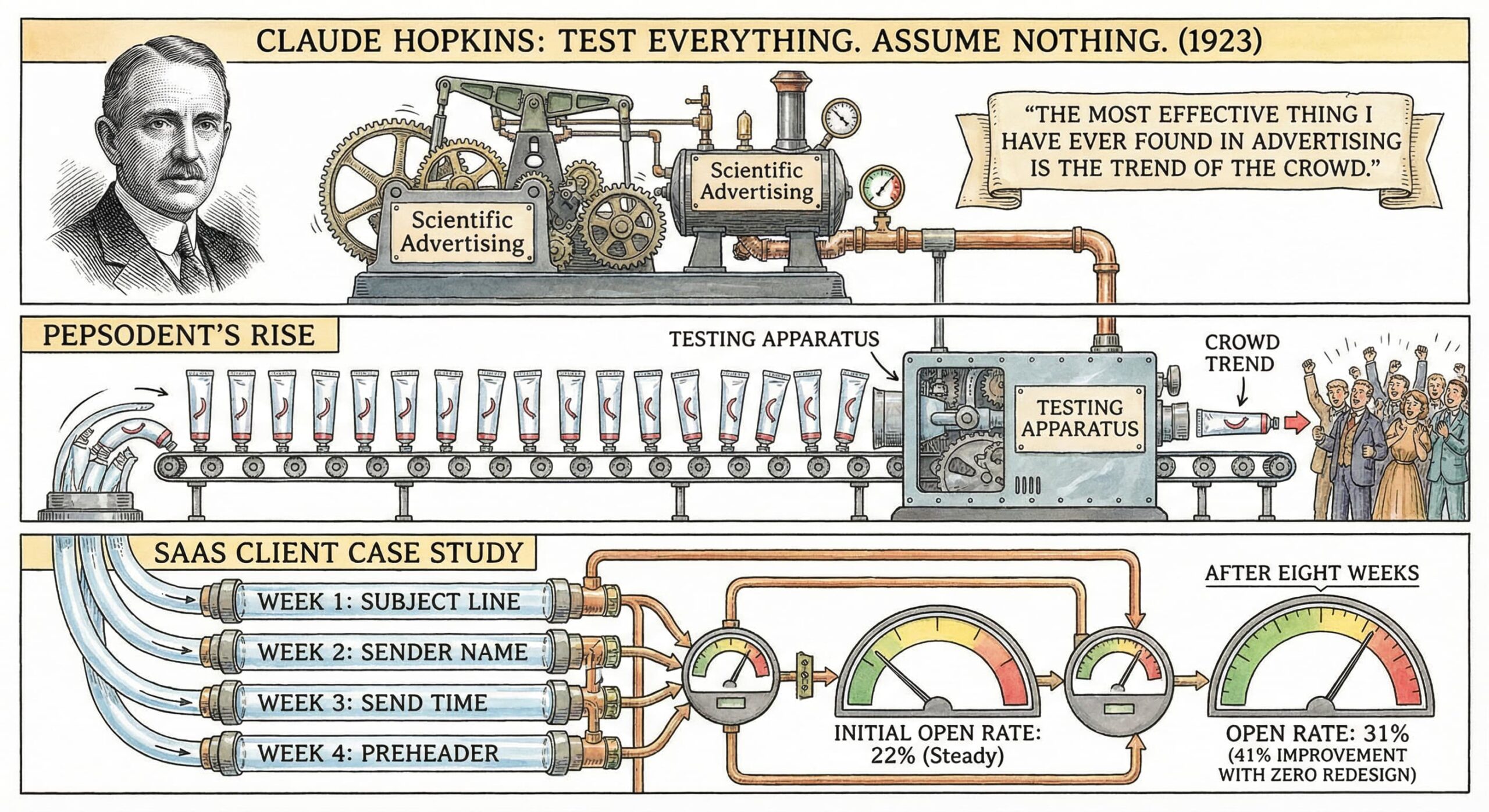
“The most effective thing I have ever found in advertising is the trend of the crowd.”
Hopkins wrote Scientific Advertising in 1923, a book Ogilvy said nobody should work in advertising without reading seven times. He turned Pepsodent into America’s best-selling toothpaste, not through creative brilliance, but by testing dozens of angles until he found the one that worked.
A SaaS client of ours had a steady 22% open rate. We implemented Hopkins-style testing: one variable per email, every week. Subject line structure, then sender name, then send time, then preheader text. After eight weeks, open rates sat at 31%, a 41% improvement with zero redesign.
Try this: Test one element in every email for the next month. Create a testing calendar. After 30 days, you’ll have more actionable data than most marketers collect in a year.
3. John Caples: A Bad Headline Kills Everything That Follows
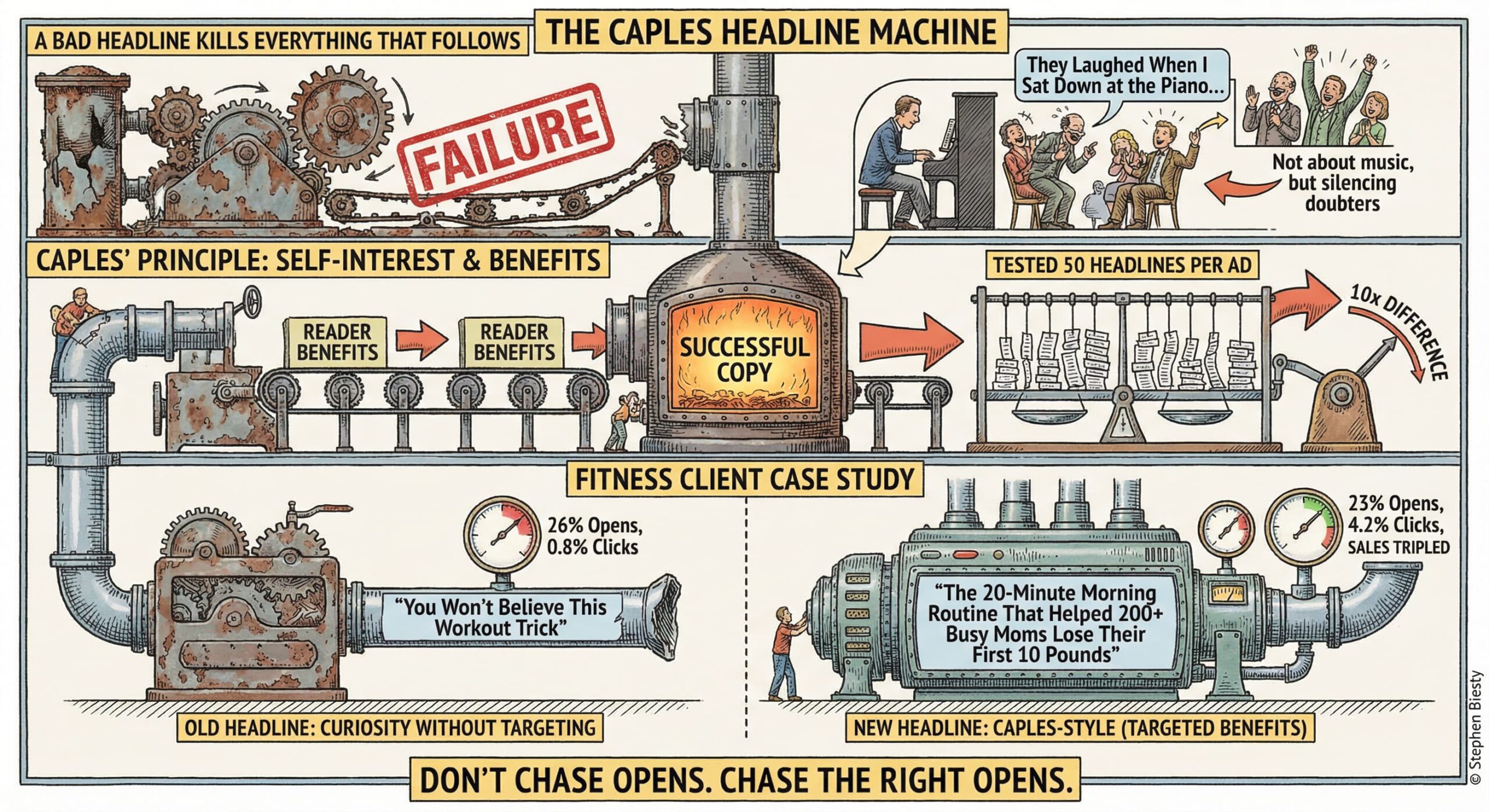
“The best headlines are those that appeal to the reader’s self-interest, that is, headlines based on reader benefits.”
Caples wrote “They Laughed When I Sat Down at the Piano…” It wasn’t about music lessons, but about silencing your doubters. He tested up to 50 headlines per ad and proved the difference between great and mediocre could be 10x.
A fitness client’s subject line, “You Won’t Believe This Workout Trick,” got 26% opens but only 0.8% clicks. We rewrote it Caples-style: “The 20-Minute Morning Routine That Helped 200+ Busy Moms Lose Their First 10 Pounds.” Opens dipped slightly to 23%, but clicks jumped to 4.2%, and sales tripled.
Try this: Before your next subject line, finish this sentence: “The person who opens this email wants to ______.” For more headline frameworks, see 6 Copywriting Formulas That Sell.
4. Robert Collier: Enter the Conversation Already Happening in Their Head
“You know that every man is constantly holding a mental conversation with himself, the burden of which is his own interests.”
Collier sold millions of books during the Great Depression by never starting a letter about the product. He started with what the reader was already thinking. That is what he called “joining the conversation already happening in your prospect’s mind.”
An online education platform was blasting the same email to 40,000 subscribers. Conversion: 0.6%. We split the list into three segments based on behavior and wrote different opening lines for each. Same product, same week, three conversations. Conversion: 3.1%, more than 5x the original.
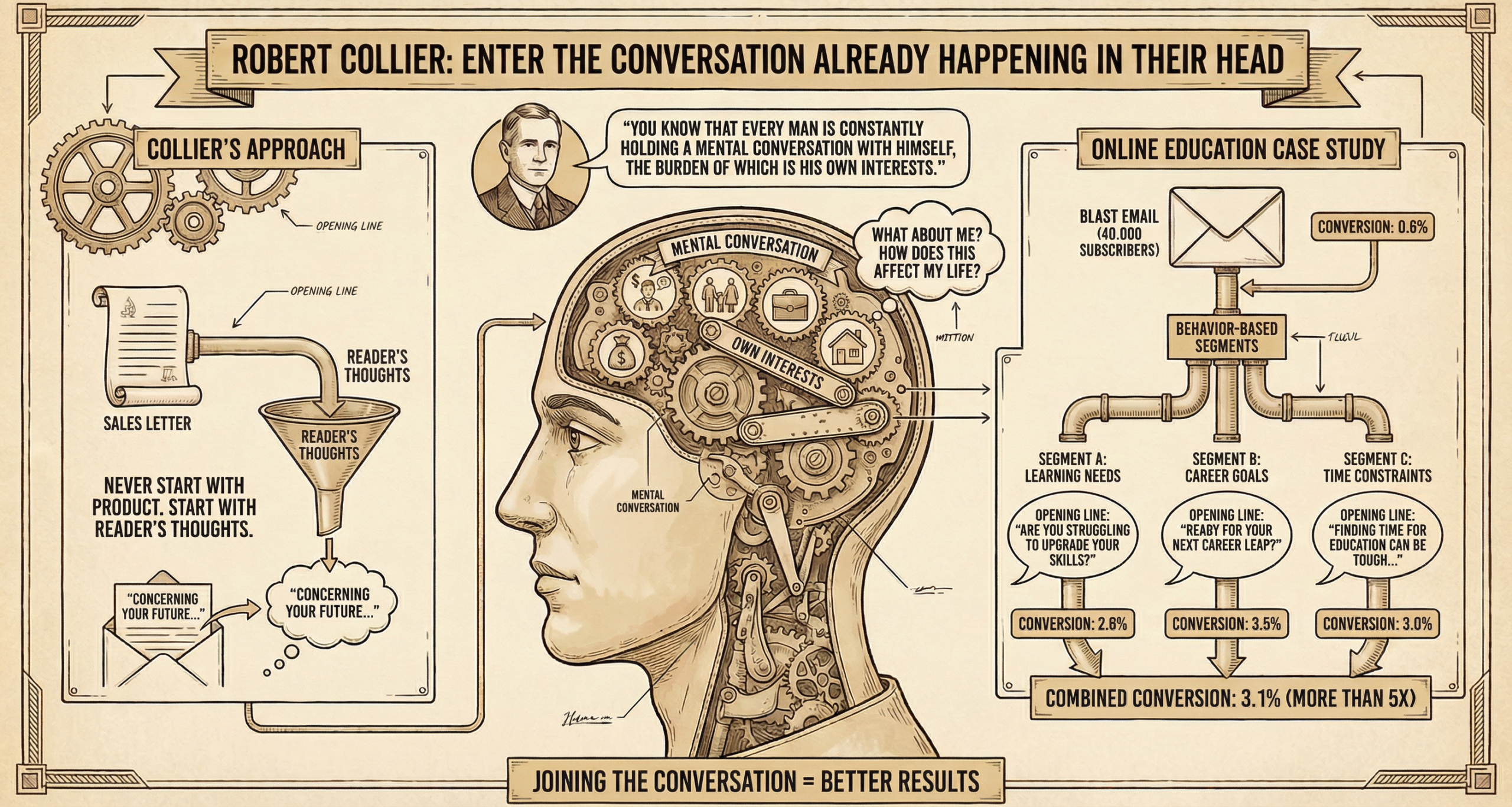
Try this: Identify three distinct “mental conversations” across your audience. Write a different opening sentence for each. That’s real segmentation.
5. Joseph Sugarman: Make Them Slide Down the Slippery Slope
“All the elements in an advertisement are primarily designed to do one thing and one thing only: get you to read the first sentence of the copy.”
Sugarman sold calculators, watches, and even a used airplane through ads by making his copy impossible to stop reading. He called it the “slippery slide”: every sentence compels you to read the next.
A client selling courses achieved a 24% open rate, but the average read time was only 4 seconds. We rebuilt using Sugarman’s method: a one-sentence opener continuing the subject line, then a story hook, then curiosity about what’s next. Read time jumped to 47 seconds. CTA clicks went from 1.1% to 3.8%.
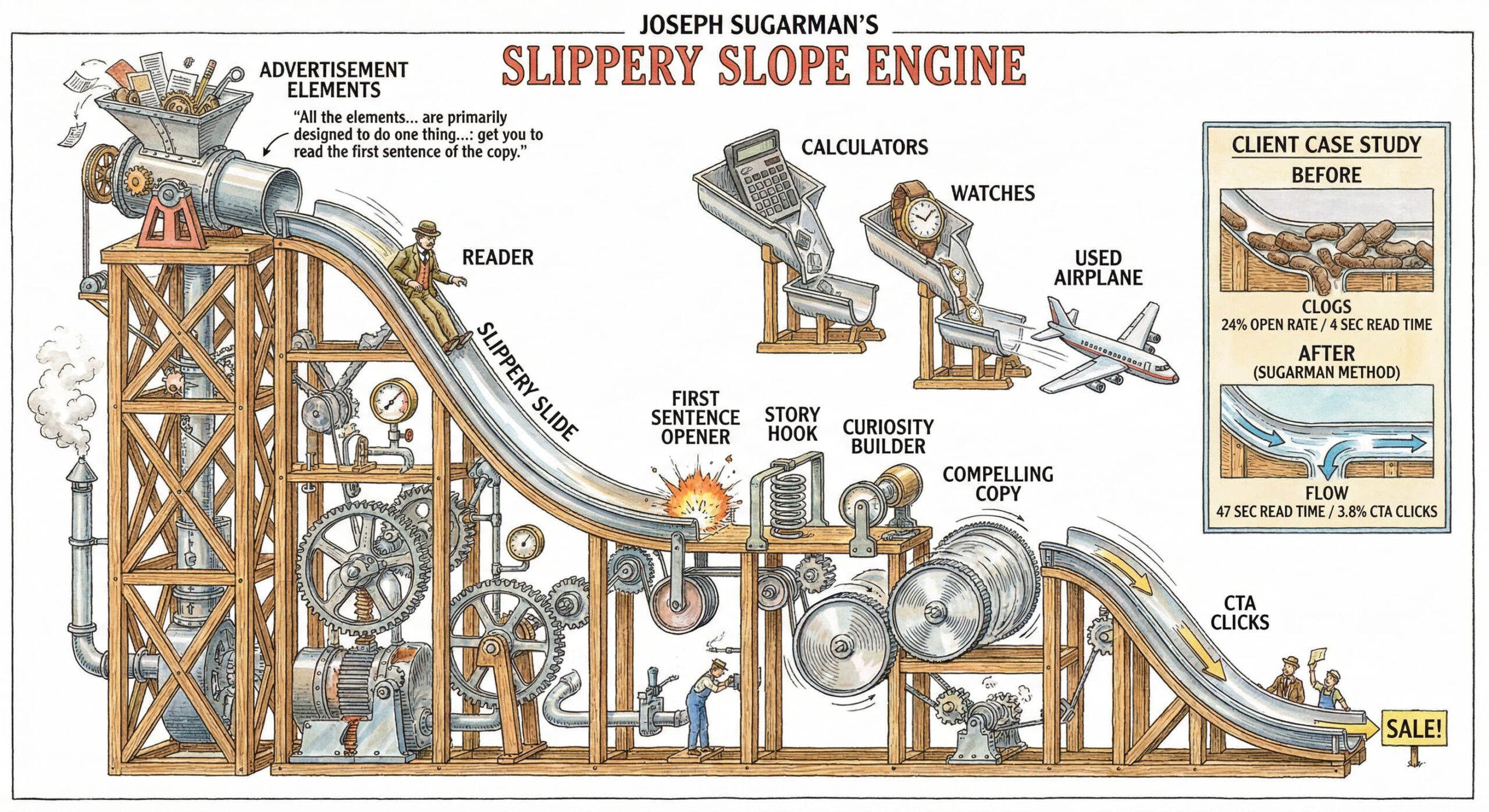
Try this: Read only the first sentence of your last email. Does it make you need to read the second one? If not, rewrite it. For more on storytelling structure in emails, we break this down in detail.
6. Gary Halbert: Find the Starving Crowd First
“The most important thing is a hungry market. Not a brilliant burger.”
Halbert’s Coat of Arms letter made $300,000 a day, not because the copy was genius, but because the market was starving for family history. A coaching client launched a $497 program to “entrepreneurs who want to grow.” Conversion: 0.3%.
We surveyed the list and discovered the real pain: “I can’t hire because I don’t know how to delegate.” We rewrote every email around that exact sentence. Conversion jumped to 2.9%.
Try this: Send a one-question survey: “What’s the single biggest challenge you’re facing with [your topic] right now?” For the full deep dive, read Gary Halbert’s 10 Email Rules.
7. Eugene Schwartz: Don’t Create Desire. Channel It.
“Copy cannot create desire for a product. It can only take the hopes, dreams, fears, and desires that already exist in the hearts of millions of people and focus those already existing desires onto a particular product.”
Eugene Schwartz matched copy to the reader’s awareness stage and hit an 85% success rate. A side-hustle coach for busy moms was pitching her $997 program in the very first welcome email. Conversions stayed at 1.4%.
We rebuilt the sequence using Schwartz’s 5 stages: pain first, then solution, then method, then offer. Conversions jumped to 5.9%.
Try this: Map your current sequence to the five awareness stages. Why are you jumping to the conclusion too fast? If you’re building from scratch, start with our beginner’s email marketing guide.
8. Leo Burnett: Give Your Brand a Soul, Not Just a Voice
“Make it simple. Make it memorable. Make it inviting to look at. Make it fun to read.”
Leo Burnett didn’t sell products; he created beloved characters that people actually fell in love with: the Marlboro Man, Tony the Tiger, and the Jolly Green Giant. He understood that brands with a strong personality build real emotional connections.
A premium coffee subscription brand was sending beautifully designed emails that felt completely generic. Everything looked professional, but the brand had zero soul — readers opened them and immediately forgot. We gave the emails a clear, human character: the founder as “the passionate coffee explorer who’s visited 30+ origin countries, rejects mediocre beans, and believes your morning cup should be the highlight of your day.”
The tone instantly became warmer, more opinionated, and genuinely fun to read. Unsubscribe rate dropped by 41%, reply rate jumped from 0.2% to 3.7%, and subscribers started replying as if they were chatting with a real friend.
Try this: Define your brand’s email personality in just three adjectives (e.g., adventurous, honest, witty). Open your last three campaign emails and ask: Would my subscribers actually use these three words to describe the voice? If not, start adding more character today.
9. Howard Gossage: Earn Attention. Don’t Demand It.
“Nobody reads ads. People read what interests them, and sometimes it’s an ad.”
Gossage ran his agency from a San Francisco firehouse and hated interruptive advertising with a passion. He believed your message should earn its place in the inbox — never demand it. His legendary Qantas Airlines campaign didn’t push flights. Instead, it invited readers to name a baby kangaroo and mail in their suggestions. Thousands participated instead of ignoring the ad.
A productivity SaaS client for creators was stuck sending standard promotional blasts with only 17% open rates. We redesigned their bi-weekly email as a genuinely useful resource: one exclusive productivity framework, one free Notion template, and one 5-minute action step, all in under 300 words. Open rates climbed to 44% within six weeks. When they later sent a promotional campaign to this warmed-up list, conversion hit 6.1%.
Try this: Write your next email as if you were not allowed to sell anything. What single piece of value would make your subscribers genuinely thankful? Create that first, then add your offer naturally at the end. That’s how you turn emails into something people look forward to instead of delete.
For a deeper look at writing sales emails that convert without feeling pushy, we have a dedicated guide.
10. Robert W. Bly: Clarity Beats Cleverness. Every Time.
“The words in your copy should be like the windows in a storefront. The reader should be able to see right through them and see the product.”
Bly has written for IBM, AT&T, and Forbes. His “4-U” filter (Urgent, Unique, Ultra-specific, Useful) is the most practical test for email copy I’ve ever used.
A financial services client wrote emails like this: “leverage our synergistic portfolio optimization tools for enhanced yield generation.” Open rate: 14%. We rewrote at an eighth-grade reading level: “See exactly where your money is going and move it somewhere better in 3 clicks.” Open rate: 27%. Revenue per email: up 412%.
Try this: Run your next email through Hemingway App. If it scores above grade 8, simplify. For more, start with our email campaign guide.
The Common Thread
Ten copywriters. Ten eras. One pattern: they obsessed over the reader, not the product.
Ogilvy researched before writing. Hopkins tested after. Caples selected his audience. Collier joined their mental conversation. Sugarman made every line earn the next. Halbert found the starving crowd. Schwartz matched the message to awareness. Burnett gave brands a soul. Gossage earned attention. Bly chose clarity over cleverness.
These principles work in email for the same reason they worked on paper: human psychology doesn’t get software updates.
Cheat Sheet: 10 Rules at a Glance
| Copywriter | Core Email Rule | Example Subject Line |
|---|---|---|
| David Ogilvy | Your subject line is 80% of your budget | “The linen shirt that sold out in 3 hours is back” |
| Claude Hopkins | Test one variable per email, every time | A/B test: sender name vs. brand name |
| John Caples | Select your audience, don’t just grab attention | “The 20-min routine that helped 200+ busy moms lose 10 lbs.” |
| Robert Collier | Enter the conversation already in their head | Segment by behavior, not just demographics |
| Joseph Sugarman | Every line must earn the next one | First sentence continues the subject line’s promise |
| Gary Halbert | Find the starving crowd before you write | Survey your list: “What’s your #1 challenge?” |
| Eugene Schwartz | Match the message to the awareness stage | Welcome sequence: problem → solution → product → offer |
| Leo Burnett | Give your brand a soul, not just a voice | Write as a founder persona, not a company |
| Howard Gossage | Earn attention, don’t demand it | Lead with value, CTA second |
| Robert W. Bly | Clarity beats cleverness, every time | Grade 8 reading level or simpler |
FAQ
Which copywriting rules work best for email marketing in 2026? All ten apply directly to email. If you’re picking a starting point, focus on Ogilvy’s subject line rule, Hopkins’ testing habit, and Schwartz’s awareness stages. These three alone will improve open rates, click rates, and conversions faster than any design tweak or send-time hack.
Can I use these classic rules together with AI writing tools? Absolutely. AI generates drafts fast, but it doesn’t know your audience’s pain points. Use these rules as your editing filter: run AI drafts through Halbert’s “starving crowd” test, Sugarman’s “slippery slide” check, and Bly’s clarity filter. AI speed plus classic principles is where the real leverage is.
Which copywriter should a beginner study first? Start with Gary Halbert. His writing is raw, practical, and impossible to misunderstand. Read The Boron Letters (free online), then move to Hopkins’ Scientific Advertising and Ogilvy’s Confessions of an Advertising Man.
How long should a marketing email be? As Sugarman would say: long enough to make the reader take action, not a word longer. A welcome email might need 400 words. A flash sale might need 50. The real question is whether every sentence earns the next one.
Are these principles only for email, or do they work for other channels too? These rules were written for print ads, direct mail, and sales letters. They work just as well in email, landing pages, social ads, and video scripts. The channel changes. Human psychology doesn’t.
Start Using These Rules. Today.
These ten principles aren’t “nice to have” for your email marketing. They’re the difference between campaigns that convert and campaigns that get ignored.
The best part: you don’t need a copywriting degree. You need customer empathy, a clear message, and the discipline to put the reader before the sell.
Ready to put these legendary frameworks into your next email campaign?
→ Start free at novaexpress.ai.
✓ AI-powered copy generation to draft emails built on proven persuasion principles
✓ 270+ ready-to-use templates with narrative frameworks these legends would approve of
✓ Segmentation tools to match the right message to the right audience
Nova Express Resources
Getting Started:
- What is Nova Express?
- How to Start Email Marketing: Guide for Beginners
- How to Start Your First Email Campaign
- AI Tools for Marketers in 2026
- Nano Banana Pro: The Complete Guide for Marketers 2026
- NotebookLM for Marketers
- Storytelling elements for high-converting marketing campaigns
- NotebookLM Infographic: The Complete Guide to Turning Your Data Into Visual Stories
- How Humor in Advertising Boosts Engagement
- 6 Psychology Triggers That Make People Share Your Brand
Boost Your Results:
- 6 Copywriting Formulas That Convert
- 9 Steps to Sales Emails That Actually Sell
- The Preheader Tweak That Boosts Opens by 30%
About the Author
Serafima Osovitny is a marketing manager at Nova Express. Passionate about turning complex marketing tactics into simple, actionable guides, she shares insights about email marketing and e-commerce. Follow her on Twitter: @OSerafimaA.






Leave a Comment