

Most competitor analysis starts with competitors. That’s usually the wrong place to start.
People rarely stay loyal to products that merely satisfy them. They stay loyal to products that reflect something about who they believe they are.
A 2024 study in Nature’s Humanities and Social Sciences Communications found that brand identity alignment was a stronger predictor of repurchase intention than satisfaction alone.
The implication is simple but uncomfortable: you can know everything about your competitors and still misunderstand your customers. Even a full map of features, pricing, and content topics may still miss what actually drives preference: whether your language sounds like the way customers already think.
Competitor analysis, done well, reveals something more useful: what your market is asking for in a language your competitors haven’t learned to speak yet.
TL;DR
- The most valuable output of competitor analysis isn’t information about competitors. It’s information about customers.
- Three gaps worth tracking: the messaging gap (what no one is saying), the language gap (Customer Language Delta), and the visibility gap (who AI recommends).
- A 6-step framework (with prompts) that turns research into insight, not just data.
- The question to ask isn’t “What are competitors doing?” It’s “What do customers keep wishing existed?”
The Question Behind the Question
Before any tool, any prompt, or any framework, ask yourself what you’re actually trying to understand.
Most teams frame competitor analysis as an information-gathering exercise. Who are they? What do they say? Where do they rank?
These are useful questions. They’re just not the first ones you should ask.
The first-order question is this: What does my market keep asking for that nobody is currently providing?
Competitors are just a mirror for that question. Their gaps are not random. Their blind spots reflect choices: what they’ve decided isn’t worth saying, what customer frustration they’ve decided isn’t worth solving, and what territory they’ve quietly abandoned.
The answers to those questions form what we call a competitive gap map: a live picture of where your market is underserved and where you can move with the wind at your back, not against it.
Competitive Gap Map
Competitor Analysis
↓
Competitors
↓
Messaging Gaps
↓
Content Gaps
↓
Customer Language Delta
↓
AI Visibility Gap
↓
Unmet Market Needs
↓
Strategic Actions
Every layer of the map moves you one step further away from competitors and one step closer to customers. The goal isn’t to understand what others are doing. The goal is to understand why customers are still looking for something more.
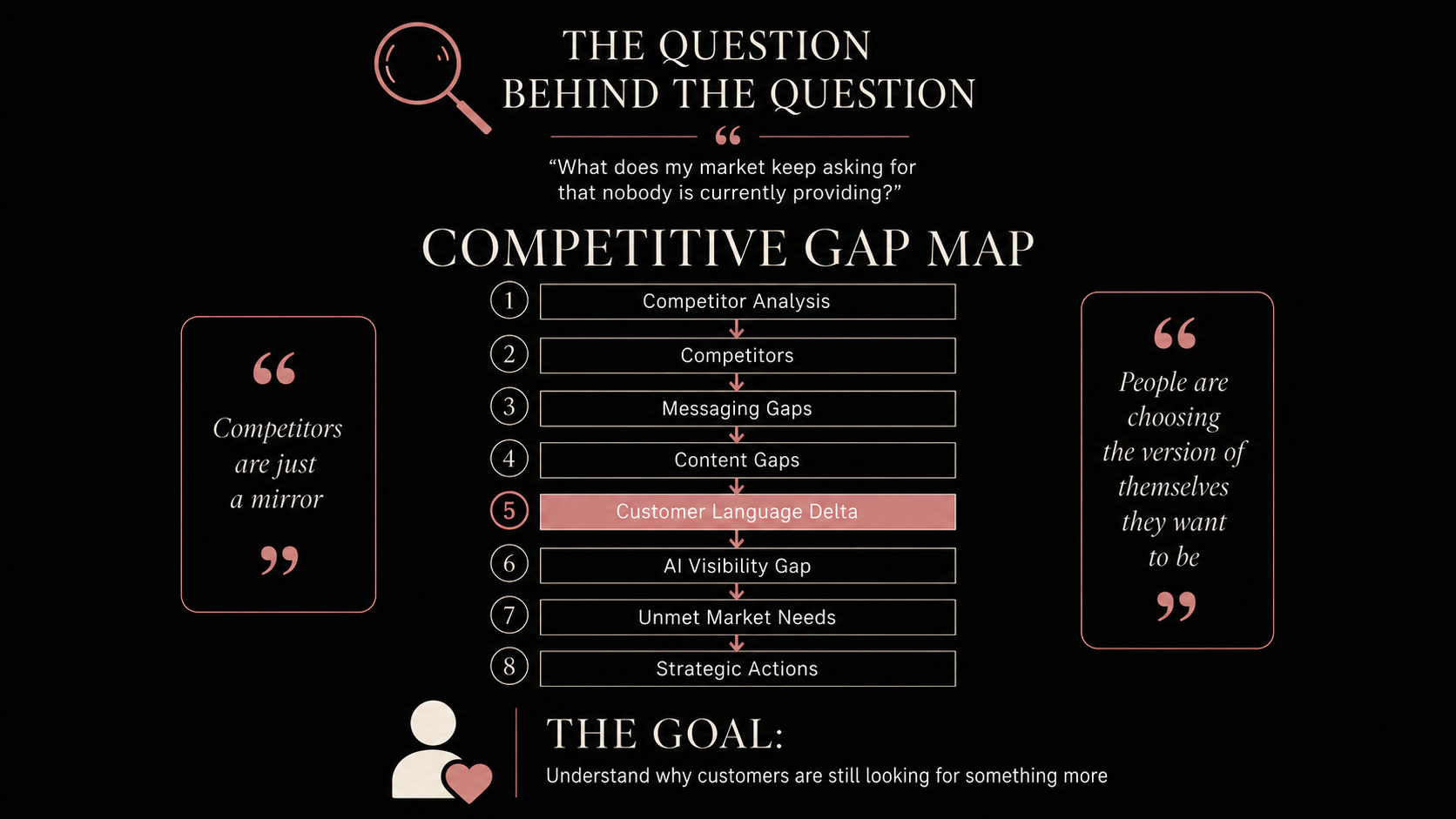
Research on decision-making consistently shows that people are not choosing products so much as choosing the version of themselves they want to be. The brand that articulates that version most clearly, in the language the customer already uses, wins. Not always. But more often than the data would predict.
Why We Do This Wrong
Here’s what competitor analysis usually looks like in practice.
A team member opens a spreadsheet. Five competitor websites are visited, noted, and summarized. Keywords get exported. LinkedIn gets scrolled. Reviews get skimmed. Everything goes into a document.
That document is thorough. It is also, almost immediately, out of date.
I’ve seen teams spend two full days building competitive reports that were never opened again after the presentation. The work wasn’t wrong. It just stopped being useful almost immediately.
According to Optimizely, 40% of B2C content marketers look at competitors less than once a year. This isn’t negligence. It’s a rational response to the cost of doing it well manually.
The problem isn’t the effort. It’s the model. Treating competitor analysis as a periodic project rather than a continuous practice is like checking the weather once in January and dressing for the rest of the year.
Markets don’t wait for quarterly reviews. Neither do the customers moving through them.
Signs your current approach isn’t working:
- Your messaging hasn’t changed after the last analysis cycle
- You have no running document where insights accumulate over time
- You only track direct competitors, not adjacent players or emerging alternatives
- You’ve never checked whether you appear in AI-generated recommendations
- Your last competitive review was more than three months ago
If two or more of these are true, the framework below is where to start.
What Changes When AI Is Involved?
The honest answer is simple: not the questions, but the frequency.
AI doesn’t make competitor analysis smarter. It makes it possible to do it more often, at lower cost, with less friction. What used to be a quarterly project becomes a weekly signal.
Three things shift meaningfully:
Monitoring becomes continuous. Not a snapshot: an ongoing reading of what competitors publish, change, and quietly remove.
Surface area expands. The competitors you didn’t know to look for. The messaging shift that happened last Tuesday. The pricing page no longer mentions “affordable.”
Language differences become measurable. This is the deepest shift. The gap between how you describe your product and how customers describe their problem (what researchers might call a translation failure) becomes something you can actually measure.
We call that translation failure the Customer Language Delta. Closing it is often worth more than any campaign optimization. Not because the words are magic. Because they signal that you’ve actually listened.
Competitive teams saw a 76% year-over-year increase in AI adoption for competitive analysis workflows, and 60% now use AI daily, according to the Crayon State of Competitive Intelligence report. In our own work with clients, the first weekly cycle almost always surfaces at least one competitor signal from the past 30 days, something a quarterly review would have missed entirely.
A Framework for Finding What Matters
Step 1: Define the real competitive landscape
Start with a prompt, not a list. If you already know exactly who your competitors are, you’re probably working with a narrower picture than reality.
Ask an AI tool:
“I’m building [product/service] for [audience]. Who are the direct competitors, adjacent players, and emerging alternatives I should be tracking? Include companies that might not be obvious.”
The goal here isn’t comprehensiveness for its own sake. It’s to surface what you didn’t know to look for.
Step 2: Read their positioning carefully
Visit their homepage, pricing page, and about page. Then prompt:
“Based on this homepage copy, what is the core value proposition? Who are they targeting? What pain are they leading with? What’s missing or conspicuously absent?”
What no one is saying is as revealing as what everyone is saying. Research on brand personality consistently shows that differentiation lives in the white space: the emotional territory left unoccupied.
Only 52% of organizations have a value proposition that truly differentiates them from competitors (KLIQ Interactive B2B Benchmarks, 2026). Nearly half of your competitive landscape is positioning on borrowed language. The gap is real.
Step 3: Map their content strategy
“Here are the last 20 articles published by [competitor]. What topics are they prioritizing? What audience are they writing for? What topics are notably absent?”
Absence is data. The topics a competitor doesn’t cover represent either a blind spot or a considered retreat. Either way, they’re available territory.
AI Overviews now appear on approximately 48% of tracked Google queries, up 58% year over year (BrightEdge, 2026). Competitors whose content gets cited in those overviews are capturing traffic that used to go to ranked pages. Content strategy and visibility strategy are no longer separate questions.
Step 4: Listen to what customers are actually saying
This is the step that makes the others meaningful.
Go to G2, Trustpilot, Reddit: wherever your market talks honestly. Pull competitor reviews, especially the 3-star ones. Those are the ones written by people who wanted to love the product but couldn’t.
“Here are 20 reviews of [competitor]. What are the most common complaints? What do people wish existed? What do they consistently praise?”
What emerges from this exercise is not information about competitors. It’s a map of unmet needs, described in the language customers already use.
The Customer Language Delta, visualized:
What you say: “Enterprise-grade all-in-one platform”
↕ (the Delta)
What they say is “Too complicated.” Takes forever to set up.
Our team never fully adopted it.”
↕
What you should say: “Get your team organized in 15 minutes.”
One SaaS company described itself as an “all-in-one collaboration platform.” Review analysis showed customers repeatedly used words like “too many steps” and “takes forever to set up.” The company rewrote its homepage around a simpler promise: “Get your team organized in 15 minutes.” The product didn’t change. The message did. In many cases, engagement improves because the message stops sounding like marketing and starts sounding like the customer.
The connection between this kind of listening and effective customer pain point work is direct.
Step 5: Track changes over time
Every 2-4 weeks, revisit the same pages:
“Here is [competitor]’s homepage now and the version from 30 days ago. What changed? What was added, removed, or reworded? What might this signal?”
Pricing changes signal competitive pressure. New messaging signals a strategic pivot. A removed feature page signals retreat. These signals rarely get announced. But they’re legible if you’re watching.
Step 6: Measure AI visibility
This is the newest dimension of competitive analysis and the one most teams haven’t mapped yet.
A company can rank first in Google and still be entirely absent from AI-generated recommendations. These are increasingly different lists. 89% of B2B buyers now use generative AI during purchasing research (Demand Gen Report, 2025).
Open ChatGPT, Perplexity, or Claude. Ask the questions your customers ask:
“What’s the best tool for [your category]?”
Who appears? What language is used to describe them? Do you appear at all?
The gap between who shows up in AI answers and who doesn’t is the AI visibility gap, one of the fastest-compounding competitive advantages in marketing right now. The mechanics of how to close it are covered in Why AI Cites Some Brands and Ignores Others.
The Prompts
The prompts themselves aren’t the advantage. Anyone can copy them. The advantage comes from asking better questions and returning to them repeatedly.
The prompts matter less than the questions behind them. Each one is designed to uncover a different kind of gap: competitive, linguistic, or visibility-related.
Six prompts from the framework above, ready to use in ChatGPT, Claude, or Perplexity.
Prompt 1: Landscape “I’m building [product/service] for [audience]. Who are the direct competitors, adjacent players, and emerging alternatives I should track? Include non-obvious ones.”
Prompt 2: Positioning “Based on this homepage copy, what is the core value proposition? Who are they targeting? What pain are they leading with? What’s conspicuously absent?”
Prompt 3: Content gaps. “Here are [competitor]’s last 20 articles. What topics do they prioritize? What audience are they writing for? What’s notably absent?”
Prompt 4: Customer language: “Here are 20 reviews of [competitor]. What are the most common complaints? What do people wish existed? What do they consistently praise?”
Prompt 5: Change detection “Here’s [competitor]’s homepage now vs. 30 days ago. What changed? What might that signal about their strategy?”
Prompt 6: AI visibility “What are the best tools for [your category]? Which companies come up most when someone asks how to solve [problem]?” Run this in ChatGPT, Perplexity, and Claude separately. The results differ, and the differences are informative.
When an Agent Does This for You
The six-step process above requires your direction at every stage. An AI marketing agent runs the sequence autonomously and returns a weekly brief (competitor positioning shifts, content gaps, customer language signals, and AI visibility scores) without you gathering the inputs.
The practical difference: manual AI-assisted analysis takes 2-3 hours quarterly. An agent runs continuously. More on the mechanics: What Is an AI Marketing Agent?
For most teams, start with the manual process. It builds the intuition to recognize a signal from noise. Once you know what good output looks like, automation becomes useful rather than just fast. Understanding where competitive intelligence fits in the broader AEO vs SEO vs GEO landscape helps, too.
Manual vs AI-Assisted vs AI Agent
| Manual | AI-Assisted | AI Agent | |
|---|---|---|---|
| Time required | 6-8 hours | 2-3 hours | Minutes |
| Frequency | Quarterly | Monthly | Continuous |
| Change detection | Rare | Partial | Automatic |
| Competitor discovery | Limited | Broader | Continuous |
| Outcome | Static report | Faster research | Ongoing intelligence |
What to Do With What You Find
Research that doesn’t change anything is just sophisticated procrastination.
Leave every competitor analysis session with three things:
- One positioning shift. Something you should say differently based on what no one else is saying.
- Three content gaps. Topics your competitors have ignored that your audience cares about.
- One customer language delta fix. A phrase from real reviews that belongs in your copy this week.
The positioning work connects directly to your Brand DNA, the documented foundation that keeps messaging consistent regardless of who (or what) is producing it.
Why Frequency Changes Everything
There is a finding in happiness research that applies, unexpectedly, to competitive intelligence: the value of an experience is not just in its quality but in how recently it happened.
A quarterly analysis tells you what your market looked like in March. A weekly analysis tells you what it looks like now and, more importantly, what it’s becoming.
Since the rollout of AI Overviews, nearly 39% of marketers have seen traffic declines: 44% in tech, 43% in travel, and 35% in retail (SE Ranking, 2025). The brands absorbing that traffic are the ones appearing in AI answers. The redistribution is already underway.
Markets move between quarterly reviews. Teams with fresher intelligence make different decisions: not always bigger ones but better-timed ones.
Competitor analysis isn’t really a study of competitors. It’s a study of unmet desire.
Competitors don’t create customer desires. They simply expose the places where those desires remain unmet. The teams that listen continuously don’t just react faster. They hear what the market is becoming before everyone else does.
The real output of competitor analysis is not a competitor report. It’s a clearer understanding of what people still hope someone will build for them.
FAQ
How often should I run competitor analysis? Weekly for AI visibility and messaging signals, monthly for content gaps, and quarterly for deep positioning reviews. Most teams only do the quarterly pass, which is exactly why continuous monitoring is a structural advantage, not a tactical one.
What’s the difference between SEO competitive analysis and AI competitor analysis? SEO analysis tells you who ranks for your keywords. AI competitor analysis tells you who gets recommended when customers ask AI tools for advice. These are increasingly different lists. A brand can dominate traditional search and be invisible in AI-generated answers, and vice versa. Both maps matter.
How do I find competitors I don’t know about yet? Ask an AI tool: “I’m building [product] for [audience]. Who are the direct competitors, adjacent players, and emerging alternatives I’m probably not tracking?” Repeat quarterly. New entrants appear faster than most teams notice, especially in AI-adjacent categories.
What should I do with competitor review data? Mine it for language, not features. The goal is to find the words customers already use to describe their frustration and use those exact words in your own positioning. That’s the Customer Language Delta, closed.
What is the AI visibility gap? The difference between which brands appear in AI-generated answers and which don’t. As search behavior shifts toward AI tools, this gap is becoming as strategically significant as Google rankings. Why AI Cites Some Brands and Ignores Others: Explain the mechanics in full.
Related reading:
- What Is an AI Marketing Agent?
- What Is AEO?
- Brand DNA: The Missing Piece Between Your Brand and AI
- AEO vs SEO vs GEO: What’s the Difference and Where to Start in 2026
- Customer Pain Points: Why Your Marketing Isn’t Working
- What Is Generative Engine Optimization?
- AI Tools for Marketers in 2026
- The Pre-Launch Content Sprint: A 30-Day Plan to Build an Audience Before Launch
- The 2026 Marketing Audit
- Why AI Engines Trust Reddit More Than Brand Content (And How to Change That)
About the author
Serafima Osovitny is a Marketing Manager at Nova Express, where she focuses on digital marketing, search visibility, content strategy, and marketing workflows. She writes practical guides that help marketing teams research their audiences, develop strategies, and put their plans into action.
Explore her work at serafima.digital and follow her on X: @OSerafimaA.








Leave a Comment