

You’ve spent six figures on this launch. The landing page took four weeks. The ad creatives went through seven rounds of approval. You’re getting traffic. You’re not getting customers.
Here’s why: most marketing fails not because the product is wrong but because it solves problems nobody asked to be solved.
This guide will show you how to identify, validate, and apply real customer pain points so your marketing actually converts. You’ll learn what pain points are, the four types you need to recognize, five proven methods to find them, and how to turn them into copy that sells.
What Is a Customer Pain Point?
A customer pain point is a specific friction, frustration, or obstacle that prevents a customer from achieving a desired outcome.
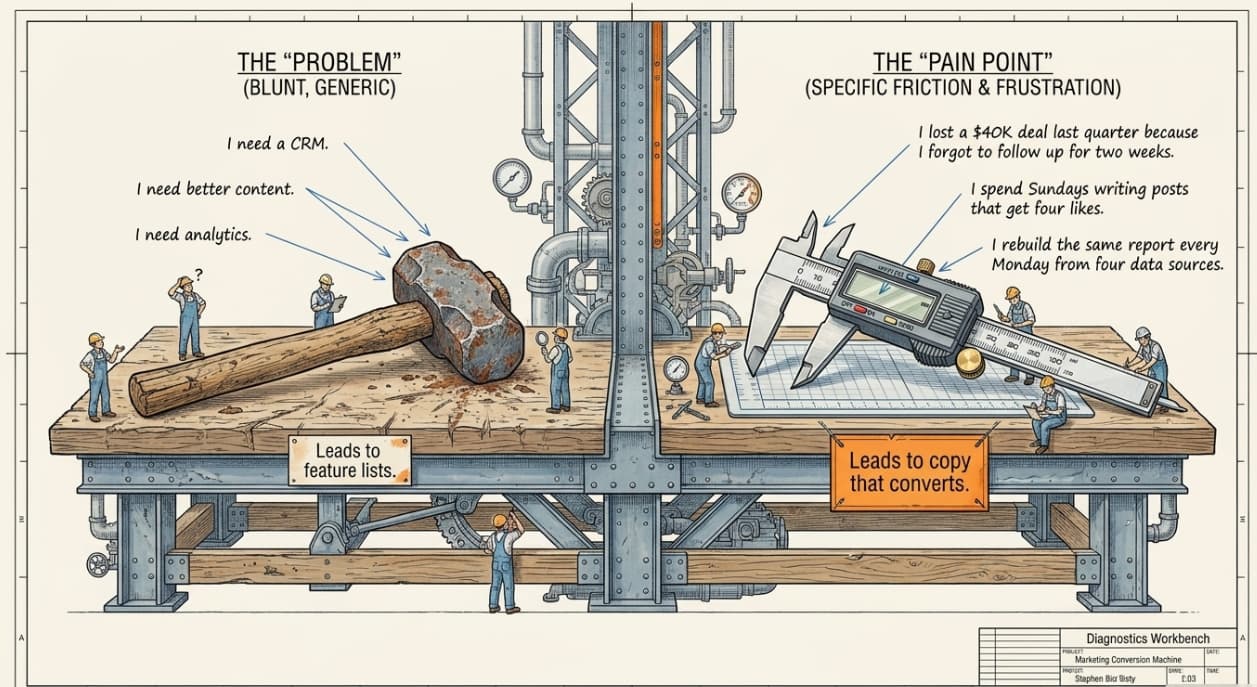
The keyword is specific. Most marketers confuse pain points with general problems, which is why their copy doesn’t convert.
Problem: “I need a CRM.”
Pain point: “I lost a $40K deal last quarter because I forgot to follow up for two weeks.”
Problem: “I need better content.”
Pain point: “I spend my Sundays writing posts that get four likes.”
Problem: “I need analytics.”
Pain point: “I rebuild the same report every Monday from four data sources.”
Marketers who address problems write feature lists. Marketers who address pain points write copy that converts. For a deeper look at how pain works on four emotional levels, see Customer Pain in Marketing: 4 Levels That Drive Conversions.
The gap between those two approaches can be the difference between a 1% and a 6% conversion rate.
The 4 Types of Customer Pain Points
Customer pain points fall into four categories. Most products solve at least one. The best products address two or three.
1. Financial Pain Points
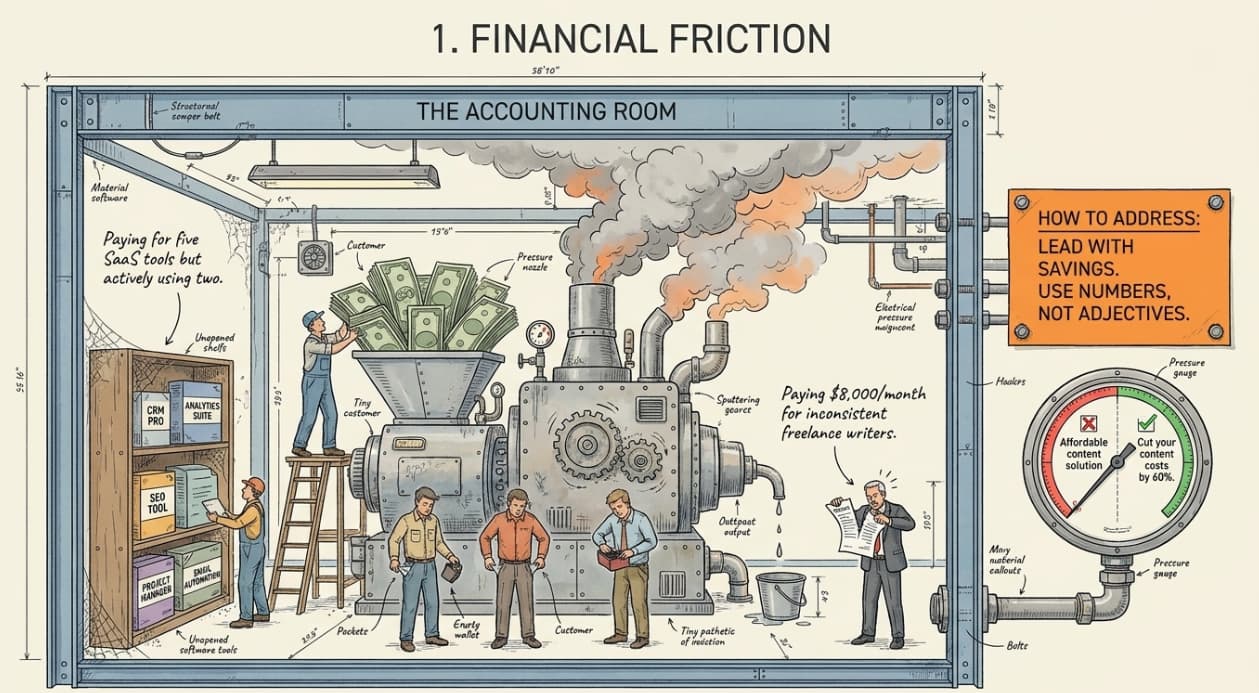
Your customer is spending too much money on a current solution, or they can’t afford a solution at all.
Examples:
- “We’re paying $8,000/month on freelance writers who deliver inconsistent work.”
- “We pay for five SaaS tools but actively use two.”
- “I can’t afford a full-time designer, and project freelancers cost more in the long run.”
How to address it in copy: Lead with the savings. Use numbers, not adjectives. “Cut your content costs by 60%” beats “affordable content solution” every time.
2. Productivity Pain Points
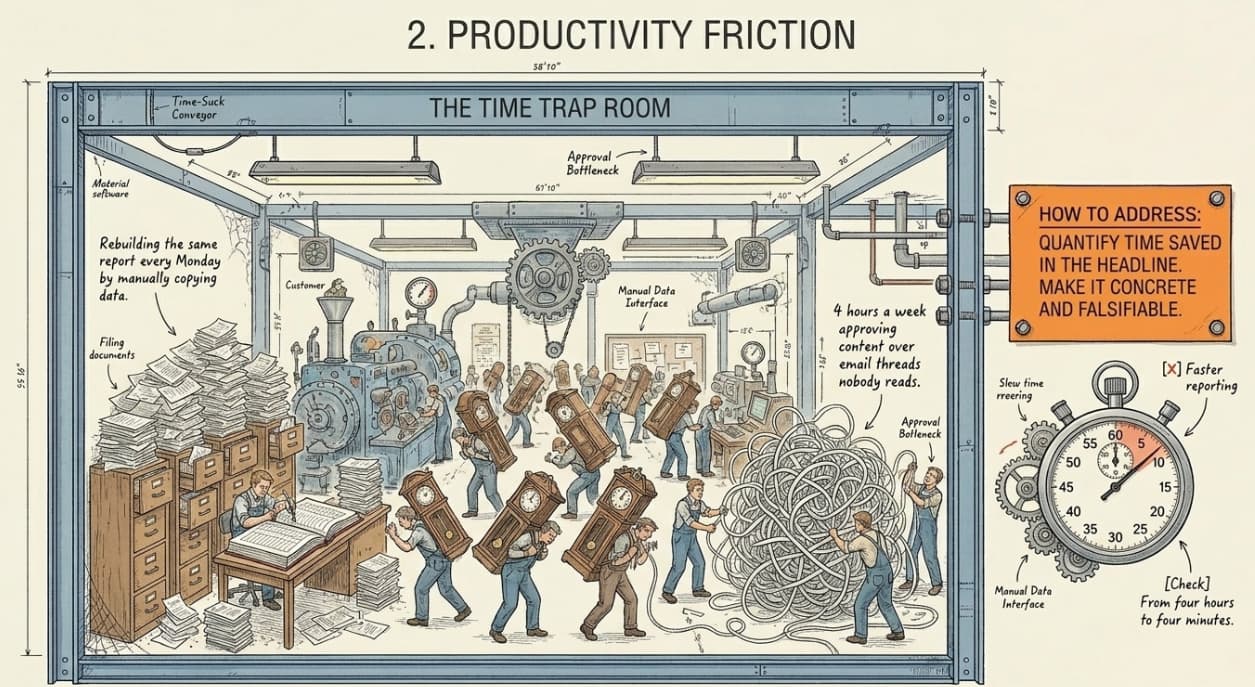
Your customer is wasting time on processes that should take minutes, not hours.
Examples:
- “My team spends four hours a week approving content over email threads nobody reads.”
- “I rebuild the same report every Monday by copying data from four sources into Excel.”
- “I can’t find the file I need because it lives across three tools and five folders.”
How to address it in copy: Quantify time saved in the headline. “From four hours to four minutes” works because it’s concrete and falsifiable.
3. Process Pain Points
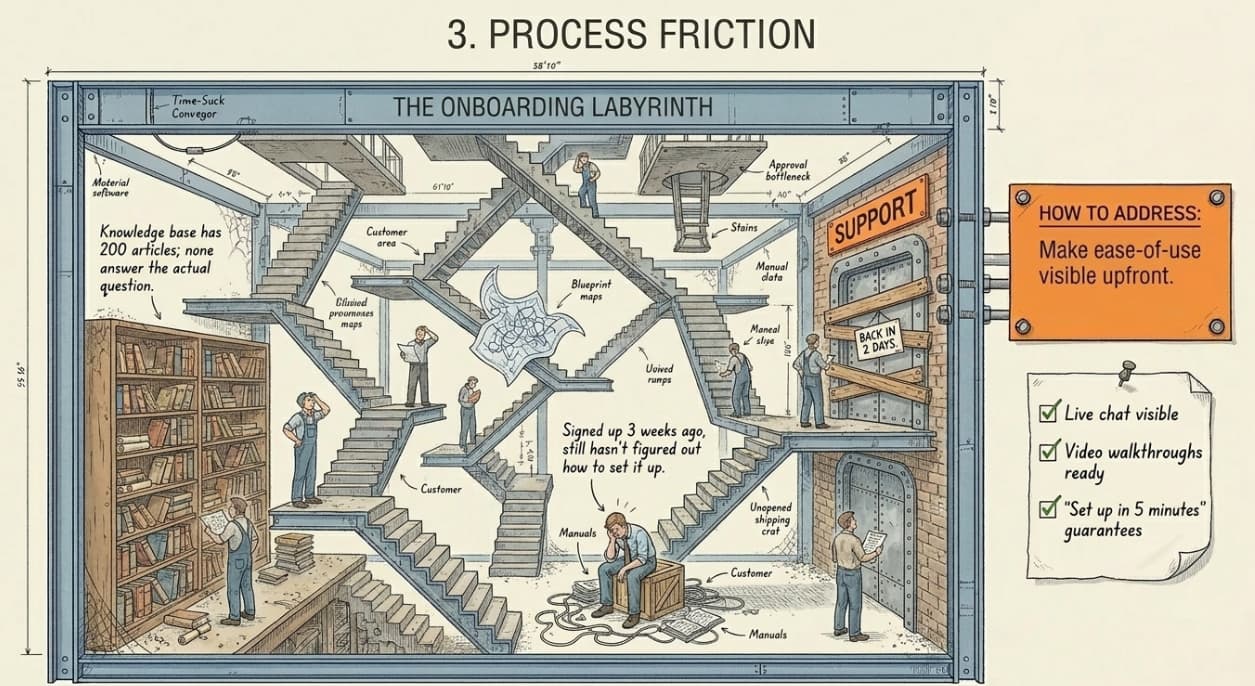
Your customer struggles with confusing workflows, slow support, or unclear onboarding.
Examples:
- “I signed up three weeks ago and still haven’t figured out how to set it up.”
- “Support takes two days to respond. By then, I’ve moved on.”
- “The knowledge base has 200 articles, but none answer my actual question.”
How to address it in copy: Make ease-of-use visible upfront. Live chat, video walkthroughs, and “set up in five minutes” claims (when true) reduce abandonment.
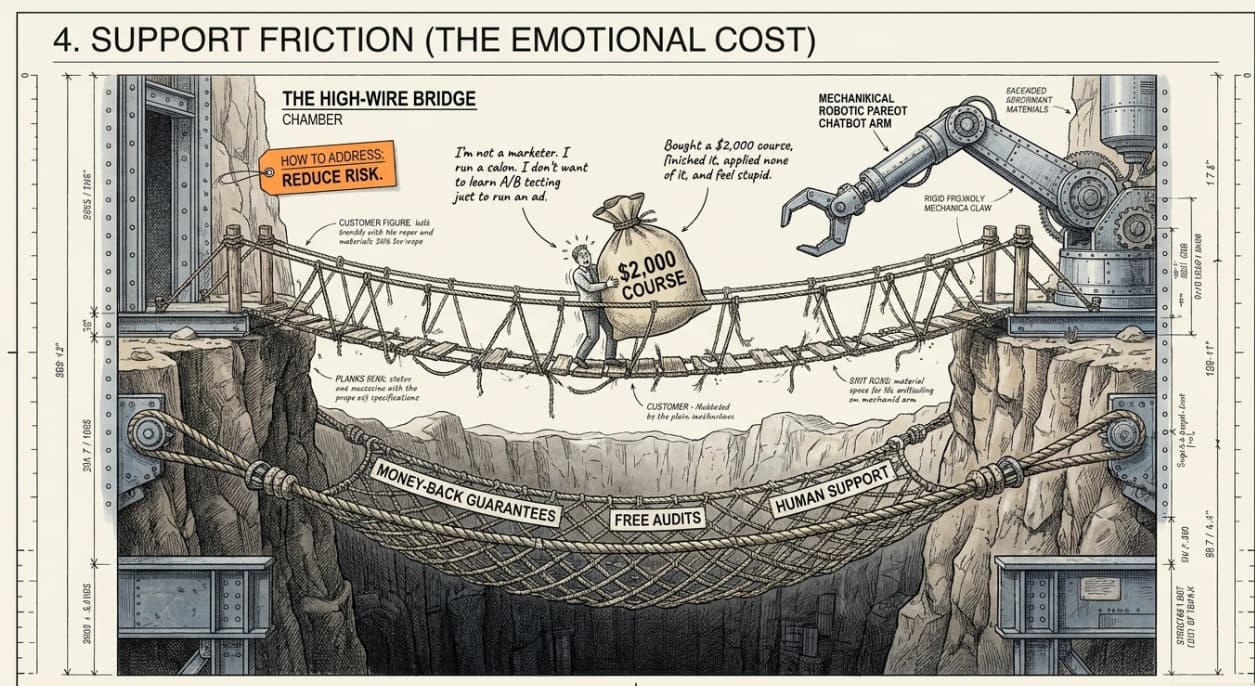
4. Support Pain Points
Your customer feels unsupported, unsure, or anxious about making the wrong choice.
Examples:
- “I’m not a marketer. I run a salon. I don’t want to learn what an A/B test is just to run an ad.”
- “I bought a $2,000 course, finished it, applied none of it, and feel stupid.”
- “I’m afraid to sign a yearly contract in case I realize next month it’s wrong.”
How to address it in copy: Reduce risk. Money-back guarantees, monthly billing, free audits, and human (not chatbot) support all signal that you understand the emotional cost of a bad decision.
How to Find Real Customer Pain Points: 5 Methods That Work
Pain points can’t be invented at off-sites. They have to be discovered where customers express them.
Method 1: Read Your Competitors’ Negative Reviews
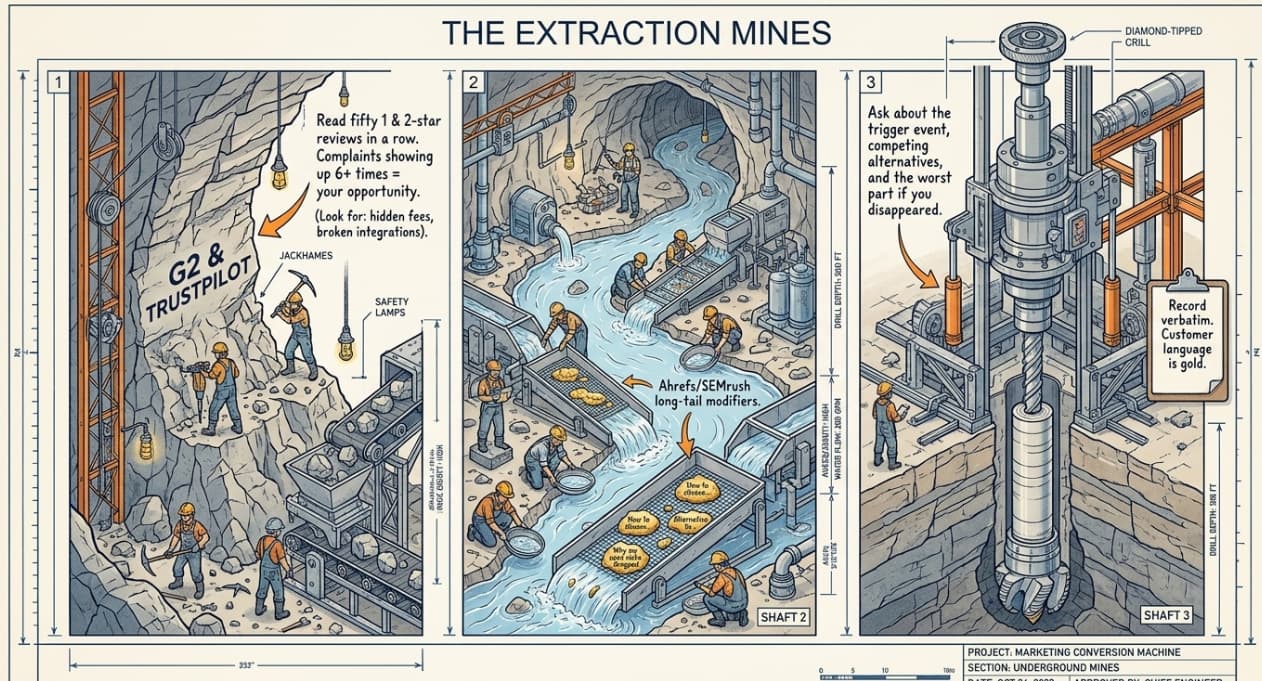
Open the one-star and two-star reviews of your top three competitors on G2, Trustpilot, Capterra, and the App Store. Read 50 in a row.
The complaints that show up six, seven, or eight times are the pain points your competitors aren’t solving, and that’s your opportunity.
What to look for:
- Complaints about specific features that don’t work as advertised
- Onboarding frustrations
- Hidden fees or pricing surprises
- Support response times
- Integrations that broke
Method 2: Analyze Long-Tail Search Queries
Use Ahrefs, SEMrush, or Google’s autocomplete. Type your category plus question modifiers: how, why, what’s the best way to, and alternative to.
Examples of high-intent queries:
- “How to choose a CRM for a small business.”
- “Why have my email open rates dropped?”
- “Alternative to [competitor name]”
- “Is [competitor name] worth it?”
Every query is a pain point someone took the time to articulate. For a fuller framework on identifying market signals through search and trend data, see Target Market: Trends and Analytics. Build content around the queries with the highest volume and lowest competition.
Method 3: Conduct Customer Interviews: The Right Way
Most customer interviews fail because the questions are about the product. Ask three different ones instead:
- What were you doing the day you decided to look for a solution? (Reveals the trigger event)
- Walk me through what you tried before you found us. (Reveals competing alternatives and switching costs)
- If we disappeared tomorrow, what would be the worst part? (Reveals the actual job-to-be-done)
Record verbatim. Customer language is gold. Marketing language written from notes is a copy of a copy.
Method 4: Mine Communities Where Your Audience Complains
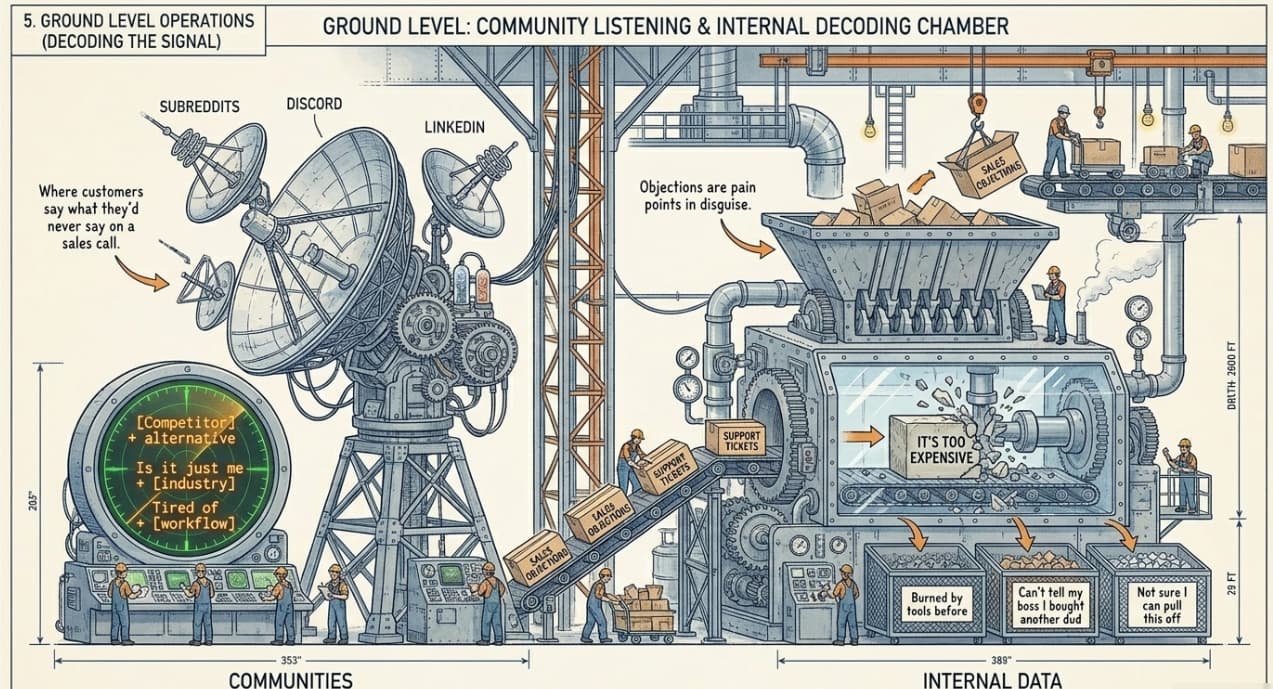
Subreddits, Discord servers, niche Slack groups, LinkedIn discussions, X threads, industry forums. Search for:
- Your competitors’ names plus “alternative” or “issue.”
- “Anyone tried [tool category]?”
- “Is it just me?” plus your industry
- “Tired of” plus the workflow your product replaces
This is where customers say what they’d never say on a sales call.
Method 5: Audit Sales Objections and Support Tickets
Your sales team hears objections daily. Your support team hears complaints daily. Both are pain points in disguise.
The objection “it’s too expensive” is rarely about price. It usually decodes to one of three deeper pains:
- “I’ve been burned before by tools that promised this.”
- “I can’t tell my boss I bought another thing that didn’t work.”
- “I’m not sure I’m the kind of person who can pull this off.”
Reframe each objection as a fear. Build content that addresses each fear directly.
How to Validate Pain Points Before You Build
Finding a pain point is step one. Validating that it’s worth solving is step two — and most teams skip it.
A pain point is worth solving when you can answer yes to all four questions:
Is it searchable? Use Ahrefs or Keyword Planner to check search volume. If nobody searches for it, the pain is either not strong enough or so latent that it’ll require huge education spending before customers recognize they have it.
Is it repeatable? Count how often it appears across reviews, interviews, and support tickets. One complaint is a person. Fifty is a market.
Is anyone already paying to solve it? Look for paid competitors in the space. Existing competitors prove demand. No competition usually means you’re either early or alone, and most of the time, you’re alone.
Will they pay you specifically? Describe the pain point to a potential customer in their own language and name a price. Having your Brand DNA documented makes this test dramatically faster, your ICP is already written down. If they ask when it’s ready, you have a signal. If they nod politely and change the subject, you don’t.
Solve pain points that fail these tests, and you’ll spend a year building something nobody wanted.
How to Use Pain Points in Marketing Copy
Once you’ve found and validated a pain point, the writing part follows a five-step structure that works for landing pages, emails, and ads. For tested copywriting formulas you can plug pain points into, see 9 Copywriting Tricks That Sell (Even When Your Product Is Complex) and 6 Copywriting Formulas for Email Marketing That Sell.
Step 1: Name the Pain in Your Customer’s Exact Words
❌ “You struggle with content marketing.”
✅ “You spend Sundays writing posts that get four likes.”
Step 2: Show the Cost of Staying Stuck
What does another six months of this pain look like? Quantify it in hours, dollars, missed opportunities, or eroded confidence.
Step 3: Offer the Solution as a State, Not a Feature
❌ “AI-powered content generation engine.”
✅ “Open the app on Monday; your week is already planned.”
Step 4: Prove It
One concrete proof beats five vague testimonials. Use a real customer name, a real number, and a real before/after.
Step 5: Make the Next Step Embarrassingly Small
❌ “Book a demo.”
✅ “See three pain points your competitors are missing: free, no signup.”
This structure mirrors how people actually decide: I have a problem → I see what it’s costing me → I see a way out → I trust the way out → I take the smallest possible step toward it. For the full system of running marketing alone with this kind of framework, see Solo Marketing in 2026: The 4-Loop System.
According to research cited in HubSpot’s Cold Email Trends report, subject lines containing pain point language increase open rates by 29%. The structure works because it speaks to the reader’s reality, not to your product’s features.
The Real Reason This Works
Pain-point marketing converts better than feature marketing for a reason that has nothing to do with copywriting tricks.
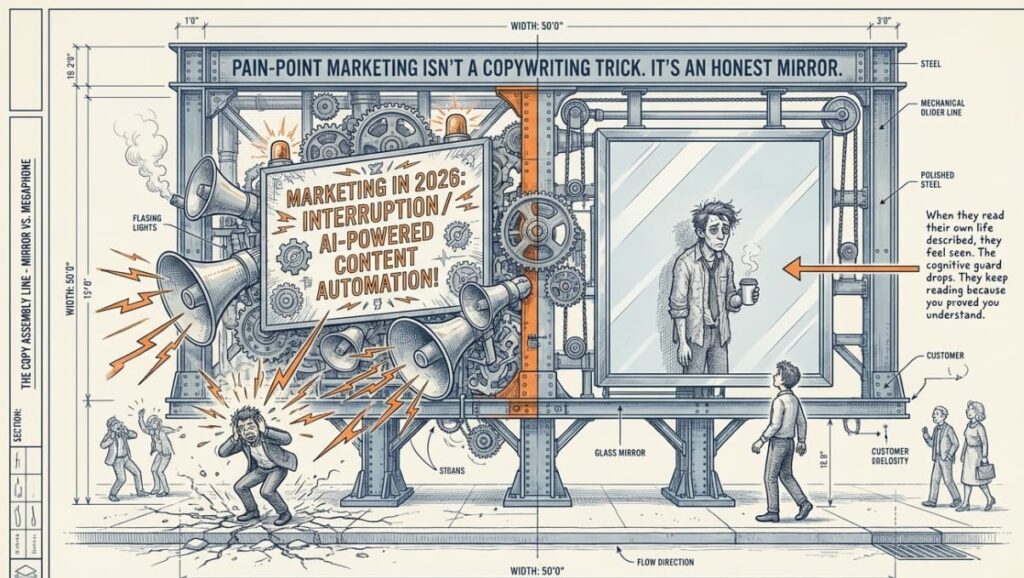
It works because most marketing in 2026 feels like an interruption. Pain-point marketing feels like recognition.
When a customer reads “AI-powered content automation,” their brain files it as another ad. When they read “you spend Sundays writing posts that get four likes,” something different happens. They feel seen. The cognitive guard drops. They keep reading not because the headline is clever, but because someone finally described their actual life.
That’s the whole game. Not better adjectives. Not stronger CTAs. Not louder claims. Just an honest mirror, held up at the right moment. The mechanics of how emotion drives conversion in marketing copy, fear, shame, status, and control are unpacked in Emotions in Email Marketing: How to Influence Decisions.
The methods in this article (competitor reviews, customer interviews, search queries, and forum mining) are different ways to find what that mirror should reflect. The five-step copy structure is how you frame it. The validation tests are how you make sure you’re reflecting something real and not something you imagined.
The work isn’t easy. But it’s surprisingly simple: stop talking about yourself, and start describing what your customer was already feeling before you showed up.
FAQ
What’s the difference between a customer pain point and a customer need?
A need is what a customer is trying to accomplish. A pain point is what’s stopping them. Need: “I want to grow my email list.” Pain point: “I keep losing 40% of new subscribers to spam folders.”
How many pain points should I target in a single campaign?
One per piece of copy. Headlines, ads, and landing pages convert best when they name a single, specific pain. Spread your pain coverage across multiple campaigns instead of cramming three pain points into one ad.
What if my customers don’t know they have the pain point yet?
These are called latent pain points. They exist, but customers haven’t articulated them. Latent pain requires education-led marketing content that helps customers recognize the problem before you sell the solution. This is exactly the topic of Stop Selling to People Who Don’t Know They Have a Problem your previous post. The deeper the pain layer (psychological, existential), the more likely it’s latent.
How often should I refresh my pain point research?
Quarterly at a minimum. Markets shift, competitors change, and pain points evolve. The pain that drove signups twelve months ago may no longer be top-of-mind today.
Can I use the same pain point messaging across all channels?
The pain point stays the same. The expression changes. A pain point works as a headline on a landing page, a subject line in an email, a hook in a TikTok script, and an ICP description in a sales deck. But each channel needs its own length and tone.
Nova Express Resources
- AI Tools for Marketers in 2026
- Nano Banana Pro: The Complete Guide for Marketers 2026
- NotebookLM for Marketers
- 7 Midjourney V7 Prompts for Marketing Ads, Products, and Social Media
- What Is Generative Engine Optimization?
- What Is an AI Marketing Agent?
- What Is AEO?
- What Competitor Analysis Reveals About You (Not Just Them)
- The 2026 Marketing Audit
- Why AI Engines Trust Reddit More Than Brand Content (And How to Change That)
Ready to engineer the system? Read the next article in this series:
- Why AI Cites Some Brands and Ignores Others: The Citation Stack Explained
- AEO vs SEO vs GEO: What’s the Difference and Where to Start in 2026
- Brand DNA: The Missing Piece Between Your Brand and AI
About the author
Serafima Osovitny is a Marketing Manager at Nova Express, where she focuses on digital marketing, search visibility, content strategy, and marketing workflows. She writes practical guides that help marketing teams research their audiences, develop strategies, and put their plans into action.
Explore her work at serafima.digital and follow her on X: @OSerafimaA.








Leave a Comment